


4 disciplines of execution better ways of working




Try Before you Buy Download Free Sample Product
 Impress Your
 Audience
 100%
100% Editable
 Save Hours
 of Time


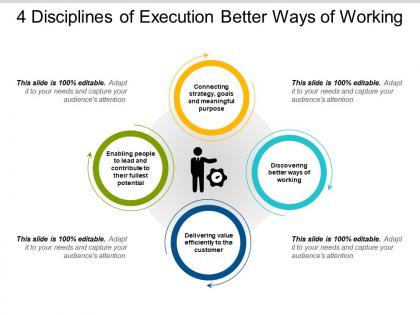
Introducing 4 Disciplines Of Execution Better Ways Of Working template. Identify and act upon activities that have more impact on results with the help of this orderliness PPT layout. Showcase your wildly important goal with the discipline of focus PowerPoint slide design. Determine your wildly important goal by showcasing the examples for the same. Discuss the rules to determine your WIG such as defining the lag measures, begin with a verb, etc. Align your business process, teams, and technology around a Wildly Important Goal by following four disciplines of focus, impact, engagement, and accountability. Discuss the things that tell if you have achieved a specific goal such as revenue, profit, quality, and customer satisfaction by utilizing the lag measure PPT visual. This 4DX execution framework PPT slideshow will help leaders and teams execute the business strategy. Explain how the four disciplines of execution are implemented by downloading our ready to use 4DX methodology PPT Presentation.
People who downloaded this PowerPoint presentation also viewed the following :
4 disciplines of execution better ways of working with all 5 slides:
Create an inviting environment with our 4 Disciplines Of Execution Better Ways Of Working. Give folks an incentive to attend.

FAQs for 4 disciplines of execution better
Honestly, most projects fail because people skip the boring stuff upfront. Document your scope super clearly first - like, painfully detailed. Make sure everyone actually gets what they're building and when it's due. I've seen teams waste weeks because someone misunderstood the deadline. Weekly check-ins are clutch for catching problems early. Don't just hope everything's fine. Also, fight for realistic timelines with buffer time built in. Something always goes sideways. Oh, and sort out who gets what budget/tools before you start - nothing derails momentum like people scrambling for resources mid-project.
Honestly, good communication is what keeps teams from falling apart during execution. When everyone knows their role, deadlines, and why the work matters, things actually get done. I've watched entire projects derail because people thought they were aligned but weren't even close. Quick check-ins help catch this stuff early. Define who's doing what upfront - sounds obvious but you'd be surprised how often this gets skipped. Also, make sure your kickoff meetings cover specific deliverables and success metrics that people can actually wrap their heads around. Otherwise you're just setting everyone up for confusion later.
Dude, leadership during execution is EVERYTHING. Think of it like being a conductor - you're keeping everyone in sync. Your teams need you to stay crystal clear on what matters most and jump in when they hit roadblocks. Those tough trade-off calls? That's on you too. I've literally watched amazing plans crash because the leader disappeared once implementation started. Super frustrating to see. Keep communicating how things are going and don't forget to celebrate the wins - people need that momentum. Stay visible, check in weekly minimum, and never assume stuff will just work itself out.
Honestly, you've gotta track both the stuff that predicts problems and the stuff that shows results after the fact. Cycle times are huge - also look at whether you're actually hitting milestones and delivering on time. Quality metrics too, because shipping fast but creating a mess isn't worth it. I'm big on measuring team velocity and how burned out people are getting, since exhausted teams can't execute for shit. Pick maybe 3-4 metrics that actually matter to your situation, not just numbers that look good. Throw them on a basic dashboard and check in weekly with everyone.
Oh man, the classic killers are scope creep, terrible communication, and not watching progress closely. Projects go sideways when people keep tossing in "quick wins" (spoiler: they're never quick), or everyone works alone without checking in. Been there - it sucks! Set boundaries from day one. Weekly meetings help, even when they feel annoying. Use whatever tracking system people will actually update - doesn't matter if it's fancy. Flag problems early instead of crossing your fingers they'll magically fix themselves. Trust me, scrambling at deadline time is way worse than dealing with issues now.
Think of strategic alignment like a compass for your whole team. Everyone needs to see how their daily tasks actually connect to the bigger picture. Otherwise you end up with people grinding away on random stuff that doesn't move the needle - honestly happens way too often. When people get the "why" behind their work, they'll make smarter choices about what to focus on. No more competing priorities or that weird busy-but-unproductive feeling. I know it sounds obvious, but most teams skip this step and wonder why projects fall apart later.
Honestly? Just pick Asana or Trello for tracking stuff - Monday.com works too but it's pricier. Slack beats email chains any day, trust me on that one. Google Docs or Notion for collaborating on actual documents. Here's the thing though - I've watched teams completely bomb with fancy expensive tools while others crush it using basic spreadsheets. The secret isn't the software, it's whether people actually stick with whatever you choose. Don't go overboard with options. Pick maybe 2-3 tools and train everyone properly instead of just saying "figure it out."
Honestly, feedback loops are a game changer - they stop you from flying blind. Instead of waiting months to realize something's broken, you're getting constant reality checks from customers, your team, whatever metrics matter. Short bursts of info help you pivot fast. Think of it like... I don't know, checking your mirrors while driving instead of just hoping for the best? The trick is actually doing something with what you hear, not just hoarding data. Pick one thing that's driving you crazy right now and set up a simple way to track it. You'd be shocked how much faster you can fix stuff when you're not just winging it.
Honestly, culture is everything when it comes to execution. Your team either has that accountability thing down or they don't - and you can tell pretty quickly. When people actually own their stuff and have real conversations about problems, things get done. But when everyone's tiptoeing around issues or passing the buck? Even brilliant strategies crash and burn. I swear it's like clockwork - just watch how your team runs meetings and makes decisions. That's your culture right there. If people follow through on what they say they'll do, you're golden. If not... well, you've got some work to do.
I always pick my 2-3 must-dos first thing in the morning - honestly anything more than that is just wishful thinking. Hit the high-impact stuff that actually moves things forward, then deal with urgent items so you're not blocking other people. Dependencies are huge though. If someone's sitting around waiting for your work, that automatically jumps to the top. Don't guess what matters most - just ask your stakeholders about trade-offs when you're not sure. Keep whatever system works for you, whether it's a basic numbered list or those color-coded things. I'm terrible at fancy apps but a simple list I actually check? That works.
Honestly, don't treat risk management like some separate thing you do on the side. During planning, pick your 3-4 biggest risks and bake checkpoints right into your timeline to see how they're changing. Weekly risk reviews sound super boring (and they kinda are) but they actually catch stuff before it blows up. Build contingency plans for the worst-case scenarios. Make sure your team knows what to do if things go sideways. The trick is making it a habit instead of scrambling when you're already in trouble.
Look, milestone completion and budget variance are your bread and butter - they work everywhere. Timeline stuff too, obviously. Then add quality metrics for whatever you're actually delivering plus how happy your stakeholders are. Revenue impact is gold if you can track it directly. Here's the thing though - I've watched teams go crazy measuring everything that looks impressive but tells them nothing useful. Stick to maybe 3-5 metrics max that actually connect to your big picture goals. Start by figuring out what success looks like for your specific project, then find the numbers that'll predict and show you're hitting that.
So here's what's worked for me - start with quick weekly check-ins where everyone shares what they're stuck on and what's next. Document your goals somewhere accessible (I swear, most alignment problems happen because people have different ideas of what "finished" looks like). Dashboards help too, but honestly? Just overcommunicate everything. Don't assume people get it. Short sentences work better than long ones for updates. Maybe do a team pulse check this week to see where the disconnect is - you'll probably find gaps you didn't know existed.
Honestly, if your team isn't engaged, your strategy is basically dead in the water. I've watched amazing plans completely tank because people just weren't into it. When employees actually care, they'll jump on problems before they blow up and find ways around roadblocks instead of just doing the bare minimum. Plus they work way better with other departments - which you absolutely need since nothing happens in a vacuum. The key is getting people pumped about *why* you're doing something, not just rattling off tasks. Spend real time on that part.
Honestly, visual templates are a game changer for execution plans. They break down all that complex stuff into chunks people can actually wrap their heads around. Flowcharts, timelines, dashboards - whatever works. You'll instantly see who's doing what and when things are due, instead of digging through endless paragraphs. I swear, stakeholders love this because they get the big picture without getting lost in the weeds. Just pick something simple that fits your project type. Even a basic timeline will save you from creating another one of those dreaded walls of text nobody reads anyway.
-
Unique design & color.
-
Easy to edit slides with easy to understand instructions.