

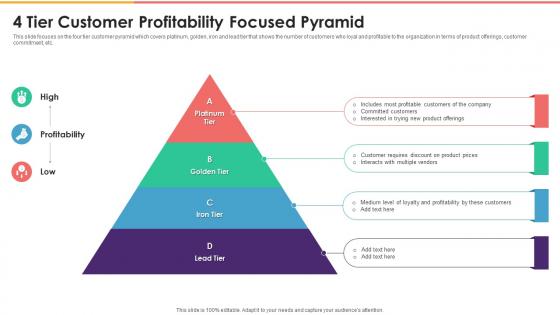
4 Tier Customer Profitability Focused Pyramid




Try Before you Buy Download Free Sample Product
 Impress Your
 Audience
 100%
100% Editable
 Save Hours
 of Time


This slide focuses on the four tier customer pyramid which covers platinum, golden, iron and lead tier that shows the number of customers who loyal and profitable to the organization in terms of product offerings, customer commitment, etc.
People who downloaded this PowerPoint presentation also viewed the following :
4 Tier Customer Profitability Focused Pyramid with all 6 slides:
Use our 4 Tier Customer Profitability Focused Pyramid to effectively help you save your valuable time. They are readymade to fit into any presentation structure.





FAQs for 4 Tier Customer
Honestly, start with Customer Lifetime Value - it's everything. Track how much it costs to get customers, then see how many stick around and what they spend. Some clients are total money pits to serve (we all have those nightmare ones), so gross margin per customer matters way more than people think. Watch how often they buy and how many support tickets they create too. Here's what really works though - slice your customers into profitability groups. Just run CLV for your top 20% first. I bet you'll find some weird patterns that surprise you.
So customer segmentation is basically grouping your customers to see who's actually profitable vs who's costing you money. Most people just look at averages which is pretty useless tbh. Break them into segments - high spenders, deal seekers, regulars, whatever makes sense. You might find out your biggest volume customers are actually losing you money because they need tons of support, while some quiet group you barely notice is where all your profit comes from. It's wild when you first see it broken down like that. Start with buying patterns and how much they cost to service.
So CLV shows you how much profit you'll actually make from a customer over their whole relationship with your company. Way better than just looking at single purchases - that stuff can be super misleading. Honestly, once you start using it, you'll wonder how you made decisions before. You can figure out which customers are worth the investment and which ones are just bleeding money. It helps with everything from marketing budgets to knowing who deserves your attention. Pretty much changes how you think about customer profitability entirely.
Okay so first thing - dig into your customer data on the down-low. Look at lifetime value, what each account actually costs you to service, profit margins, all that stuff. Don't make it super obvious you're basically grading them though! Try nudging the unprofitable ones with things like minimum orders or pushing them toward self-service instead of just cutting them off. Sometimes customers hit rough patches but bounce back later. I'd start small - test some policy tweaks on your worst performers and see what happens. The trick is making changes feel like normal business upgrades, not like you're punishing anyone.
Honestly, bundling is your best bet - makes customers spend more while feeling like they're getting a deal. Volume discounts work too if you can swing it. Look, sometimes you gotta get creative with the backend stuff. Automate whatever you can to slash your costs, or push for better payment terms so cash flow isn't killing you. I'd probably focus on cutting costs first since that's easier than convincing people to spend more, but depends on your customers I guess. Either way, pick one approach and stick with it.
So CAC basically eats into your profits since you're paying upfront to get customers. You've gotta subtract those acquisition costs from whatever each customer brings in over time. The annoying part? You spend money now but don't see returns for months. I always aim for at least 3:1 LTV to CAC ratio - anything lower gets sketchy fast. Also track your payback period so you know exactly when customers stop being a money pit and actually turn profitable. Makes budgeting way less stressful when you can predict cash flow.
Honestly, you've got tons of good options here. HubSpot and Salesforce both have profitability tracking built right in - they'll pull your revenue and cost data automatically. Power BI, Tableau, or Looker are great if you want something more advanced with custom dashboards. Don't sleep on Excel though, it's still surprisingly solid for this stuff if you're not ready to drop serious cash on new software. The main thing is picking something that plays well with whatever accounting and sales systems you're already using. I'd figure out which data sources you need first, then just go with whatever connects easiest.
Oh yeah, customer profitability is all over the place - never stays the same. You'll lose money upfront with acquisition costs and getting them set up. But then it gets better as they stick around and buy more stuff. What really drives it? How often they purchase, how much they spend, and honestly some customers are just way more needy than others (you know the type). Loyal customers usually stop caring as much about price and go for the premium stuff. I'd check these numbers every quarter so you can catch patterns before they bite you. Early adjustments to your retention game make a huge difference.
Don't fall into the trap of splitting overhead costs evenly - that'll mess up your whole analysis. Companies do this all the time and wonder why their numbers look weird. Focus on your biggest spenders and lowest revenue customers first instead of trying to tackle everyone. Some clients are just way more demanding than others, honestly. You'll miss tons of hidden costs too - support tickets, returns, payment headaches. Short-term metrics will fool you when you should be thinking lifetime value. Oh, and indirect costs? They add up fast. Build your method around those extreme cases first, then expand from there.
Look, returns and warranty claims are profit killers that most people don't think about upfront. You've got shipping costs, restocking fees, plus some stuff just can't be resold. Warranty work hits you with repair or replacement expenses too. What's crazy is how fast a "good" customer becomes unprofitable once you factor this stuff in. I'd definitely track these costs by customer type - you'll probably spot some patterns that'll help you tweak pricing. Otherwise you're basically flying blind on who's actually making you money.
Look, most loyalty programs are backwards - they just reward any purchase instead of the ones that actually make money. You want to give better rewards for high-margin stuff, bulk orders, or when business is slow. Create tiers that make customers want to spend everything with you instead of shopping around. I'd start by figuring out which customers are actually profitable, then design rewards around keeping those behaviors going. Honestly? Just audit what you're rewarding now vs. what brings in real profit. The whole point is making your best deals feel like their best deals too.
Oh man, seasonality totally screws with customer profitability if you're not watching for it. Peak season customers look amazing on paper but might barely make you money the other 9 months. Track them over full years, not just quarters - learned that one the hard way. The annoying thing? Seasonal customers usually want white-glove treatment during their busy periods, which kills your margins. I'd split customers by their seasonal patterns first, then calculate yearly profits. Way better for figuring out who's actually worth keeping around.
Good customer service literally makes you more money - it's that simple. Happy customers stay longer and spend way more over time. They'll also recommend you to friends, which is honestly the best marketing you can get. Bad service? Total opposite effect. People leave faster, you're drowning in complaints, and those nasty online reviews will kill your reputation. I've seen businesses tank from this stuff. The numbers don't lie though - most companies see 3-5x returns when they actually invest in better service. Just track what you're doing now and fix the worst problems first.
Numbers are everything here - show them actual revenue per customer segment and what you're spending to get them. Dashboards beat spreadsheets every time, seriously. Lifetime value tells the real story way better than looking at one-off purchases. Pull examples they'll actually recognize, like how your premium clients bring in 3x more profit than the budget ones. Then connect it to stuff they lose sleep over - marketing budgets, where to invest in service levels. Once they see how profitability data directly hits their own budgets and planning, they'll get it. It's honestly that straightforward.
Look at purchase frequency and service costs per customer, not just who spends the most. Some big spenders are actually money pits - constantly returning stuff or needing tons of support (trust me on this one). Product mix matters too. You'll be surprised how different your "valuable" customers look when you factor in actual profitability. Oh, and watch for patterns that predict long-term buyers vs. one-time purchases. Try segmenting your top 20% by different metrics first. The rankings will probably shift way more than you'd expect.
-
I have just started downloading templates for my presentations and I must say this is a great design. It helped accelerate my presentation design process and made it more visually appealing.
-
The templates are easy to get, and the chat customer support is excellent.