

5 pieces circle puzzle variation powerpoint presentation





Try Before you Buy Download Free Sample Product
 Impress Your
 Audience
 100%
100% Editable
 Save Hours
 of Time


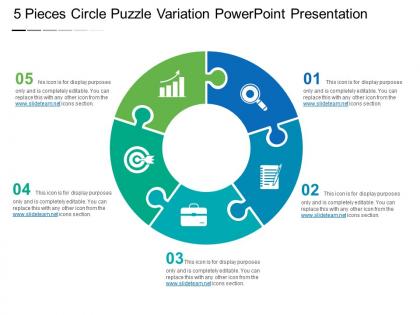
We assure you 100% benefit in your business organization if you download and use our 5 pieces circles puzzle variation PowerPoint presentation. This circular cycle diagram model has been designed using high resolution and premium quality slides which will definitely help you raise the standard of your work. Our business experts have with utmost care and protection designed this 5 pieces circle PowerPoint presentation which is ready to use. So the use of this jigsaw puzzle piece business slides will help you save a lot of your precious time and energy. Also, if you wish that all the stress and workload you go through while making the presentation reduces you should download this 5 segment circular puzzle as the slides are ready to use. We assure you because this round shape business template has been designed in such a manner that you will be able to leave your audience awe struck. So if you are ready to make most of these above mentioned features and take your business organization to new heights of success simply download, edit and present it. Ensure consequences are good for all with our 5 Pieces Circle Puzzle Variation Powerpoint Presentation. It helps influence the event.
People who downloaded this PowerPoint presentation also viewed the following :
5 pieces circle puzzle variation powerpoint presentation with all 5 slides:
Come up with ideas impossible to beat with our 5 Pieces Circle Puzzle Variation Powerpoint Presentation. It helps create an indomitable impression.

FAQs for 5 pieces circle puzzle
So basically you want to limit movement without making it unsolvable. Work backwards from your end state first - trust me on this one. I used to overcomplicate everything but simple rules actually create the best complexity. Pick one main thing like rotation limits or directional blocks. Honestly, test it way more than you think you need to because you'll miss obvious solutions after staring at it forever. Oh and map out at least three different ways to solve it before you're done. That'll save you headaches later.
So basically you've got three things to mess with: how many pieces, how detailed the picture is, and piece shapes. Little kids (3-6) need like 12-24 big pieces with simple stuff - cartoon animals work great. Ages 7-12 can do 50-100 pieces, maybe landscapes or whatever. The piece shapes actually make a huge difference in difficulty, which people don't realize. For teens and adults, go crazy - 200+ pieces with those annoying subtle colors where everything looks the same. I'd definitely test it out first though, because you never know what'll be too easy or impossibly hard.
Oh, circle puzzles are actually pretty great for your brain! They really help with spatial reasoning - like when you're rotating those segments and figuring out how pieces fit together. Pattern recognition gets a workout too. Plus you end up thinking several moves ahead, which is solid problem-solving practice. Your hand-eye coordination improves from all the piece manipulation. Honestly, I think they're more engaging than regular jigsaw puzzles. Try doing one for maybe 10-15 minutes daily if you want to boost focus and patience. It's a surprisingly good mental workout!
Warm colors work really well for beginner stuff - oranges and yellows make things feel welcoming. Blues and purples are better for harder levels since they help people focus. Red's great for anything timed because it creates that urgency feeling. And green? Players go crazy for a good green success animation, I swear it's like magic. Oh, and don't forget about contrast ratios for accessibility - that stuff matters. You should definitely A/B test a few different schemes on some levels. See what actually keeps people playing longer instead of just guessing.
Honestly, symmetry is like a cheat code for circle puzzles. Our brains are weirdly wired to love balanced stuff - radial patterns from the center, rotational elements that repeat as you spin around. But here's the thing: perfect symmetry can get boring fast. Start with your symmetric foundation, then throw in one asymmetric element to mess with people's expectations. That's where the magic happens. Don't just randomly scatter puzzle pieces though - be deliberate about where you're breaking the pattern. It's the difference between "oh that's pretty" and "wait, I need to solve this now."
Honestly, touchscreen apps are perfect for circle puzzles - way better than the old paper versions. You can do drag-and-drop where people rotate rings or swap segments with finger gestures. HTML5 canvas works great, or Unity if you want something fancier. JavaScript alone can handle decent circle animations though. Timers and scoring make it addictive, plus you could add multiplayer stuff later. Progressive difficulty that ramps up based on how well they're doing is clutch. I'd start with just a basic rotating ring puzzle first - don't overcomplicate it right away.
Start with easy circle puzzles first, then work up to harder ones. Gets their confidence going. Have them talk through what they're thinking out loud - super helpful for spotting where they get stuck. Sketching helps too, doesn't matter if it's messy. I love when kids work together on these because they explain things differently than we do. Don't jump in with answers right away though. Ask stuff like "what do you see happening here?" Let them wrestle with it a bit. That's honestly where the real learning happens.
Oh, these are actually perfect for math class! Start simple with basic circle patterns for the little kids - builds that pattern recognition. Middle schoolers can handle the trickier rotation stuff. High school? Go nuts with circle packing problems that tie into calculus. Honestly, kids way prefer these over boring worksheets - can't blame them. The visual aspect just makes everything click better, you know? I'd throw one in weekly as a warm-up, maybe use them for group work too. Really gets them thinking instead of just memorizing formulas.
Honestly, theming is where you can get really creative with this stuff. Space exploration works great, or cooking themes - I've seen some wild ones with recipe ingredients arranged in circles. Gaming themes are absolutely crushing it right now, especially anything retro arcade. Nature's always solid too. Seasons, ecosystems, that kind of thing. Oh, and don't sleep on movie/TV franchises - those hook people who'd normally run from puzzles. The trick is keeping your core mechanics but swapping out the visuals and terminology. Pick something you're actually into though, because fake enthusiasm is pretty obvious. Trust me on that one.
Oh totally, culture plays a huge role in this stuff. Like in some places, circles have serious spiritual vibes, so people expect more meditative puzzles instead of straight competition. Western folks usually want pure logic challenges, but East Asian markets? They're all about that beautiful design mixed with brain teasers. Even colors mess with reception - red screams "lucky!" in China but "danger!" over here. Honestly, what one group finds super zen, another might just find annoying. If you're making one, definitely check out your audience's visual style and how they typically solve things first. Makes a massive difference in how it'll land.
Don't overcomplicate things right away - that's the biggest trap. Players need to understand the basic idea before you start messing with it. Also, that "circle logic" thing? Don't break it. It's what makes these puzzles click in people's heads. Here's what I learned the hard way: you HAVE to test with people who've never seen your puzzle. What makes perfect sense to you will completely confuse them. Seriously, it's wild how different their perspective is. Oh, and make sure everything's visually clear. If they can't tell different elements apart easily, you're just creating frustration. Keep it simple at first, test constantly, then adjust based on what actual players tell you.
Get people to actually play your puzzles and tell you what sucks. Seriously, playtesting is everything - set up sessions, post in forums, send out surveys after people solve them. When someone gets stuck or starts swearing at your puzzle, that's your cue something's broken. Don't take it personally when they complain (I used to get so defensive about my designs). Look for the same issues popping up - difficulty jumps, confusing clues, boring parts. Then tweak your constraints and visual hints based on what you're hearing. A simple feedback form works great - just ask about fun factor, difficulty curve, and whether instructions made sense. Way better than guessing what went wrong.
Oh yeah, those circle puzzles are everywhere now! I keep seeing those ring-rotation games on TikTok and they're weirdly addictive. The circular format is refreshing after staring at square grids forever. What's great is you can knock one out during your lunch break - they're quick but still make your brain work. Circle sudoku apps are probably the best place to start if you want to try them. Honestly, I think part of their appeal is just how clean they look compared to messy jigsaw pieces scattered everywhere. Perfect commute entertainment.
So each puzzle piece can drop little story bits as they solve - character backstories, plot twists, that kind of thing. Maybe theme the whole puzzle around one narrative? Like they're building a treasure map or piecing together some historical timeline. Circles work great for cyclical stories too, which is kinda cool. You could add little flavor text to different sections, or honestly, let their solving path change how the story unfolds - that'd be pretty unique. I'd probably start with just one simple story thread first though. Don't overcomplicate it right away, you know?
Honestly, working with other puzzle designers is where the magic happens. You get this cool mix of different strengths - like maybe you're great with logic but terrible at visual stuff, and they're the opposite. Bouncing ideas back and forth leads to those "holy shit" moments you'd never reach solo. I've seen partnerships create these wild hybrid puzzles that blend math sequences with geometric patterns in ways that shouldn't work but totally do. Oh, and multiple solution paths become way easier when you have different brains tackling the same problem. Find someone whose skills fill your gaps and just start messing around together.
-
Great product with highly impressive and engaging designs.
-
Thanks for all your great templates they have saved me lots of time and accelerate my presentations. Great product, keep them up!