


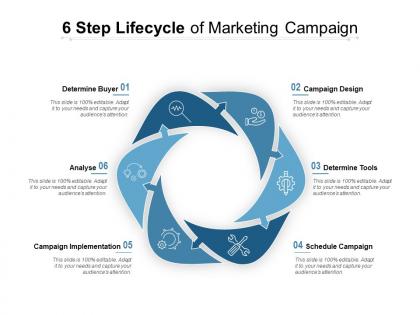
6 step lifecycle of marketing campaign




Try Before you Buy Download Free Sample Product
 Impress Your
 Audience
 100%
100% Editable
 Save Hours
 of Time


Blow past your goals with our 6 Step Lifecycle Of Marketing Campaign. Achieve far beyond the dream you have.
People who downloaded this PowerPoint presentation also viewed the following :
6 step lifecycle of marketing campaign with all 5 slides:
Achieve far beyond the dream you have with our 6 Step Lifecycle Of Marketing Campaign. They enable you to blow past your goals.


FAQs for 6 step lifecycle
The key phases of a marketing campaign lifecycle include planning and strategy development, creative development and asset creation, campaign launch and execution, monitoring and optimization, and performance evaluation and analysis. These phases work together by establishing clear objectives, developing targeted messaging, implementing across multiple channels, and measuring results, with many organizations finding that systematic lifecycle management delivers improved ROI and more effective customer engagement.
Goals and objectives are defined by aligning specific, measurable outcomes with each campaign phase, including awareness metrics for launch, engagement rates for activation, conversion targets for optimization, and retention benchmarks for sustaining momentum. Financial services and retail companies typically establish KPIs like cost-per-acquisition during growth phases and customer lifetime value during maturity phases, ultimately delivering measurable ROI and strategic market positioning.
Marketing campaign lifecycle metrics include awareness indicators like reach and impressions, engagement metrics such as click-through rates and social interactions, conversion tracking through lead generation and sales data, and retention measures like customer lifetime value. These comprehensive measurements enable marketers to optimize performance at each stage, identify bottlenecks in the funnel, and demonstrate ROI, with many organizations finding that stage-specific tracking ultimately delivers more strategic resource allocation and campaign effectiveness.
Market research enhances campaign planning by identifying target audience preferences, analyzing competitor strategies, uncovering market gaps, and validating messaging approaches before launch. Through comprehensive data collection, organizations can optimize budget allocation, refine positioning strategies, and anticipate market responses, with many companies finding that research-driven campaigns deliver significantly higher engagement rates and ROI.
Audience segmentation enables marketers to deliver personalized messages, optimize resource allocation, improve conversion rates, and enhance customer experiences by targeting specific demographics, behaviors, and preferences. Through strategic segmentation, organizations streamline campaign execution, reduce costs, and maximize ROI, with many retail and financial services companies finding that targeted approaches deliver significantly higher engagement rates than broad-based marketing efforts.
Content strategy aligns with campaign lifecycle through strategic planning during pre-launch, dynamic content creation and distribution during execution, and performance analysis during post-campaign phases. This integrated approach enables marketers to deliver consistent messaging across touchpoints, optimize content based on real-time engagement data, and measure ROI effectively, with many organizations finding that synchronized content strategies increase campaign effectiveness by streamlining resource allocation and enhancing audience engagement throughout each lifecycle stage.
Effective distribution channels include email marketing, social media platforms, content management systems, paid advertising networks, and direct sales outreach. These channels streamline campaign delivery by targeting specific audiences, automating content distribution, and tracking engagement metrics, with many organizations finding that integrated multi-channel approaches ultimately deliver higher conversion rates and broader market reach.
Feedback loops enable real-time campaign optimization by continuously collecting performance data, analyzing audience responses, and automatically adjusting targeting, messaging, and budget allocation. Through advanced analytics platforms, marketers can monitor engagement rates, conversion metrics, and customer behavior patterns, while AI-driven systems instantly modify ad placements, content variations, and bidding strategies, ultimately delivering improved ROI and enhanced customer experiences.
Launch phase tactics include coordinated multi-channel rollouts, influencer partnerships, targeted media outreach, strategic timing optimization, and audience segmentation strategies. These approaches streamline market penetration by creating immediate awareness, building authentic credibility, and driving early adoption, with many organizations finding that synchronized campaigns across digital and traditional channels ultimately deliver higher engagement rates and stronger competitive positioning.
Marketers can leverage demographics and psychographics during campaign preparation by analyzing age, income, location, and lifestyle data to create detailed buyer personas, segment target audiences, and customize messaging strategies. Through demographic targeting, retail brands identify optimal channels and timing, while psychographic insights reveal emotional triggers and values, ultimately enabling personalized campaigns that resonate deeply and drive higher conversion rates.
Marketing campaign lifecycle legal and ethical considerations include data privacy compliance, truth in advertising standards, intellectual property protection, consent management, and accessibility requirements. These frameworks streamline regulatory adherence by establishing clear guidelines, implementing transparent practices, and ensuring inclusive messaging, with many organizations finding that proactive compliance ultimately delivers enhanced consumer trust and competitive advantage.
A/B testing is crucial during evaluation as it provides quantitative data to measure campaign effectiveness, identify optimal messaging, determine audience preferences, and validate strategic decisions. Through systematic comparison of variables like headlines, visuals, and call-to-actions, marketers can enhance conversion rates, reduce acquisition costs, and refine targeting strategies, ultimately delivering measurable ROI improvements and competitive advantage.
Common pitfalls include inadequate audience research, unclear messaging, poor timing, insufficient budget allocation, and lack of performance tracking throughout campaign phases. These challenges can be avoided by conducting thorough market analysis, establishing clear KPIs upfront, implementing robust testing protocols, and maintaining consistent monitoring, with many organizations finding that structured campaign management ultimately delivers higher ROI and more effective customer engagement.
Technology and automation streamline the marketing campaign lifecycle by enabling real-time data analysis, automated audience segmentation, and cross-platform campaign management from a single dashboard. Through AI-driven tools and integrated marketing platforms, organizations can accelerate campaign deployment, minimize manual tasks, and enhance targeting precision, ultimately delivering faster market responses and improved ROI across their marketing operations.
Effective stakeholder communication requires establishing clear reporting schedules, creating standardized dashboards with key metrics, conducting regular checkpoint meetings, and maintaining transparent documentation of decisions and changes. Through consistent weekly updates, real-time performance tracking, and proactive issue escalation protocols, marketing teams streamline collaboration, minimize misalignment, and ensure all stakeholders remain informed throughout campaign execution, ultimately delivering better outcomes.
No Reviews