


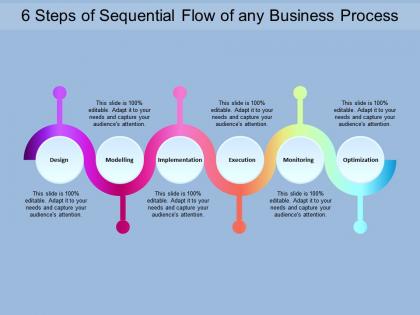
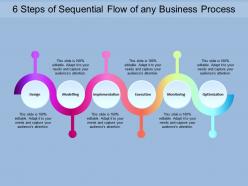
6 steps of sequential flow of any business process




Try Before you Buy Download Free Sample Product
 Impress Your
 Audience
 100%
100% Editable
 Save Hours
 of Time


Our 6 Steps Of Sequential Flow Of Any Business Process improve the ease of functioning. It facilitates implementation of decisions.
People who downloaded this PowerPoint presentation also viewed the following :
6 steps of sequential flow of any business process with all 5 slides:
Encourage free and fair discussions with our 6 Steps Of Sequential Flow Of Any Business Process. Be an advocate of good debate.



FAQs for 6 steps of sequential flow of
Key components of an effective business process flow include clear inputs and outputs, defined roles and responsibilities, standardized procedures, quality checkpoints, and performance metrics. These elements streamline operations by eliminating redundancies, reducing errors, and enhancing accountability across departments, with many organizations finding that well-structured processes ultimately deliver faster cycle times and improved customer satisfaction.
Visualizing business process flows improves team collaboration by creating shared understanding of workflows, clarifying role dependencies, and identifying communication gaps that often cause delays. Through process mapping tools, teams can streamline handoffs, reduce miscommunication, and coordinate tasks more effectively, with many organizations finding that visual workflows ultimately enhance productivity and accountability across departments.
Technology revolutionizes business process flows by automating repetitive tasks, providing real-time data analytics, and enabling seamless integration across departments and systems. Through AI-powered workflow management and cloud-based platforms, organizations streamline operations, reduce manual errors, and accelerate decision-making processes, ultimately delivering enhanced operational efficiency and competitive advantage in increasingly digital business environments.
Identifying bottlenecks involves analyzing process metrics like cycle times, wait periods, and resource utilization rates, while mapping workflow stages to pinpoint delays and capacity constraints. Manufacturing companies and financial services often use process mining tools and performance dashboards to reveal where work accumulates, ultimately enabling targeted improvements that streamline operations and reduce costs.
Essential metrics include cycle time, throughput, error rates, cost per transaction, resource utilization, and customer satisfaction scores. These measurements enable organizations to identify bottlenecks, streamline operations, and enhance overall performance, with many companies finding that tracking these indicators delivers faster processing times, reduced operational costs, and improved competitive advantage.
A well-defined business process flow enhances customer satisfaction by streamlining service delivery, reducing response times, and minimizing errors throughout customer interactions. Through standardized processes, organizations deliver consistent experiences, faster resolution times, and improved communication transparency, with many retail and financial services companies finding that structured workflows ultimately reduce customer complaints while increasing loyalty and repeat business.
Common pitfalls include overcomplicating workflows, failing to involve stakeholders in design phases, neglecting regular process reviews, creating bottlenecks through poor resource allocation, and ignoring automation opportunities. These design flaws often result in inefficient operations, frustrated employees, and customer service delays, with many organizations finding that thorough stakeholder consultation and iterative testing significantly enhance process effectiveness and adoption rates.
Businesses should review process flows quarterly for operational adjustments and conduct comprehensive updates annually or when major changes occur, such as technology implementations, regulatory shifts, or organizational restructuring. Companies in fast-evolving sectors like fintech and healthcare often adopt continuous monitoring approaches, enabling them to streamline operations, maintain compliance, and preserve competitive advantage through agile process optimization.
Business process flow diagram tools include Visio, Lucidchart, Draw.io, ProcessOn, and Bizagi, along with specialized platforms like Nintex and Kissflow. These solutions streamline workflow visualization by offering drag-and-drop interfaces, collaborative features, and integration capabilities, with many organizations finding that cloud-based options deliver enhanced accessibility and real-time collaboration across teams.
Businesses ensure compliance within their process flows by implementing automated monitoring systems, establishing clear audit trails, and integrating regulatory checkpoints at critical stages. Through compliance management software and standardized workflows, organizations streamline adherence to industry regulations while reducing human error, with many financial services and healthcare institutions finding that these systematic approaches ultimately deliver enhanced transparency and reduced regulatory risk.
Business process automation strategies include robotic process automation, workflow management systems, artificial intelligence integration, API-based system connections, and rule-based decision engines. These technologies streamline operations by eliminating manual tasks, reducing processing times, and minimizing errors, with many organizations in banking, healthcare, and manufacturing finding that automated workflows deliver faster customer service and significant cost reductions.
Cross-functional teams significantly enhance business process flow effectiveness by eliminating silos, accelerating decision-making, and ensuring comprehensive problem-solving across departments. These collaborative structures streamline workflows by reducing handoff delays, improving communication between finance, operations, and marketing teams, while delivering faster project completion and enhanced innovation, with many organizations finding that integrated teams reduce process cycle times by up to forty percent.
Business process flows and project management are interconnected, with process flows providing the structured framework that guides project execution, resource allocation, and milestone tracking. Through standardized workflows, project managers streamline task sequences, enhance team coordination, and minimize bottlenecks, with many organizations finding that integrated process flows ultimately deliver faster project completion and improved operational efficiency.
Feedback loops integrate into business process flows through automated data collection, real-time monitoring dashboards, and structured review cycles at key decision points. Manufacturing companies and financial services increasingly embed customer satisfaction metrics, performance indicators, and quality checkpoints directly into their workflows, enabling teams to identify bottlenecks, optimize resource allocation, and enhance operational efficiency while maintaining competitive advantage.
Effective training practices for new process flows include hands-on simulations, role-specific modules, visual workflow guides, mentorship programs, and gradual implementation phases. These approaches enhance adoption by providing practical experience, addressing individual learning styles, and building confidence, with many organizations finding that combining digital training platforms with peer support accelerates competency development while reducing implementation resistance.
No Reviews