


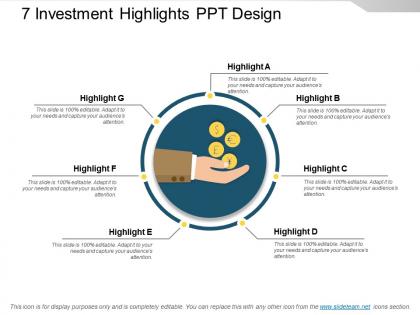
7 investment highlights ppt design




Try Before you Buy Download Free Sample Product
 Impress Your
 Audience
 100%
100% Editable
 Save Hours
 of Time


Evaluate the prospective investment opportunities for your business with our investment highlights PPT design. This key investment highlights PowerPoint diagram will allow your management to take effective financial decisions by evaluating the existing business position. It also allows you to predict the future growth of investments for your business. It also allows you to calculate your future profits and the appropriate rate of returns for your organization. This speculation highlights PowerPoint layout design also helps in defining the potential sources of investments for the business. Thus, you can analyze the entire sources graphically through this investment management PPT diagram layout. It further allows your management to allocate your business resources and assets in such a way that it helps in improving your company long term returns. Use this investment portfolio management PowerPoint diagram to further identify the growth opportunities for your company. Just simply start working over this professional Presentation template design now by clicking over the download link given below. Display information about the journey with our 7 Investment Highlights Ppt Design. Get folks acquainted with the itinerary.
People who downloaded this PowerPoint presentation also viewed the following :
7 investment highlights ppt design with all 5 slides:
Our 7 Investment Highlights Ppt Design are forever on guard. They keep bad habits at bay.

FAQs for 7 investment
So rates are still the main thing moving markets right now. Bonds look way better than they did, but growth stocks are getting crushed. AI stuff is absolutely everywhere - can't escape it honestly. ESG has cooled down but hasn't disappeared completely. There's this whole trend of investing in friendly countries instead of just going for cheap labor (geopolitics, ugh). Cash flow is king right now since borrowing money costs so much. Oh, and supply chain investments are hot if companies are moving away from China. Pretty wild how much has shifted in just a year or two.
Honestly, the economy controls pretty much everything about investing. Strong economy? Go for growth stocks and riskier stuff. But when things get messy with downturns or crazy inflation, you gotta pivot to safer bets - bonds, dividend stocks, that kind of thing. Interest rates mess with everything too, especially real estate and tech stocks. I'm always checking unemployment and GDP numbers since they tell you where we're headed. The whole trick is being flexible instead of stubbornly sticking to one strategy. My dad learned that the hard way in 2008.
Look, when markets get crazy, you've got to step back and think about how much risk you can actually handle. I usually check if I'm still cool with my timeline too. Choppy markets? That's when I consider adding some bonds or dividend plays to chill things out. Don't panic and start trading every dip though - that's how people lose money. It's more like... use the craziness as a reminder to see if your strategy still makes sense for where you're headed. Sometimes you need more defensive stuff, sometimes you don't. The weather comparison is pretty spot on actually.
Tech's been absolutely killing it lately - AI, cloud stuff, all that. Renewable energy too. Healthcare and biotech are huge right now, especially after those crazy pharma wins we saw. Oh, and anything cybersecurity or fintech related is just swimming in money. Digital transformation basically prints cash at this point. Real estate and old-school manufacturing? Eh, not great. I'd watch those growth sectors for sure, but don't go crazy putting everything in one basket. Actually been thinking about this myself lately.
Start by screening for low P/E ratios and price-to-book values, then dig into the actual financials. DCF analysis helps too if you're into that. Compare everything against historical averages and competitors in the same space. Honestly, it's brutal out there - everyone's chasing the same opportunities. I'd focus on solid companies that got temporarily beaten up, maybe because their sector fell out of favor or they had some bad headlines that don't really hurt their long-term story. Sometimes the best deals are hiding in boring industries nobody wants to talk about at parties. Just make sure the fundamentals actually back up what looks like a bargain on paper.
Honestly, just pick a few metrics that actually matter and stick with them. Revenue growth and profit margins are solid starters - shows if they're growing and not bleeding money. Cash flow is huge too, way more important than people think. Debt levels can totally wreck a company even if everything else looks good. I'd throw in ROE and P/E ratios for context. The real trick? Don't look at these things separately - they work together to tell the whole story. Find 4-5 you like and use them for every stock you're considering.
Honestly, geopolitical stuff can mess with your portfolio pretty hard. Wars and trade fights usually hurt the regions involved, but they boost safe assets like gold. Energy conflicts are weird - oil stocks tank in some places but surge in others. Everything's so connected now it's crazy. Best thing you can do? Spread your investments across different regions and sectors so one political disaster doesn't wreck you. Oh, and don't freak out and sell everything when you see scary headlines - I learned that the hard way in 2020. Stay informed but keep your cool.
Look, don't put everything into one thing - spread it around different types of investments. Mix stocks with bonds, maybe throw in some REITs. Your age matters here though. If you're buying stocks, grab some international ones plus different sectors like healthcare or utilities, not just whatever's trendy (looking at you, tech bros). Same goes for geography - don't stick to just US stuff. The annoying part is you'll need to rebalance every so often when things get out of whack, but it's worth it.
Honestly, tech trends just shuffle where all the money goes - creating whole new industries while killing off others. Right now everyone's pouring cash into AI, quantum computing, green energy, and biotech since those are gonna be the big winners. But timing's everything though. Jump in too early and you're bleeding money, wait too long and you've missed the boat entirely. Cloud computing's a perfect example - went from "eh, maybe useful" to absolutely critical in like three years. I'd watch adoption rates and what regulators are doing. That's usually when you know something's moved past the hype stage into actual profit territory.
Honestly, I'd start by figuring out what actually matters to you - like do you care about avoiding tobacco companies or places with sketchy labor practices? ESG investing is kind of everywhere now, which is cool because you don't have to choose between making money and not feeling gross about your portfolio. Environmental stuff, how companies treat employees, whether the leadership is transparent - all that factors in. I mean, weapons manufacturing might bother some people but not others, you know? Once you know your dealbreakers, just screen investments against those criteria.
Honestly, data analytics is a game changer for finding stuff you'd totally miss just staring at balance sheets. Screening tools let you filter by whatever metrics matter to you. Sentiment analysis is pretty cool too - tracks what people are actually saying on social media and news. I'd definitely backtest any strategy with historical data before throwing real money at it (learned that one the hard way). You can combine tons of different sources - technical stuff, fundamental ratios, economic indicators. Some people even use satellite data for commodities which is wild. Just don't go crazy at first - pick one tool and actually learn it inside out.
Look, due diligence is like your insurance policy against throwing money away. You're double-checking everything they tell you - financials, how good their management actually is, what the competition looks like. It's kinda like inspecting a used car before you buy it, but with way more zeros involved. Skip this step and you're basically rolling dice with your cash based on whatever story they're selling you. Good DD helps you catch problems early and get better deals too. Oh, and don't rush it - I've seen too many people get burned trying to speed through this stuff.
So here's the deal - rates and investments move opposite each other. Bonds get hit first when rates climb, stock valuations usually follow since companies can't borrow as cheaply. Growth stocks? They get absolutely crushed compared to dividend ones. It's honestly like watching a seesaw that never stops. Your stock picks matter more than people think though - some sectors just shrug it off. Fed meetings are your friend for timing this stuff. Maybe shuffle your portfolio around when you see big rate moves coming. Oh and borrowing costs spike for everyone, not just companies.
Dude, I'd definitely look at India and Vietnam right now. India's domestic market is huge and still growing like crazy. Vietnam's becoming the new manufacturing hotspot since everyone's trying to reduce their China exposure. Poland and Czech Republic are decent EU plays too. Actually, most of Southeast Asia is pretty hot - Indonesia and Thailand included, though I haven't dug as deep into those yet. Just don't put everything in one basket because emerging markets can swing wild. Start with smaller positions across a few different countries and build from there.
Honestly, diversification is your best friend here - spread your money across different stocks, bonds, maybe some international stuff too. Don't dump everything into one sector because that's how people get burned. Set up automatic investing so you're buying regularly instead of trying to time the market (spoiler: you can't). Keep some cash on the side for emergencies or you'll end up panic-selling at the worst possible times. Oh, and actually rebalance once in a while - I know it's boring but most people never do it. Just match your investments to how much risk you can actually stomach and you're already doing better than half the people out there.
-
Designs have enough space to add content.
-
Design layout is very impressive.