


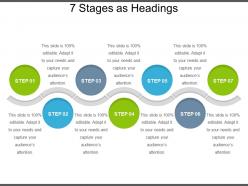
7 stages as headings presentation examples





Try Before you Buy Download Free Sample Product
 Impress Your
 Audience
 100%
100% Editable
 Save Hours
 of Time


Use our most demanded and downloaded 7 stages as headings presentation examples if you wish to change the negative opinion everyone has formed about you. Our business experts have designed this 7 stages business slideshow using high resolution and premium quality slides which will help you raise the standard of your work. We know that you have a busy schedule that is why we offer you this predesigned and ready to use 7 steps cycle PowerPoint presentation slideshow. Also, this seven steps process diagram has been designed in such a manner that you will be able to get rid of all the stress and workload that you usually go through while designing the slides all by yourself. Using this 7 circles PPT template you will be able to discuss a number of business-related processes like sales, marketing, financing, manufacturing, development, etc. If you are ready to get applauded without putting in a lot of efforts simply download and make the most of it. Identify exaggerated demands with our 7 Stages As Headings Presentation Examples. Ignore attempts at indulging in excesses.
People who downloaded this PowerPoint presentation also viewed the following :
7 stages as headings presentation examples with all 5 slides:
Our 7 Stages As Headings Presentation Examples are designed to serve. They will satisfy your every whim and fancy.



FAQs for 7 stages as
Here's how the 7 stages work: **Awareness** kicks things off when you realize something's gotta change. Then **Resistance** hits - and honestly, this part sucks but it's completely normal to fight it. **Exploration** comes next where you're basically experimenting with different approaches. Once you find what clicks, **Commitment** happens and you're all in. **Implementation** is the actual doing part (the hard work), then **Integration** where it starts feeling more natural. **Mastery** is the final stage - you've transformed and can actually guide others through it. Oh, and don't expect this to be a straight line. You'll probably ping-pong between resistance and exploration a bunch.
Honestly, knowing those 7 stages is a game changer because you can actually meet people where they're at. Don't just dive into solutions right away. Figure out if they're still unaware there's even a problem, or maybe they're already thinking about change but haven't pulled the trigger yet. Makes your whole presentation feel way more dialed in - nobody wants to sit through something that feels totally off base. You'll know exactly which pain points to hit and what pushback to expect. Structure it so you're nudging them to the next stage instead of dumping everything on them at once. Start by figuring out where most people are, then craft your opening around that.
Okay so feedback is like your GPS between transformation stages - shows you when to move forward or hang back a bit longer. You'll get it from mentors, peers, actual data, or just your gut feeling about what's working. Without it? You're basically flying blind and might skip important stuff or get stuck when you should keep going. Honestly, the GPS comparison is kinda perfect because it's those constant little course corrections that matter. Don't wait for feedback to come to you though. Set up regular check-ins with people and build in feedback moments at each transition point.
Honestly, visual aids make the 7 Stages way easier to understand. Instead of abstract ideas, people get something concrete they can actually see. Flowcharts work great for showing how you move between stages. Infographics are perfect for highlighting key milestones. Even basic sketches help illustrate the emotional shifts - which can be tricky to explain otherwise. Timeline visuals are my personal favorite because they show people exactly where they are in the process. Oh, and color-coding each stage is brilliant since our brains grab onto visual patterns so much better than text walls. Create a one-page visual map of all seven stages and you'll be amazed how quickly your team gets it.
Honestly, most companies just rush through everything without laying proper groundwork first. They skip that whole "creating urgency" step because leadership thinks everyone already gets why change is needed - which is like, never true. Communication is where things really fall apart though. People see all this disruption happening but have zero clue why it matters. Then you've got the resource problem - not enough people or budget allocated, so everything just stalls out halfway through. My take? Map everything out beforehand, figure out where people will push back, and give yourself way more time than you think you need for the culture stuff to actually stick.
Look, your mindset is what drives how you handle change. When you're stuck thinking everything's fixed, you'll fight against the uncomfortable stuff - like letting go or trying new things. Growth mindset though? You lean into that weirdness, even when it sucks at first. The way you think about change matters. Are obstacles just roadblocks, or chances to learn something? You can actually shift this by catching those negative thoughts and flipping challenges into growth opportunities. Honestly, just start noticing what you tell yourself when things get hard - that's half the battle right there.
Honestly, case studies are where you see the real mess of transformation - not just clean theory. Most people get stuck at stage 4 (resistance, every damn time), and you can actually see how long each phase takes in practice. The non-linear reality is wild compared to those neat frameworks. What really sells stakeholders though? Concrete examples, not abstract models. You'll notice patterns too - like how skipping prep stages always bites people later. Oh, and find ones with failure points included. Those messy parts teach you way more about what'll actually stick when you try it yourself.
Honestly, the biggest thing is not rushing people through each phase just because you're pumped about where you're heading. People need time to actually absorb what's happening. I'd set up clear check-ins so you can see if they're ready before moving to the next stage. Also - and this might sound obvious but leaders forget this all the time - celebrate when you finish each phase! Those small wins keep everyone motivated. Oh, and make sure people feel safe asking questions or voicing concerns. Nothing kills momentum like confused team members who are too scared to speak up.
Honestly, you've got to celebrate the tiny wins - like every single one. Set mini-goals so you're not waiting forever for the big stuff. Around stage 4 or 5, everyone crashes (I swear it's like clockwork), so just expect it. Get someone who'll actually call you out when you're being lazy about it. Keep some note on your phone about WHY you're doing this for the crappy days. Oh and review your plan regularly because nothing ever goes how you think it will. The small celebrations thing though? That's seriously what keeps most people going when everything else feels pointless.
Honestly, data is like having a GPS for your transformation - you're not just guessing your way through. First thing: figure out your baseline metrics so you know your starting point. Real-time dashboards become your best friend during implementation (I can't stress this enough - you need visibility into what's happening). Predictive stuff helps you spot problems coming down the pipeline. The trick is picking 3-5 metrics that actually matter for whatever stage you're in right now. Weekly check-ins work well. Oh, and don't get caught up measuring everything - focus on what moves the needle.
Honestly, I'd go with Kotter's 8-step process or ADKAR - they're solid for handling the people stuff while your 7 stages cover the transformation journey. Design thinking works great for early phases too. Systems thinking helps you map out all the stakeholder chaos (and there's always chaos). Agile keeps things moving without getting stuck in analysis paralysis. Don't go overboard though - pick maybe 1-2 max or you'll just create more work for yourself. Figure out what's your weakest spot right now, then grab whichever tool actually fixes that specific problem. Way better than trying to use everything at once.
Honestly, culture can make or break your whole transformation. People who don't trust leadership or hate change will torpedo even brilliant strategies. You need folks feeling safe enough to actually try new things. Leadership has to walk the walk too - can't just talk about change while doing the same old stuff. Here's the thing though: culture shifts take forever and you can't wait for it to happen first. Figure out what parts of your current culture help vs. hurt your goals. Then start chipping away at the problem areas early. It's messy but totally necessary.
Pick a real person or company and follow them through all 7 stages - that's what I'd do. People tune out with bullet points, but they'll actually listen to "Sarah's story" or whatever. Metaphors work great too - the whole butterfly thing or hero's journey stuff. Makes it way less abstract. If you've been through a transformation yourself, throw in some personal bits. I mean, anything beats theoretical frameworks, right? Short version: make each stage feel real instead of like textbook material. Trust me, your audience will thank you for it.
Honestly, cross-functional teams are brilliant for breaking down those departmental walls that usually torpedo change efforts. You get way better ideas when marketing, IT, and operations actually talk to each other instead of working in separate bubbles. People buy into changes more when their colleagues helped create them - makes total sense, right? The trick is giving these teams real decision-making power, not just asking them to brainstorm and submit suggestions that'll sit in someone's inbox forever. I'd start by figuring out where you're most stuck and build teams around those specific problems. Works way better than generic "innovation committees" or whatever.
Honestly, just pick 2-3 solid metrics per stage - otherwise you'll drown in spreadsheets. Early on, track participation rates and feedback scores from your transformation stuff. Middle stages are about skill building, so measure how fast people adopt new processes and actually get competent at them. Later stages get weird though. You're basically measuring if people's mindsets actually shifted long-term. Retention rates help, plus innovation metrics and whether performance improvements actually stick around. I learned this the hard way - don't try tracking everything from day one or you'll burn out.
-
The Designed Graphic are very professional and classic.
-
Use of different colors is good. It's simple and attractive.