


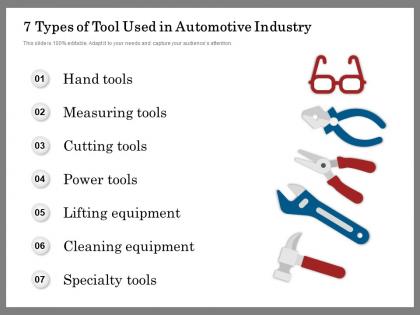
7 types of tool used in automotive industry




Try Before you Buy Download Free Sample Product
 Impress Your
 Audience
 100%
100% Editable
 Save Hours
 of Time


Help folks to conquer disability with our 7 Types Of Tool Used In Automotive Industry. It will enable the invalids.
People who downloaded this PowerPoint presentation also viewed the following :
7 types of tool used in automotive industry with all 2 slides:
Give invalids a helping hand with our 7 Types Of Tool Used In Automotive Industry. Increase their confidence in handling disability.

FAQs for 7 types of tool used
Essential automotive tools include socket sets, wrenches, screwdrivers, pliers, jack and jack stands, oil drain pan, and multimeter for electrical diagnostics. These tools enable DIY mechanics to perform routine maintenance like oil changes, brake repairs, and engine diagnostics, ultimately delivering significant cost savings and enhanced vehicle reliability for car enthusiasts.
Specialized automotive tools enhance efficiency by reducing repair time, improving diagnostic accuracy, and ensuring precise component installation through purpose-built designs. These tools, from torque wrenches to computerized diagnostic scanners, enable mechanics to complete complex tasks faster while minimizing errors, ultimately delivering cost savings and enhanced service quality for automotive service centers.
**INPUT**: Which automotive tools are most commonly used for diagnosing engine problems? **OUTPUT**: Common automotive diagnostic tools include OBD-II scanners, multimeters, compression testers, fuel pressure gauges, and oscilloscopes for comprehensive engine analysis. These instruments streamline troubleshooting by identifying error codes, measuring electrical systems, and testing mechanical components, with many repair shops finding that strategic tool combinations ultimately deliver faster diagnostics and enhanced customer satisfaction. [Word count: 56 words]
Automotive tool safety precautions include wearing protective equipment, ensuring proper tool maintenance, securing work areas, following manufacturer guidelines, and using appropriate tools for specific tasks. These practices streamline operations by preventing workplace injuries, reducing equipment damage, and maintaining productivity, with many automotive shops finding that consistent safety protocols ultimately deliver lower insurance costs, improved efficiency, and enhanced worker confidence.
Digital automotive tools like OBD-II scanners enhance vehicle diagnostics by providing real-time data access, pinpointing fault codes accurately, and enabling predictive maintenance capabilities. These technologies streamline repair processes by reducing diagnostic time, minimizing guesswork, and delivering comprehensive system analysis, with many automotive shops finding that faster, more precise diagnostics ultimately improve customer satisfaction and operational efficiency.
Manual automotive tools rely on physical force and provide precise control, durability, and cost-effectiveness, while electric tools offer speed, consistency, and reduced physical strain through powered operation. Manual tools excel in delicate work, tight spaces, and situations requiring tactile feedback, whereas electric tools streamline repetitive tasks, heavy-duty applications, and high-volume operations, with many automotive shops finding that combining both types delivers optimal efficiency and versatility.
Torque wrenches ensure precise fastener tightening by applying manufacturer-specified torque values, preventing over-tightening that damages components or under-tightening that compromises safety and performance. These tools enable automotive technicians and manufacturers to maintain consistent quality standards across critical systems like engines, brakes, and suspension components, ultimately delivering enhanced vehicle reliability, reduced warranty claims, and improved customer safety outcomes.
Common first-time automotive tool mistakes include using incorrect tool sizes, applying excessive force, neglecting safety equipment, skipping proper vehicle securing, and misunderstanding torque specifications. These oversights can damage components, create safety hazards, and lead to costly repairs, with many mechanics finding that starting with basic projects and following manufacturer guidelines prevents most beginner errors while building confidence.
Automotive tool brands significantly impact repair quality through precision engineering, durability standards, and specialized functionality that ensures accurate diagnostics, proper torque specifications, and reliable performance. Premium brands like Snap-on and Matco enable technicians to deliver consistent results, reduce comebacks, and maintain professional credibility, while quality tools ultimately enhance customer satisfaction and shop profitability through faster, more reliable repairs.
Innovations in automotive tools include advanced diagnostic scanners with AI capabilities, augmented reality repair guides, wireless diagnostic systems, 3D printing for custom parts, and IoT-enabled predictive maintenance tools. These technologies streamline repair processes by reducing diagnostic time, enhancing technician accuracy, and enabling remote troubleshooting, with many automotive service centers finding that these innovations ultimately deliver faster turnaround times and improved customer satisfaction.
Automotive tool storage solutions significantly enhance workspace efficiency by reducing tool retrieval time, minimizing workspace clutter, and improving workflow organization through systematic categorization and easy access designs. Well-designed storage systems enable mechanics and technicians to complete tasks faster, reduce downtime between jobs, and maintain safer work environments, with many automotive shops finding that organized tool storage ultimately delivers improved productivity and enhanced service quality.
Pneumatic tools offer automotive shops enhanced power-to-weight ratios, consistent torque delivery, reduced operator fatigue, lower maintenance costs, and improved durability compared to electric alternatives. These air-powered systems streamline tire changes, brake repairs, and engine work by delivering reliable performance and faster cycle times, ultimately reducing labor costs and increasing shop productivity while handling demanding automotive applications.
Proper tool maintenance extends automotive tool lifespan by preventing corrosion, maintaining calibration accuracy, and reducing mechanical wear through regular cleaning, lubrication, and proper storage. Regular maintenance schedules enable mechanics and automotive professionals to avoid costly replacements, ensure precise measurements, and maintain consistent repair quality, ultimately delivering improved operational efficiency and reduced downtime in workshops and service centers.
Automotive tools for hybrid and electric vehicles include high-voltage safety equipment, insulated hand tools, battery diagnostic systems, thermal imaging cameras, and specialized lifting equipment. These tools enable technicians to safely service complex electrical systems, diagnose battery performance issues, and perform routine maintenance, with many automotive shops finding that investing in EV-specific equipment delivers faster service times and enhanced safety protocols.
Automotive technicians can stay updated through manufacturer training programs, industry trade shows, online certification courses, technical publications, and professional associations like ASE. These resources enable technicians to learn about advanced diagnostic equipment, electric vehicle systems, and emerging repair techniques, with many automotive shops finding that continuous education enhances service quality and customer satisfaction.
No Reviews