

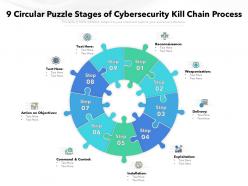
9 circular puzzle stages of cybersecurity kill chain process





Try Before you Buy Download Free Sample Product
 Impress Your
Audience
 100%
Editable
 Save Hours
of Time


Our 9 Circular Puzzle Stages Of Cybersecurity Kill Chain Process are topically designed to provide an attractive backdrop to any subject. Use them to look like a presentation pro.
People who downloaded this PowerPoint presentation also viewed the following :
9 circular puzzle stages of cybersecurity kill chain process with all 2 slides:
Use our 9 Circular Puzzle Stages Of Cybersecurity Kill Chain Process to effectively help you save your valuable time. They are readymade to fit into any presentation structure.

FAQs for 9 circular puzzle stages of cybersecurity
So basically there are seven stages attackers go through - reconnaissance, weaponization, delivery, exploitation, installation, command & control, then finally their actual goal. Think of it like dominoes. First they'll scout your systems, build malware, send it via phishing or whatever, exploit bugs to get in, plant backdoors, set up their communication, then steal data or encrypt everything. Here's the thing though - you can stop them at ANY stage. I'd focus on catching those transitions between stages rather than just hoping your antivirus catches everything. Way more effective than playing defense at the very end.
Map your security controls to each kill chain stage and hunt for gaps. Monitor external scanning and weird DNS queries during reconnaissance. Email security and web filtering handle weaponization/delivery phases. Exploitation is honestly where vuln scanners and pen testing become your best friends. After that, endpoint monitoring catches installation attempts while network analysis spots command & control traffic. DLP tools track the final actions stage. You really want multiple detection layers at each point so nothing slips through. Oh, and run tabletop exercises - they'll show you where your coverage actually sucks.
Think of threat intelligence as getting a heads up before the bad guys even knock on your door. You can catch malicious domains and sketchy IPs before they reach your network, plus spot dangerous file signatures during the actual attack. What I love about good threat intel is how it flips the script - instead of scrambling after you've been hit, you're already three steps ahead. Feed it into your security stack and it'll auto-block the known nasties. Just make sure you're getting intel that's actually relevant to your sector and location, not some generic feed that's half useless.
Think of it like knowing how a thief operates - they scout your house, pick the lock, sneak around inside, then grab your stuff. Cyber attackers follow the same playbook. Map your security tools against each step they take. Block their initial scouting, stop sketchy downloads, catch them moving between systems. Honestly, this approach is so much smarter than scrambling after you've already been breached. You don't need bulletproof protection everywhere either. Break their chain at any point and their whole attack fails. First step? Figure out what stages your current tools actually protect.
Look at the Target hack from 2013 - hackers sent phishing emails to some HVAC company, got in through that connection, then moved sideways into Target's actual network. Boom, 40 million credit cards stolen. Equifax was similar but messier - they exploited an Apache bug and just sat there for months pulling data on 147 million people. Nobody even noticed, which is honestly wild. Both cases show how these aren't quick hits. They're drawn-out campaigns where attackers move through different stages over weeks. That's why you've got to monitor each phase if you want any chance of catching them.
So here's what I'd do - map each kill chain stage to your incident response procedures. That way when shit hits the fan, you're not scrambling around wondering what to do. Reconnaissance gets one playbook, initial compromise gets another, data exfil gets its own thing. Makes way more sense than just winging it every time. Your SOC people will actually thank you for giving them clear escalation points instead of guessing. I'd start by looking at your current runbooks and see how they line up with those seven phases. You'll probably find some weird gaps you didn't know existed.
Honestly, start with the basics - how fast you're catching threats and actually responding to them at each kill chain stage. False positive rates matter too because alert fatigue will kill your team's motivation. I'd focus on prevention metrics first, like blocking phishing emails vs how many users still click malicious links (spoiler: there's always someone). Track your containment times and escalation processes. The real win is stopping attacks before they reach the nasty stuff like data theft. Once you nail these fundamentals, then you can get fancy with more detailed tracking.
Honestly, ML and AI are pretty amazing at breaking up cyberattacks because they can process way more data than any human team. They're constantly analyzing network traffic, user patterns, and system logs to catch threats at different stages - from the initial scouting phase right through to when hackers try stealing your data. What's really cool is how they learn from past attacks to spot new ones. They're particularly good at detecting when attackers move laterally through your network or abuse stolen credentials. Oh, and traditional security tools often miss this stuff completely. I'd start with ML-based endpoint detection and user behavior analytics - you'll see results pretty quickly.
Yeah totally! Each kill chain stage maps to different defensive tools. Reconnaissance gets handled by threat intel platforms like Recorded Future. Email gateways and web proxies catch weaponization/delivery attempts. EDR tools like CrowdStrike are solid for the installation phase - honestly they've gotten way better lately. Network monitoring usually stops command and control traffic, which is where most SOCs actually catch stuff if they're paying attention. Data loss prevention handles the final stage. I'd map your current stack against each phase to see what you're missing, but that's probably obvious.
Honestly, just map each training module to the kill chain stages - it's way more effective than generic cybersecurity training. Start with phishing awareness for reconnaissance/delivery, then hit endpoint security for exploitation. Your SOC team should focus on lateral movement detection for command & control. Finance folks need totally different kill chain training than IT staff though. Actions-on-objectives? That's where incident response procedures matter most. The whole thing feels less theoretical when you break it down this way. First step is figuring out what stages your current training actually covers - might be surprised by the gaps.
Honestly, the Kill Chain model is getting pretty outdated. Modern attackers don't follow those neat steps anymore - they're using fileless malware, living-off-the-land techniques, and supply chain attacks that skip around or happen all at once. It's like trying to navigate with an old GPS that doesn't know about half the roads. Insider threats and cloud attacks? They don't even fit the framework. My advice is to pair it with something like MITRE ATT&CK for better coverage. Don't rely on Kill Chain alone - you'll miss way too much stuff that matters.
Yeah, ransomware totally fits the kill chain model. Attackers scope out targets first, then slip in through phishing emails or security holes. They'll actually hang out in your system for weeks - just watching and mapping everything before they strike, which is honestly terrifying. Once they move laterally and grab admin rights, game over. But here's the thing - you can build defenses at each step. Email filters catch most phishing attempts. Good endpoint monitoring spots weird activity early. Network segmentation stops them from spreading around. The trick is catching them during that initial recon phase instead of dealing with encrypted files later. Way less painful that way.
Honestly, sharing threat intel is a total game-changer for catching attacks early. You'll spot reconnaissance and IOCs way before they hit your network. Why build defenses from scratch when someone already figured out how to block that campaign? Just grab their playbooks and signatures. Industry sharing groups are clutch for this stuff - we started using one last year and response times dropped like crazy. The best part is coordinated response though. One company sees lateral movement, boom - they alert everyone about the related infrastructure. Start with your industry's threat sharing community. Trust me, the visibility boost alone makes it worth it.
So they're actually meant to work together, which is pretty cool. Kill Chain shows you the big picture - like the timeline of an attack from start to finish. ATT&CK gets into the weeds with specific techniques. Think of it this way: Kill Chain tells you "lateral movement phase is happening," but ATT&CK lists out exactly HOW they're moving around - maybe 15+ different methods. Pretty overwhelming honestly, but super useful. Most security folks I've worked with use both. They'll map their detection rules to Kill Chain phases AND specific ATT&CK techniques. Gives you way better coverage than picking just one framework.
Dude, the Kill Chain framework totally flips supply chain security on its head. Attackers don't bother hitting you head-on anymore - they're way smarter than that. They'll backdoor through your vendors first, then wiggle sideways into your actual systems. Pretty sneaky, right? You've gotta think like them and map out attack paths from every supplier relationship. Zero-trust verification for third-party access is non-negotiable. Oh, and audit your most critical vendors first - those are your biggest blind spots. The whole "trusted partner" thing? That's exactly what makes this attack vector so dangerous.
-
Amazing product with appealing content and design.
-
Illustrative design with editable content. Exceptional value for money. Highly pleased with the product.
-
Much better than the original! Thanks for the quick turnaround.
-
Nice and innovative design.
-
Good research work and creative work done on every template.