


A Comprehensive Guide To Classes Of Fire Training Ppt





Try Before you Buy Download Free Sample Product
 Impress Your
 Audience
 100%
100% Editable
 Save Hours
 of Time


This set of slides discusses the categorization of fires into various classes. The classes are as follows Class A Ordinary Combustibles, Class B Flammable Liquid, Class C EU or AU, Class B US Flammable Gases, Class D Metal, Class E AU, Class C US Electrical, and Class F EU or AU, Class K US Cooking oil and fats.
People who downloaded this PowerPoint presentation also viewed the following :
Content of this Powerpoint Presentation
Slide 1
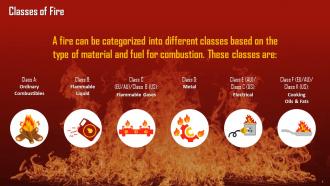
This slide lists classes of fire. A fire can be categorized into classes based on the type of material and fuel for combustion. These are A, B, C (AU/EU)/ B (US), D, E (AU)/ C (US), and F (EU/AU)/ K (US).
Slide 2
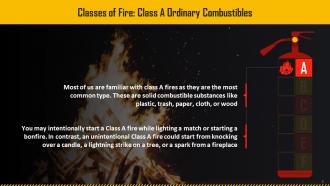
This slide talks about Class A fires that consist of ordinary combustibles. Most of us are familiar with Class A fires as they are the most common type. Theses are solid combustible substances like plastic, trash, paper, cloth, or wood.
Slide 3
This slide talks about Class B fires that consist of flammable liquid. These fires follow the same fundamental fire tetrahedron as regular combustible fires (heat, fuel, oxygen, chemical reaction), except that the fuel in question is a flammable liquid like gasoline or natural gas
Slide 4
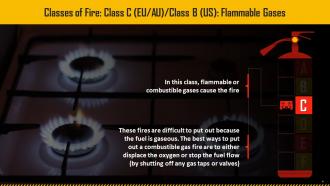
This slide talks about Class C (EU/AU)/Class B (US) fires that consist of flammable gases. These fires are difficult to put out because the fuel is gaseous. The best ways to put out a combustible gas fire are to either displace the oxygen or stop the fuel flow (by shutting off any gas taps or valves)
Instructor’s Notes: In the European/Australian system, fires involving flammable or combustible fuel are categorized as "Class C"; however, in the US system, flammable liquids and gases together are categorized as "Class B" fires
Slide 5
This slide talks about Class D fires that consist of metal. Combustible metals, particularly alkali metals like lithium and potassium, alkaline earth metals like magnesium, and Group 4 elements like titanium and zirconium, are involved in Class D fires
Instructor’s Notes: Metal fires are typically dangerous when metal is present as sawdust, machine shavings, or other metal "fines," which ignite more quickly than bigger blocks due to their higher surface area
Slide 6
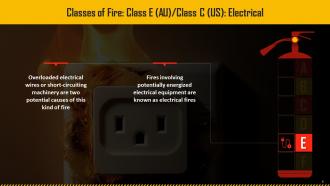
This slide talks about Class E (AU)/ Class C (US) fires that involve electricity. Overloaded electrical wires or short-circuiting machinery are two potential causes of this kind of fire.
Instructor’s Notes: Firefighters who use water or other conductive materials to put out these fires risk serious injury because electricity can travel through the water to the firefighter's body and subsequently to the earth
Slide 7
This slide talks about Class F (EU/AU)/ Class K (US) fires that consist of cooking oils and fats. Although these fires are essentially a subclass of flammable liquid/gas fires, their unique characteristics, particularly their higher flash point, are considered significant enough for these to be categorized as a seperate class.
Slide 8
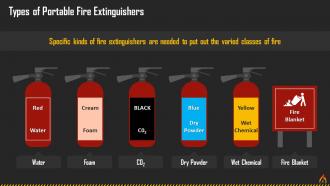
This slide highlights types of fire extinguishers. These are water, foam, carbon dioxide, dry powder, wet chemical, and a fire blanket.
Instructor’s Notes:
- Water: Water fire extinguishers are labelled red and are used for extinguishing Class A fires. They effectively put out fires caused by solid combustibles like wood, paper, and textiles
- Foam: Foam fire extinguishers come with a cream label and are highly effective in extinguishing Class A and Class B fires
- Carbon Dioxide: Carbon Dioxide fire extinguishers have a black label and were designed to extinguish flammable liquid fires; hence they have a Class B fire rating. They can also be used to put out electrical fires, as carbon dioxide is not a conductor, and these do not leave any toxic residue
- Dry Powder: Dry Powder fire extinguishers come with a blue label and can be used to extinguish Class A,B,C, and electrical fires
- Wet Chemical: Wet chemical fire extinguishers come with a yellow label and are designed specifically for extinguishing fires involving combustible cooking material such as burning oil and fat
- Fire Blanket: A fire blanket is a safety tool designed to put out incipient or developing fires. It consists of a sheet made of fire-resistant material that can be placed over a fire to smother it. In addition to being frequently used for chip pan and toaster fires, they can also be found in laboratories and waste bins
Slide 9
This slide depicts a fire classification and extinguisher table. It highlights types of fire extinguishers that can be used for putting out types of fires.
A Comprehensive Guide To Classes Of Fire Training Ppt with all 25 slides:
Use our A Comprehensive Guide To Classes Of Fire Training Ppt to effectively help you save your valuable time. They are readymade to fit into any presentation structure.
-
A Comprehensive Guide To Classes Of Fire Training Ppt
-
A Comprehensive Guide To Classes Of Fire Training Ppt
-

A Comprehensive Guide To Classes Of Fire Training Ppt
-
A Comprehensive Guide To Classes Of Fire Training Ppt
-

A Comprehensive Guide To Classes Of Fire Training Ppt
-
A Comprehensive Guide To Classes Of Fire Training Ppt
-

A Comprehensive Guide To Classes Of Fire Training Ppt
-
A Comprehensive Guide To Classes Of Fire Training Ppt
-

A Comprehensive Guide To Classes Of Fire Training Ppt
-

A Comprehensive Guide To Classes Of Fire Training Ppt
-

A Comprehensive Guide To Classes Of Fire Training Ppt
-

A Comprehensive Guide To Classes Of Fire Training Ppt
-
A Comprehensive Guide To Classes Of Fire Training Ppt
-

A Comprehensive Guide To Classes Of Fire Training Ppt
-

A Comprehensive Guide To Classes Of Fire Training Ppt
-

A Comprehensive Guide To Classes Of Fire Training Ppt
-

A Comprehensive Guide To Classes Of Fire Training Ppt
-

A Comprehensive Guide To Classes Of Fire Training Ppt
-

A Comprehensive Guide To Classes Of Fire Training Ppt
-
A Comprehensive Guide To Classes Of Fire Training Ppt
-

A Comprehensive Guide To Classes Of Fire Training Ppt
-

A Comprehensive Guide To Classes Of Fire Training Ppt
-

A Comprehensive Guide To Classes Of Fire Training Ppt
-

A Comprehensive Guide To Classes Of Fire Training Ppt
-

A Comprehensive Guide To Classes Of Fire Training Ppt
FAQs for A Comprehensive Guide To Classes Of
Honestly, the main thing is you won't just freeze up when you see flames - which, let's be real, most people do. You'll actually know evacuation routes and how to work those fire extinguishers properly. Plus you learn when a fire's too big to mess with and you need to bail immediately. It also helps you spot hazards around the office before they turn into actual problems. Oh, and people will definitely look to you for direction if something goes down. I'd ask HR about it - companies usually cover the cost since it protects them legally too.
Dude, fire training is actually super important - most people think they'll know what to do but totally freeze when shit hits the fan. Your employees learn evacuation routes, proper fire extinguisher technique, and how to help injured people. The hands-on practice is key because muscle memory saves you when adrenaline kicks in. I mean, I've seen grown adults panic over way smaller stuff than fires. Everyone gets way more confident after going through different scenarios. Oh, and definitely do refreshers yearly - those skills get rusty fast if you don't practice them.
Dude, they'll teach you all the hands-on stuff - hose handling, ladder work, ventilation techniques. Fire behavior science is huge too, like how fires actually start and spread. Rescue ops, basic hazmat, plus that breathing apparatus training (way trickier than you'd think btw). Most places throw in CPR/first aid certification. Radio protocols and incident command structure help with communication skills. Oh and the practical scenarios are clutch - nothing beats that real pressure training. You'll definitely feel confident handling emergencies afterward. My buddy said the mask work was the hardest part for him.
So there's actually a bunch of different options depending on what you need. Basic fire safety covers evacuation stuff for regular employees. Then there's hands-on extinguisher training - that one's honestly way more fun than it sounds once you stop being terrified lol. More advanced courses exist for emergency response teams too. Different workplaces need specialized training though - industrial sites vs offices vs hospitals all have their own hazards. The skill levels vary a lot between them. I'd probably check what your job actually requires first before signing up for anything.
Yeah you basically have to do it - OSHA makes it mandatory for most places and your insurance will definitely require it. The good news is that insurance companies usually give you better rates when your people are trained properly. Some won't even cover you without it, which is kind of harsh but makes sense I guess. OSHA wants annual training and their fines are pretty brutal if you skip it. Plus if something actually happens, having proper training reduces your liability big time. I'd call your insurance agent though - they're all different about which programs they'll actually accept.
Most training companies will come assess your place and build scenarios around your actual equipment and layout. Pretty smart approach, honestly. They'll adjust intensity based on who's getting trained - so your maintenance crew gets the full extinguisher experience while office people focus on evacuation routes. Some providers even bring coffee, which is a nice bonus! I'd grab quotes from 2-3 companies and ask upfront what customization they offer. They can tailor everything to your specific fire risks and industry stuff, so it's way more relevant than generic training.
Dude, the worst mistake is thinking you're good after one training session. Skills get rusty super quick. Organizations love those cheap online videos, but you really gotta get your hands dirty with actual extinguishers - builds that muscle memory, you know? Oh, and people treat all fires the same when they're totally different beasts. Class A vs electrical? Completely different game. Most places obsess over extinguisher technique but forget to teach when you should just run. Sometimes fleeing beats fighting - cover both scenarios in your training or you're missing half the picture.
So for virtual fire training that actually works, you'll want interactive stuff - VR simulations, breakout rooms where people practice scenarios together. Don't just lecture at them for an hour straight. Break everything into shorter chunks and throw in polls or quick quizzes to keep people awake. The instructor needs to actually see what participants are doing and jump in when someone's confused. Honestly, the follow-up sessions are clutch - that's where you catch what people missed the first time. Oh, and live Q&A beats pre-recorded videos every single time.
Honestly, hands-on practice is everything - forget those boring slide presentations. Get people actually using extinguishers and running through evacuation drills that match their real workplace. Small groups work way better since everyone gets personal attention. I always cringe when I see trainers just lecturing for an hour straight. After each exercise, spend time debriefing what happened so the lessons actually stick. Oh, and create an environment where people aren't embarrassed to ask questions - this stuff could literally save their lives someday, so they need to feel confident about what they've learned.
Quarterly is usually the sweet spot - meets most safety requirements and people actually retain what they learn. Monthly feels excessive unless you're in a really hazardous place (like a chemical plant or something). Honestly, consistency matters way more than doing it super frequently. You want your team comfortable enough that they won't panic, but not so practiced they just phone it in during drills. High-risk workplaces sometimes go monthly but that's probably overkill for most offices. Start with every three months and see how people handle the actual drills - you can always adjust from there.
Look for instructors with Certified Fire Inspector (CFI) credentials and state fire marshal certifications. NFPA instructor certs are solid too. Most good ones also have EMT or paramedic training - which honestly just makes sense, right? You definitely want someone who knows their stuff when it comes to your safety. Those certifications mean they're up on current fire codes and actually know how to teach properly instead of just... figuring it out as they go. Don't feel weird about asking to see their credentials upfront. Any legit instructor won't mind showing them off.
Honestly, run some before/after tests to see if people actually learned anything. Time your evacuation drills - are folks getting faster and staying calm? I'd also send out feedback surveys because sometimes people will tell you straight up what confused them. The drill performance is where you'll really see if it's working though. Don't just check off that training box like most places do. Follow up with refresher quizzes later to see what stuck. And if you ever have a real emergency (hopefully not), that's your ultimate test of whether the training was worth anything. Watch how people respond and tweak your program based on what actually happens.
Honestly, simulators and VR are where it's at for building muscle memory. Those interactive modules work great between hands-on sessions too. Mobile apps with quick references save your butt when you're actually out there dealing with stuff. Case study videos beat reading textbooks any day - scenarios just click better that way. Oh, and don't skip the group debriefs after training. Other people always catch things you miss. My buddy's department has some solid digital resources already, so definitely check what yours offers first. Then you can figure out what else might help.
Yeah, so fire training totally depends on what kind of place you're working at. Manufacturing companies deal with chemical fires and shutting down equipment properly. Healthcare workers focus more on evacuating patients safely - plus they've got all that oxygen around which is sketchy. Restaurants? They're all about grease fires since those things go nuts in like two seconds. Most offices just cover the basics - where the exits are, how to use an extinguisher. Oil and gas companies go hardcore though, with foam systems and gas leak stuff. Honestly, just think about what could actually catch fire where you work and train for that.
VR and AR are game-changers for fire training - trainees can practice dangerous scenarios without the actual risk or crazy costs of live burns. Mobile platforms mean they can access training modules from anywhere now. The AI stuff is pretty cool too, adapting simulations to how fast each person learns. IoT sensors in training equipment give instant feedback on technique. Some of these programs are getting ridiculously immersive (my buddy showed me one last week that was insane). Data tracking lets you see exactly where someone's struggling so you can customize their training. I'd start by looking at VR options that won't break your budget.
-
I am a big fan of their newsletters because that is how I found my perfect requirement at the time of urgency. Thank God, I kept opening those.
-
Excellent work done on template design and graphics.