

 0 Comment
 Customer Reviews

In today's rapidly evolving business environment, organizations have to be ready for unexpected challenges anytime. At times, internal issues impede smooth functioning, while data leaks and customer complaints become viral, particularly on digital media. To address these issues effectively, companies need a robust crisis management system, comprehensive crisis response training, and thorough emergency management training. This preparation helps them minimize disruptions and maintain focus on their objectives. Companies should train their teams with proper planning to handle crises like natural disasters and cybersecurity breaches.
One of the most efficient ways to prepare teams for such critical situations is through well-structured crisis management training programs. A simple PowerPoint teaches employees how to react in such situations and whom to contact, ensuring that a company can not only survive adversity but also emerge stronger and more resilient.
From step-by-step crisis response strategies to communication planning and post-crisis evaluation, every organization must have this toolkit. It should also feature samples and examples to support your training materials with actionable strategies and plans. These also serve as excellent tools for disaster preparedness training, helping teams simulate emergency scenarios and strengthen their response readiness whenever needed.
We have designed the top 10 crisis management PPT templates with real-life examples and interactive elements. Whether you're an HR manager of any field, a business owner, or a trainer looking to upskill your team, these templates provide a ready-to-use foundation for educating audiences on how to anticipate, respond to, and recover from crises individually as well as in teams. Let’s explore the expert’s choice for crisis management training PPT Temlpates now!
Template 1: Crisis Management Training Wind Energy Ppt
This presentation template highlights the importance of crisis management in wind energy management. It outlines the eight key components essential for ensuring safety, continuity, and resilience in wind energy operations. These include risk assessment and proper response planning by the team to stay ready for any anticipated crisis.
Emphasize the importance of regular classes for the team members to inform them about the issues and best ways to mitigate them. In crisis management, communication protocols ensure clear and efficient information flow during emergencies. Moreover, stressing the cruciality of emergency equipment on-site with a dedicated post-crisis meeting helps them learn from experience and improve their decisions.
This PPT will help reinforce the stability and security of organizations that manage wind energy in any crisis and enable the organization to perform better.

Template 2: Training and Development Plan for Crisis Management Team
Use this PPT Slide for a well-structured training and development plan for the crisis management team. This PPT Layout covers Three types of training:
Firstly, in a simulation exercise, you learn to handle project crises and manage risk management effectively so that the project doesn't get delayed. Then, virtual reality technology teaches how to deal with crises using malware and ransomware technologies. Finally, offline training prioritizes safety to prevent accidents and ensure everyone's well-being.
Each training session must be assigned to dedicated trainers, with duration and budget allocation highlighted individually as shown in this PPT Layout. Start planning your crisis management training by downloading this PPT Design now!

Template 3: Organizational Crisis Management Team Training Plan PPT
With this presentation slide, you can outline an organizational crisis management team training plan for real-time emergencies. For example, with this PPT Slide, address the five different training programs for learners. These can be "Introduction to Crisis Management Strategy," "How to Implement Crisis Management Plan," and "crisis communication with external authorities."
All the programs can have different modes and are separated from each other, like online and hybrid, and some are classroom-based, led by different experts in the field.
This 2-week training can be designed to be compatible with smartphones and laptops, and each participant receives a certification upon completion of the program from the organization.
Thus, with this program, organizations can boost the confidence of team members during emergencies, improve internal communication, and enhance networks in the field.

Template 4: Cyber Crisis Management Powerpoint Ppt Template Bundles
Through this presentation layout, you can explain the three key phases of the crisis management cycle for managing cyber crises. The first stage, pre-crisis, involves identifying vulnerable points, training staff, and incorporating crisis leadership training, with a target of 95% completion in cybersecurity awareness.
Then, during the crisis stage, the response is activated within 15 minutes, and the affected systems are isolated in 30 minutes. Last is the post-crisis phase; the emphasis is on investigating incidents with 98% accuracy and communicating the findings within 24 hours.
This PPT Template offers a structured framework for proactive recovery and response.

Template 5: Exercise on Crisis Management Training Edu PPT
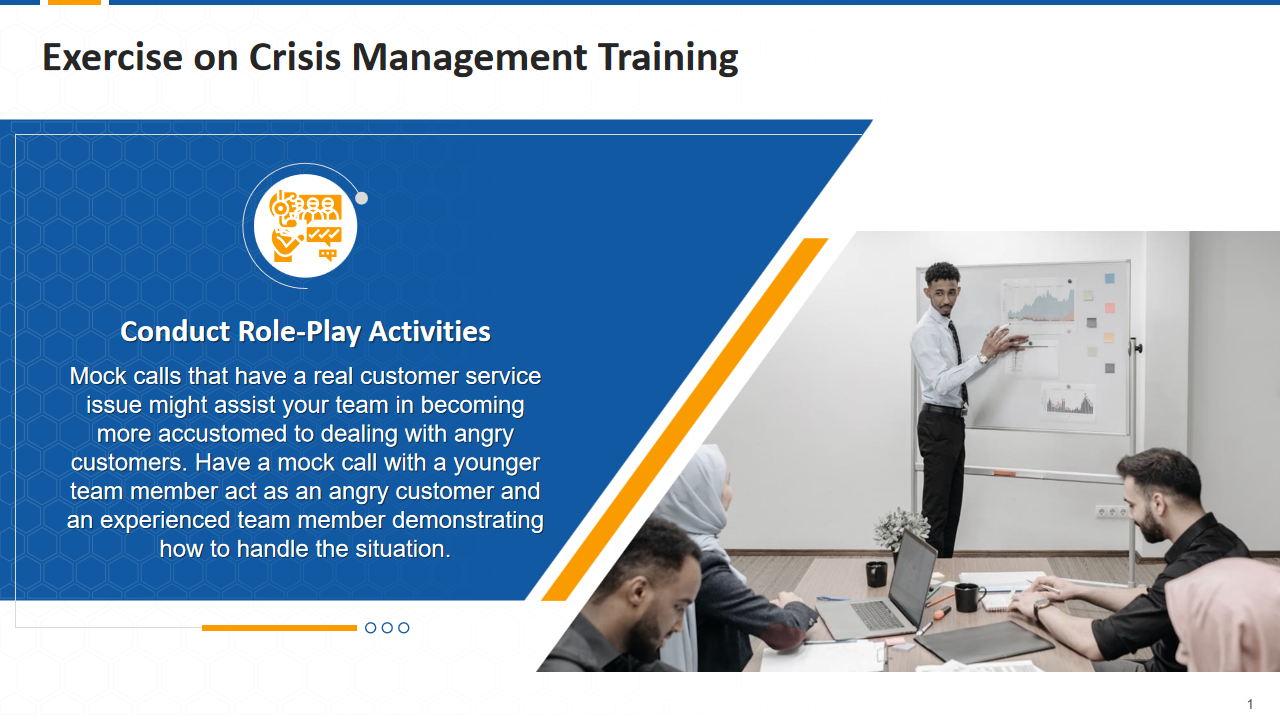
This PowerPoint Framework highlights a simple and effective training technique: role-play activities. These mock calls are targeted at people practicing as a team; a younger team member plays the role of an upset and unhappy customer, while senior members show them how to handle the situation calmly and professionally.
This practice prepares the team members to handle workplace crisis management and real-life problems with experience and mentally prepares them to face them. It builds real confidence to face frustrated customers without real consequences.
In short, the main focus is to prepare the team for real challenges through practical learning. Create seasoned professionals with this PPT Framework now!
Template 6: Essential Initiatives to Safeguard Crisis Management Team Training Schedule
Our team has designed this presentation slide to outline four essential initiatives designed to strengthen an organization's crisis preparedness, and experts will train each individual in the following areas: Hypotheticals, workshops, simulations, and field exercises.
Hypothetical sessions can involve discussing unexpected situations to enhance critical thinking and decision-making. In the
In Workshop, the focus can be on planning and guidelines, with decision-makers guiding the team according to the plan.
Next are simulations and real-time crisis setups that test your decision-making and reaction. Field exercises offer hands-on experience through demonstrations to assess the execution of emergency plans at ground level. Share individual pricing details for each step with this PPT Layout.

Template 7: Risk Identification and Crisis Management Training Plan Template
This PPT Template for a risk identification and crisis management training plan outlines four focused, 2-hour offline sessions, each with a clear date, venue, and status. Different trainers will conduct each session. For example, one of the trainers can conduct risk identification and assessment in the conference room, followed by another trainer overseeing communication, in the meeting room Next, Sessions like business continuity planning, customs, and a crisis preparedness workshop will be similarly allotted to other experts. T
These sessions covered valuable topics on risk identification and provided a transparent, easy-to-follow roadmap for building and tracking a fully prepared crisis management capability for the organizations. Get this PPT Preset now to create training schedules.

Template 8: Developing Crisis Management Training Plan
This developing crisis management training plan presentation template divides the crisis cycle into four phases: mitigation, preparedness, response, and recovery. In this PPT Slide, each stage is well structured, with clear objectives, timelines, resources, and designated training providers.
For instance, in the first 15 days, identify potential risks and preventive strategies (mitigation). Then, in 15 to 30 days, the team will be trained to deal with crises and emergency contacts. On days 31-45, using simulation tools, the team can practice real-time scenarios. The impact of the crisis will ultimately be examined, and a recovery plan for business continuity will be created. Download this presentation template to follow a step-by-step, practical approach to building a fully prepared and resilient crisis management team.

Template 9: Benefits of Crisis Management Training With Crises Control PPT
The benefits of crisis management training with a crisis control layout highlight the core advantages of conducting crisis training within an organization. Three phases divide the training.
The first phase focuses on enhancing the organization's reputation for resilience through rapid response capability, while also preparing teams to respond swiftly and effectively in critical situations.
It boosts workers' confidence and leadership during uncertain times and helps them make the right decisions when needed. This session also minimizes financial loss, as the team has the right planning and tools to act decisively.

Template 10: Crisis Management Training Program for Adverse Situation PPT
This template, titled "Crisis Management Training Program for the Adverse Situation," provides a structured overview for the organization to prepare for crisis with structured training. The template covers three scenarios: the workplace crisis, the security crisis, and the supply chain problem. A description of each scenario, including types of training, emergency response planning, budget allocated, and budget already spent, has been mentioned.
For instance, safety training for workplace crises is handled by a safety manager with a $1000 budget, of which $800 has been used. Similarly, experts in cybersecurity and supply chain management are assigned to the training. Download this template for managing crisis scenarios and emergencies.

Template 11: Crisis Management Training for Employee Workplace Safety Layout
Use this PPT Template for a clear and organized format for training employees to handle workplace safety concerns. Two training areas have been covered: anti-harassment training, risk assessment training, and natural disaster preparedness.
The anti-harassment training duration is five days and focuses on investigating complaints from employees, providing valuable results, and taking suitable actions to address offenders' behavior. On the other hand, natural disaster training includes using emergency services and creating basic plans, which are conducted over two days.
Download this presentation template to help the workplace to create a safe and responsible environment.

Crisis Management in a Nutshell
Crisis management training is essential for preparing organizations to handle routine challenges effectively and perform in unexpected situations like a pro. The above-listed crisis management training PPT Templates offer pathways for an organization, providing valuable, structured content to any individual who is planning to build their setup, strategies to perform, planning, and priorities safety in their business.
It means executing crisis management strategies across various scenarios, such as cyber threats, risk identification, and team coordination, will now be simpler and more effective in impact. Following these presentation templates and customizing them according to plans can significantly enhance the impact and make the sessions more effective to perform.
PS: Click here to grab the top 10 social media crisis management plan templates with samples and examples to help you plan and respond effectively.
FAQs on the Knowledge Management Infrastructure
1. What Are the 5 P’s of Crisis Management?
The 5 p's of crisis management:
Prevention: taking steps in advance to avoid any risk or crisis, such as following safety rules. It's advisable to prioritize safety over regret.
Preparation: teams, plans, and resources are ready to face conflicts and crises.
Prediction: identifying possible threats through a warning system and risk assessments.
Performance: performing and following the plan in the crisis, as well as executing the response plan.
Post-crisis: reviewing actions taken and making better decisions for the next time.
2. Who Should Take Crisis Management Training?
Crisis management training is important for everyone in an organization, especially for
Top management and leaders: they make decisions during crises and lead the team.
HR and admin teams: they handle people, communication, and coordination during emergencies.
IT and security teams: They protect the organization's data, cyber threats, and technical problems.
Customer service teams: This team manages the communication and helps customers to meet their requirements.
Frontline employees: anyone at the front-facing client or the public before anyone should know what to do when something goes wrong.
3. What Topics Are Covered in Crisis Management Training?
Crisis management training typically covers the following key topics:
Crisis identification and risk assessment: to recognize the type of crisis and its timing.
Crisis communication: strategies for internal and external communication during a crisis.
Emergency response planning: creating a proper plan and updating the team with their roles.
Business continuity planning: how to manage smooth operations in such situations.
Leadership in crisis: to make the right decisions under pressure.
Media management: handling media inquiries and press briefings effectively.
Stakeholder management: Addressing concerns of employees in mock scenarios.