

Business Crisis Management Plan And Checklist




Try Before you Buy Download Free Sample Product
 Impress Your
 Audience
 100%
100% Editable
 Save Hours
 of Time


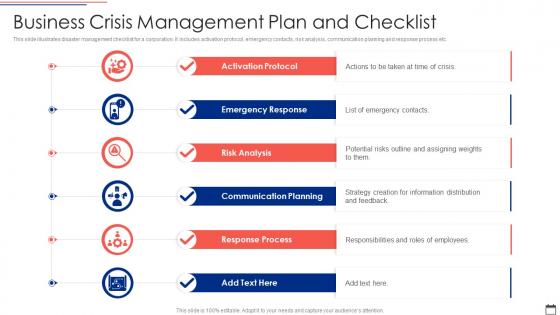
This slide illustrates disaster management checklist for a corporation. It includes activation protocol, emergency contacts, risk analysis, communication planning and response process etc.
People who downloaded this PowerPoint presentation also viewed the following :
Business Crisis Management Plan And Checklist with all 6 slides:
Use our Business Crisis Management Plan And Checklist to effectively help you save your valuable time. They are readymade to fit into any presentation structure.





FAQs for Business Crisis Management
Key components include crisis identification protocols, communication strategies, response team structures, resource allocation frameworks, and recovery procedures. These elements work together by establishing clear decision-making hierarchies, enabling rapid stakeholder communication, and ensuring business continuity, with many organizations finding that comprehensive planning significantly reduces recovery time and maintains customer trust during disruptions.
Organizations identify potential crises through comprehensive risk assessment frameworks, continuous environmental scanning, stakeholder feedback monitoring, early warning systems, and predictive analytics tools. These proactive approaches enable companies to detect emerging threats across financial, operational, and reputational domains, with many finding that systematic monitoring ultimately delivers faster response times and significantly reduced crisis impact.
Communication serves as the foundation of effective crisis management, enabling transparent stakeholder updates, coordinated response efforts, internal team alignment, and reputation protection through consistent messaging. Through strategic communication protocols, organizations maintain customer trust, preserve investor confidence, and ensure regulatory compliance, while proactive engagement with media and stakeholders ultimately minimizes long-term reputational damage and accelerates recovery.
Businesses maintain employee morale during crises through transparent communication, flexible work arrangements, mental health support, recognition programs, and strategic resource allocation. Companies like hospitals during health emergencies and financial services during economic downturns find that regular updates, wellness initiatives, and acknowledging employee contributions ultimately strengthen team cohesion and organizational resilience.
Best practices for engaging with stakeholders during a crisis include transparent communication, proactive outreach, regular updates, empathetic messaging, and multi-channel coordination. These approaches streamline crisis response by maintaining trust, managing expectations, and preserving relationships, with many organizations finding that consistent, honest communication ultimately delivers faster recovery and stronger stakeholder confidence.
Technology enhances crisis management through real-time monitoring systems, automated alert platforms, predictive analytics tools, communication networks, and data visualization dashboards. These solutions streamline response coordination by accelerating threat detection, enabling faster decision-making, and maintaining stakeholder communication, with many organizations finding that integrated technology platforms ultimately deliver more effective crisis resolution and improved business continuity.
Past business crises teach the importance of transparent communication, rapid decision-making, stakeholder engagement, contingency planning, and maintaining customer trust during uncertainty. Companies like Johnson & Johnson during the Tylenol crisis and airlines managing operational disruptions demonstrate that organizations prioritizing honest communication, swift corrective action, and long-term reputation over short-term costs ultimately emerge stronger with enhanced credibility.
Businesses should prioritize resources during a crisis by focusing on cash flow preservation, essential operations maintenance, employee safety, and customer retention. Strategic resource allocation enables organizations to maintain core services while reducing non-critical expenditures, with many companies finding that clear prioritization frameworks help navigate uncertainty and emerge stronger competitively.
Organizations can recover reputational damage through transparent communication, swift corrective actions, stakeholder engagement, consistent messaging across all channels, and demonstrating genuine accountability for improvements made. Companies like Johnson & Johnson and Tylenol have shown that proactive crisis response, coupled with long-term commitment to rebuilding trust, ultimately strengthens brand credibility and customer loyalty in competitive markets.
Crisis simulation training is essential for building employee confidence, decision-making skills, and response coordination during actual emergencies. These realistic scenarios enable teams to practice communication protocols, identify potential weaknesses, and refine response procedures, with many organizations finding that regular simulations significantly reduce response times and improve crisis outcomes.
Leadership and decision-making form the backbone of crisis management, encompassing rapid assessment, clear communication, resource allocation, stakeholder coordination, and strategic planning. Through decisive leadership, organizations streamline response efforts, maintain operational continuity, and minimize damage, with many companies finding that strong leadership during crises ultimately delivers competitive advantage and enhanced stakeholder trust.
Businesses can differentiate crises by analyzing their origin, control level, and stakeholder impact, with internal crises stemming from operational failures, leadership issues, or compliance violations, while external crises arise from market shifts, natural disasters, or regulatory changes. This distinction enables organizations to develop targeted response strategies, allocate appropriate resources, and implement preventive measures, ultimately enhancing crisis preparedness and operational resilience.
Customer relationship management during crises involves transparent communication, proactive outreach, flexible service adjustments, personalized support, and consistent value delivery across all touchpoints. Through digital platforms and direct engagement, companies like airlines during disruptions and banks during economic uncertainty maintain trust by acknowledging challenges, offering solutions, and demonstrating genuine concern, ultimately strengthening long-term loyalty and competitive positioning.
Companies should monitor crisis response effectiveness through real-time metrics tracking, stakeholder feedback analysis, media sentiment monitoring, operational performance indicators, and post-crisis comprehensive reviews. These evaluation methods enable organizations to assess communication reach, public perception shifts, and business continuity maintenance, while identifying improvement opportunities for future crisis preparedness, ultimately strengthening organizational resilience and stakeholder trust.
Emerging trends in crisis management include AI-powered threat detection, real-time social media monitoring, predictive analytics, automated response systems, and integrated communication platforms. These technologies enhance organizational resilience by enabling faster threat identification, streamlined stakeholder communication, and data-driven decision making, with many companies finding that digital tools ultimately deliver more agile crisis responses and stronger competitive positioning.
-
I have been using SlideTeam for the past six months. Very happy and satisfied!
-
Use of icon with content is very relateable, informative and appealing.