


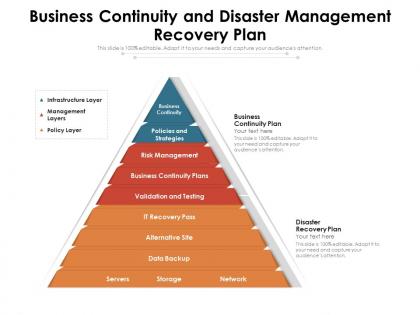
Business continuity and disaster management recovery plan




Try Before you Buy Download Free Sample Product
 Impress Your
 Audience
 100%
100% Editable
 Save Hours
 of Time


Our Business Continuity And Disaster Management Recovery Plan are topically designed to provide an attractive backdrop to any subject. Use them to look like a presentation pro.
People who downloaded this PowerPoint presentation also viewed the following :
Business continuity and disaster management recovery plan with all 2 slides:
Use our Business Continuity And Disaster Management Recovery Plan to effectively help you save your valuable time. They are readymade to fit into any presentation structure.

FAQs for Business continuity and disaster
Honestly, start with figuring out what could actually screw you over - cyberattacks, natural disasters, losing key people. Document how you'd recover from each mess step by step. Communication's critical too - how will you reach your team, customers, vendors when everything's chaos? Testing quarterly is where most people drop the ball though. You can't just write this stuff down and call it done. Run actual drills to catch problems before they bite you. Oh, and definitely tackle the risk assessment first if you're starting fresh - gives you a foundation for everything else.
Honestly, I'd start by mapping out everything that keeps your business running, then brainstorm what could screw each part up. Natural disasters, hackers, supply chain mess, your star employee quitting - whatever. Rank them by how likely they are versus how badly they'd hurt you. That's where you focus first. Don't try some generic solution for everything though. Each risk needs its own game plan. Oh, and definitely pull in people from different teams when you're doing this - they'll catch stuff you'd never think of from your perspective.
Honestly, communication can totally save your ass or completely screw you over during a crisis. People need to know what's going on - employees, customers, suppliers, everyone. Otherwise they'll just panic or freeze up while your business tanks. I've watched companies with way better resources fail hard because their messaging sucked, while others bounced back quick just from keeping everyone in the loop. The key is setting up multiple ways to reach people beforehand and having specific team members ready to handle it when things go sideways. Don't wait until you're in crisis mode to figure this out.
Look, once a year is the absolute minimum but honestly that's pretty lazy. Big changes should trigger updates immediately - new office, key people leaving, major tech overhauls. Don't just wait around. After industry shake-ups or new regulations, give it another look too. I mean, what's the point of having a plan that's completely outdated? Set quarterly reminders to actually read through it and see what's different. Most companies just let these things sit there getting more useless by the month. Make yours actually matter.
Honestly, most people mess up by overthinking it from day one - they create these crazy complicated plans that nobody understands. Start simple instead. Also, you HAVE to test your backup systems regularly or you'll be screwed when something actually goes wrong (learned this the hard way at my last job). Leadership buy-in is huge too - without someone important backing it, your whole program gets cut first during budget season. Oh, and don't treat it like some project you finish once. It's ongoing work that needs constant attention or it falls apart.
Honestly, tech is a lifesaver for keeping your business running when stuff hits the fan. Get your critical data backed up to the cloud ASAP - flooding your office won't matter if everything's stored remotely. Your team can work from anywhere with decent collaboration tools. VoIP systems are clutch too, they'll reroute calls automatically (sometimes better than our regular phones, which is wild). Set up monitoring software so you catch problems early instead of scrambling later. The whole redundancy thing is key - have backups for your backups. Test everything regularly though, or you'll find out it's broken when you actually need it.
Run them quarterly if possible, but twice a year minimum. Mix up the scenarios too - don't just do the same fire drill repeatedly. Actually include your remote people (everyone forgets this part). Document what breaks because something always will, then fix your plan based on those findings. I'd start with tabletop sessions where you just walk through scenarios verbally. Way less stressful than jumping into full simulations right away. The trick is keeping it realistic without freaking people out. Most companies find issues they never expected. Just don't be one of those places that discovers problems and then ignores them - that's pointless.
First figure out what rules actually hit your industry - HIPAA if you're in healthcare, SOX for public companies, that sort of thing. Map those against your current plan to see where you're missing stuff. Documentation and regular testing are non-negotiable for most regulations, plus you need to prove critical ops can keep running during disasters. Companies always screw up the testing though - honestly it's the easiest thing to blow off. Set quarterly reviews and track everything from drills to plan changes. Trust me, when auditors show up you'll be glad you kept those records.
Focus on four main things: RTO (how fast you get back up), RPO (data loss you can live with), MTTR (actual recovery time), and how quickly you can kick the plan into gear. Training rates matter too - I've seen companies with amazing plans that nobody knew how to use. Test regularly and track what breaks during those tests. The stuff that really counts though? Revenue hits, angry customers, reputation damage. Oh, and benchmark everything now while things are calm. You don't want your first measurement happening during a crisis when you're already panicking.
Yeah, supply chain issues can totally wreck your business - I've seen companies completely scramble when their main supplier goes down. First thing I'd do is spread your suppliers around instead of relying on just one. Keep extra stock of the really critical stuff too. Map out your whole supply chain so you know where the weak spots are. Those real-time tracking tools are honestly worth the investment - my cousin's company saved themselves so much headache with one. Oh, and have backup suppliers lined up before you actually need them. Trust me on that one.
Think of RTO and RPO as your "oh shit" benchmarks for when everything goes sideways. RTO is how long you can actually be down before the business starts bleeding money. RPO? That's your data loss tolerance - like if you can only lose 4 hours of work max, you better be backing up every 4 hours or less. Honestly, don't just let IT set these numbers in a vacuum. You've got to figure out which processes actually matter first, then work backwards from the real business pain. Short downtime sounds great until you see the backup costs.
Honestly, just start with what you've got. Map out your critical stuff and figure out basic workarounds using resources you already have. A simple Google Doc with contacts, backup locations, and procedures is totally fine - I swear, small businesses always overcomplicate this. Think about realistic problems first: power going out, someone calling in sick, your supplier being late. Worst-case planning can wait. Maybe team up with other local businesses? They could lend you space if something happens to yours. Oh, and test everything every few months with those tabletop scenario things. Just start documenting this week, even if it's rough around the edges.
Look, stakeholders are your lifeline for business continuity - customers, employees, suppliers, board members, the whole crew. Get them involved early because they know where the real operational headaches are better than you do. They'll help figure out what actually needs to keep running and provide resources when you're planning. But here's the thing - don't just ask them once and disappear. Regular check-ins are crucial since these are the people who'll execute everything during a crisis. Oh, and set up those communication channels now, not when disaster strikes. Trust me on this one.
Look, you can't just bolt cyber stuff onto your BC plan later - it needs to be woven in from the start. Map out which digital systems are absolutely critical and what breaks if they go down. Your incident response team? Make sure IT security and BC people actually talk to each other instead of working in silos like most places do. Also, your backup systems need to work for cyber attacks, not just floods and earthquakes. Run tabletop exercises with realistic cyber scenarios - they're honestly pretty eye-opening. Oh, and test this stuff regularly because what sounds good on paper doesn't always work when you're panicking at 2am.
Honestly, COVID taught us that business continuity plans need to be way more flexible than most people realize. Don't just prep for the obvious stuff like fires or outages. Global supply chains can implode overnight, and suddenly everyone's working from home - who saw that coming? I always tell people to test their plans with random "what if" scenarios, not just textbook disasters. Your communication systems will probably fail faster than you think, so build backups for your backups. Oh, and those quarterly reviews everyone skips? Actually do them. Run real drills too. A plan gathering dust won't save you when everything goes sideways.
-
Unique and attractive product design.