Levels Of Disaster Recovery Testing Disaster Recovery Implementation Plan

Rating:
90%
Levels Of Disaster Recovery Testing Disaster Recovery Implementation Plan
Slide 1 of 6

or

Favourites Favourites

Try Before you Buy Download Free Sample Product

Audience Impress Your
Audience
Editable 100%
Editable
Time Save Hours
of Time
The Biggest Sale is ending soon in
0
0
:
0
0
:
0
0
Rating:
90%
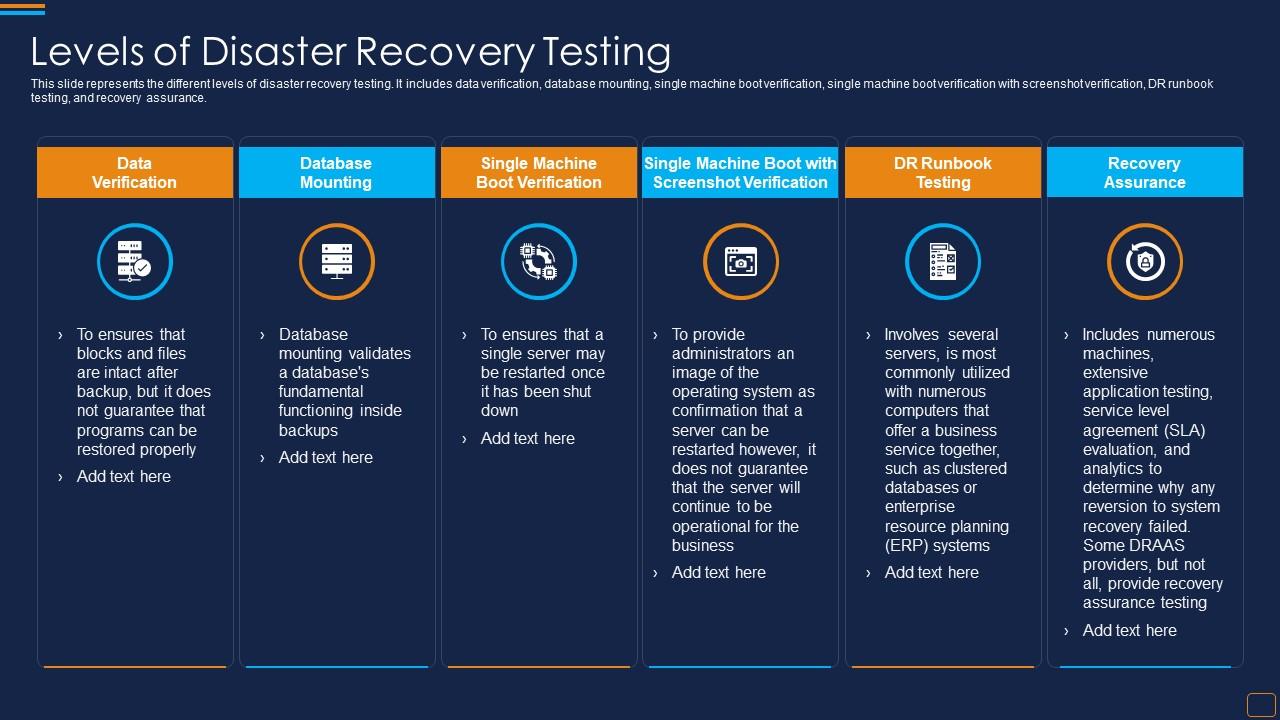
This slide represents the different levels of disaster recovery testing. It includes data verification, database mounting, single machine boot verification, single machine boot verification with screenshot verification, DR runbook testing, and recovery assurance.Increase audience engagement and knowledge by dispensing information using Levels Of Disaster Recovery Testing Disaster Recovery Implementation Plan This template helps you present information on six stages. You can also present information on Data Verification, Database Mounting, Single Machine Boot Verification using this PPT design. This layout is completely editable so personaize it now to meet your audiences expectations.

FAQs for Levels Of Disaster Recovery Testing Disaster

Disaster recovery testing objectives include validating recovery procedures, measuring recovery time objectives, ensuring data integrity, testing communication protocols, and identifying system vulnerabilities. Through simulated disaster scenarios, organizations streamline backup systems, minimize downtime costs, and enhance operational resilience, with many financial institutions and healthcare providers finding that regular testing delivers faster recovery times and improved business continuity.

Organizations should conduct disaster recovery tests at least quarterly, with critical systems tested monthly and full-scale exercises performed annually. Many financial institutions and healthcare organizations implement continuous testing approaches, rotating through different failure scenarios, business units, and recovery procedures throughout the year, ultimately ensuring comprehensive preparedness while minimizing operational disruption and maintaining regulatory compliance.

The most common disaster recovery tests include tabletop exercises, walkthrough tests, simulation tests, parallel tests, and full interruption tests. These testing methodologies enhance organizational preparedness by validating recovery procedures, identifying potential gaps, and ensuring business continuity protocols function effectively, with many organizations finding that regular testing significantly reduces actual recovery times during real incidents.

Determining disaster recovery test scope involves assessing critical business processes, identifying essential systems and data dependencies, evaluating recovery time objectives, and considering regulatory requirements and budget constraints. Organizations typically start with high-priority systems like financial databases or customer service platforms, with many finding that phased testing approaches enable comprehensive coverage while minimizing operational disruption and resource allocation challenges.

Data backup serves as the foundation for disaster recovery testing, providing the critical data sets needed to validate recovery procedures, test system restoration capabilities, and ensure business continuity protocols function effectively. Through regular backup verification and restore testing, organizations can identify potential data integrity issues, measure recovery time objectives, and confirm that essential business operations can resume seamlessly following disruptions.

Organizations ensure employee readiness during disaster recovery tests through comprehensive training programs, clear communication protocols, defined role assignments, and regular simulation exercises. These preparedness measures enable teams to respond effectively during actual emergencies, with many companies finding that hands-on practice sessions and documented procedures significantly reduce response times and improve coordination across departments.

Key disaster recovery test metrics include Recovery Time Objective (RTO) achievement, Recovery Point Objective (RPO) compliance, system functionality restoration rates, data integrity verification, and communication effectiveness scores. These measurements enable organizations to assess operational resilience, identify performance gaps, and optimize recovery procedures, with many financial institutions and healthcare systems finding that regular metric-driven testing significantly enhances their emergency response capabilities and regulatory compliance.

Essential disaster recovery testing documentation includes test plans, recovery procedures, system inventories, contact lists, and post-test reports. These documents streamline testing by establishing clear protocols, defining recovery steps, and capturing lessons learned, with many organizations finding that comprehensive documentation reduces recovery times, improves team coordination, and ultimately delivers more reliable business continuity capabilities.

Technology streamlines disaster recovery testing through automated testing frameworks, cloud-based simulation platforms, AI-driven scenario modeling, and real-time monitoring dashboards. These solutions enable organizations to conduct comprehensive tests more frequently and efficiently, while automated reporting and analysis help identify vulnerabilities faster, ultimately delivering improved preparedness and reduced downtime risks across critical business operations.

Common challenges during disaster recovery testing include incomplete documentation, insufficient testing frequency, resource constraints, data synchronization issues, and inadequate staff training on recovery procedures. Organizations often find that testing reveals unexpected dependencies between systems, outdated recovery time objectives, and coordination gaps across departments, ultimately highlighting the need for more comprehensive planning and regular updates to ensure business continuity.

Organizations maintain compliance during disaster recovery tests by implementing controlled testing environments, documenting all procedures thoroughly, and ensuring regulatory requirements remain intact throughout simulations. These structured approaches enable businesses to validate recovery capabilities while preserving data integrity, audit trails, and security protocols, with many financial services and healthcare institutions finding that regular compliance-focused testing ultimately delivers both operational resilience and regulatory confidence.

Past disaster recovery test failures reveal critical lessons including inadequate documentation, unrealistic testing scenarios, insufficient staff training, outdated recovery procedures, and poor communication protocols. These failures demonstrate that organizations must conduct comprehensive, realistic simulations regularly, maintain current documentation, and ensure cross-functional team preparedness, with many companies finding that regular testing ultimately delivers faster recovery times and minimized business disruption.

A tabletop exercise simulates disaster scenarios through structured discussions where team members walk through response procedures, identify gaps in current plans, and test communication protocols without actual system disruption. These collaborative sessions enable organizations across healthcare, financial services, and manufacturing to refine recovery strategies, clarify roles and responsibilities, and ultimately strengthen preparedness while minimizing costly downtime risks.

Cloud technology significantly transforms disaster recovery testing by enabling automated testing schedules, reducing infrastructure costs, providing scalable backup environments, and offering geographic redundancy options. Through cloud-based DR solutions, organizations can conduct more frequent testing with minimal downtime, simulate various disaster scenarios cost-effectively, and ensure faster recovery times, ultimately delivering enhanced business continuity and operational resilience.

Organizations tailor disaster recovery testing by conducting industry-specific risk assessments, implementing sector-appropriate compliance frameworks, and customizing recovery time objectives based on operational criticality. Financial services focus on transaction continuity testing, healthcare emphasizes patient data accessibility, and manufacturing prioritizes production line restoration, with many finding that targeted scenarios deliver more effective preparedness and regulatory alignment.

Ratings and Reviews

90% of 100
Review Form
Write a review
Most Relevant Reviews
  1. 80%

    by Mason Thompson

    Presentation Design is very nice, good work with the content as well.
  2. 100%

    by Duncan Berry

    The Designed Graphic are very professional and classic.

2 Item(s)

per page: