


Business continuity management powerpoint presentation slides





Try Before you Buy Download Free Sample Product
 Impress Your
 Audience
 100%
100% Editable
 Save Hours
 of Time


To analyze the risk and threats of your business use this business continuity management PowerPoint presentation slides. This resource inventory is content ready complete deck and available to download immediately. All the slides are completely customizable in terms of color, font, text, etc and can be edited as per your requirements. This business management framework PPT theme consists of a total of 52 slides and have various crucial slides like introduction, purpose, plan template, maintenance review, scope, prepare for your event, goals, emergency planning governance structure, emergency preparedness planning and management committee members, community care units, community care unit, prevention and mitigation, hazard identification, risk assessment, operational impact analysis, financial impact analysis, etc. This structural assessment PowerPoint presentation is a strong visual representation of your business scope and goals. It also shows how to be prepared for any emergency. So quickly download this business continuity framework PowerPoint presentation today and amaze your audience. Put forward your views with our Business Continuity Management Powerpoint Presentation Slides. They will acquire enhanced acceptability.
People who downloaded this PowerPoint presentation also viewed the following :
Content of this Powerpoint Presentation
Slide 1: This slide introduces Business Continuity Management. State Your Company Name and begin.
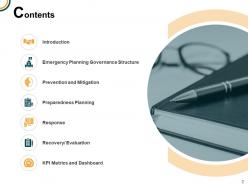
Slide 2: This slide shows Content of the presentation.
Slide 3: This is an Introduction slide with- Purpose, Plan, Maintenance Review, Scope, and Goal.
Slide 4: This slide presents Purpose to- ensure the safety and security of staff and visitors, facilitate a fully integrated multidisciplinary approach in event of external disaster, respond in timely and efficient manner, undertake the rescue operations, and to minimize losses.
Slide 5: This slide displays Plan Template with components as- Hazard Identification / Safety Assessment and Response Plan.
Slide 6: This is another Plan Template with- Response, Long Term Measures, Mitigation.
Slide 7: This slide displays Maintenance Review in tabular form.
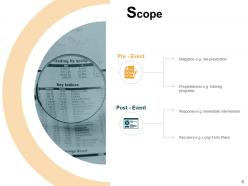
Slide 8: This slide represents Scope with Pre and Post event.
Slide 9: This slide showcases Prepare for your Event with categories as- Preparation, Pre Event, During Event, and Post Event.
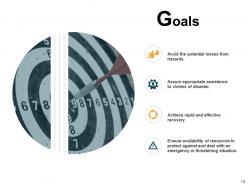
Slide 10: This slide shows Goals describing- Achieve rapid and effective recovery, Assure appropriate assistance to victims of disaster, Avoid the potential losses from hazards, Ensure availability of resources to protect against and deal with an emergency or threatening situation.
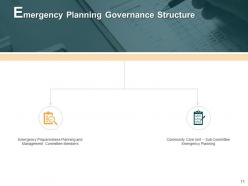
Slide 11: This slide presents Emergency Planning Governance Structure with related imagery.
Slide 12: This slide displays Emergency Preparedness Planning and Management Committee Members.
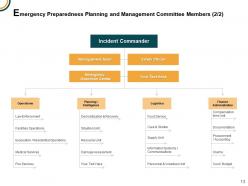
Slide 13: This is another slide for Emergency Preparedness Planning and Management Committee Members.
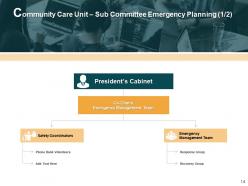
Slide 14: This slide represents Community Care Unit – Sub Committee Emergency Planning.
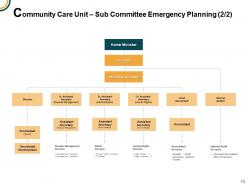
Slide 15: This is another slide for Community Care Unit – Sub Committee Emergency Planning.
Slide 16: This slide showcases Prevention and Mitigation describing- Operational Impact Analysis, Risk Assessments, Client Safety “Get Prepared” Guide, Financial Impact analysis, Hazard Identification.
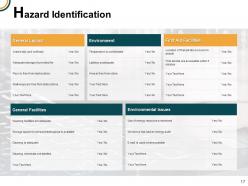
Slide 17: This slide shows Hazard Identification with the help of tables.
Slide 18: This slide presents Risk Assessment with levels from low to extreme.
Slide 19: This slide displays Operational Impact Analysis with- Low, Medium, High, Extreme likelihood.
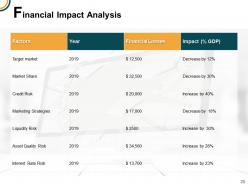
Slide 20: This slide represents Financial Impact Analysis describing factors, years, financial losses and impact.
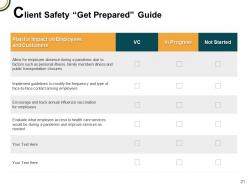
Slide 21: This slide showcases Client Safety “Get Prepared” Guide in tabular form.
Slide 22: This slide shows Preparedness Planning with related imagery.
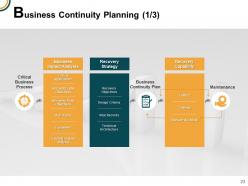
Slide 23: This slide presents Business Continuity Planning with related diagram.
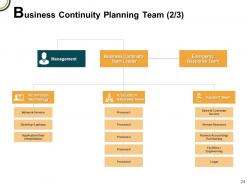
Slide 24: This slide displays Business Continuity Planning Team.
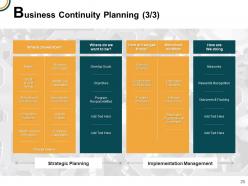
Slide 25: This slide represents Business Continuity Planning with- Strategic Planning and Implementation Management.
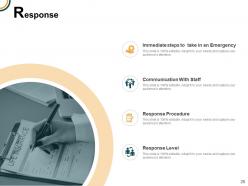
Slide 26: This slide showcases Response describing- Immediate steps to Take in an Emergency, Communication with Staff, Response Procedure, Response Level.
Slide 27: This slide shows Immediate Steps to Take in an Emergency.
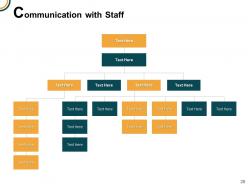
Slide 28: This slide presents Communication with Staff with the help of hierarchy chart.
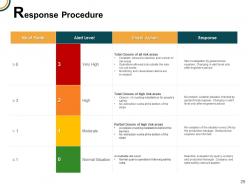
Slide 29: This slide displays Response Procedure with levels of alert.
Slide 30: This slide represents Response Level describing- Incident, Emergency, and Crisis.
Slide 31: This is another slide for Response Level describing- Potential or Actual Threat, Normal Operations, Event in Progress- Major Event, and In Progress - Response Activities required.
Slide 32: This slide showcases Recovery/ Evaluation with related imagery.
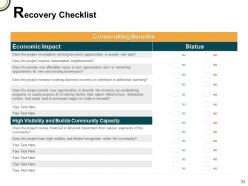
Slide 33: This slide shows Recovery Checklist with economic impact, high visibility and builds community capacity.
Slide 34: This slide displays KPI & Dashboards with related imagery.
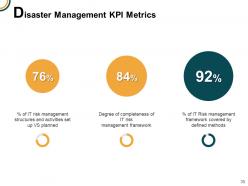
Slide 35: This slide represents Disaster Management KPI Metrics.
Slide 36: This slide showcases Disaster Management Dashboard Showing Risk Consequences Type.
Slide 37: This slide shows Disaster Management Dashboard Showing Risk Heat Map Risk Score.
Slide 38: This slide shows Disaster Management Dashboard Showing Risk Distribution by Business Process.
Slide 39: This slide presents Disaster Management Dashboard Showing Company Compliance and Risk Posture.
Slide 40: This slide displays Business Continuity Management Icons.
Slide 41: This slide reminds about 15 minute coffee break.
Slide 42: This slide shows Clustered Column chart with two products comparison.
Slide 43: This slide presents Combo Chart with three products comparison.
Slide 44: This slide is titled as Additional Slides for moving forward.
Slide 45: This is About our Company slide to show company specifications etc.
Slide 46: This is Our Mission slide with related imagery and text boxes.
Slide 47: This is Meet Our Team slide with names and designation.
Slide 48: This is a Timeline slide to show information related with time period.
Slide 49: This is a Puzzle slide with text boxes.
Slide 50: This slide is titled as Generate Idea to state a new idea or highlight information, specifications etc.
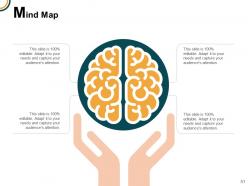
Slide 51: This slide shows Mind Map for representing entities.
Slide 52: This is a Thank You slide with address, contact numbers and email address.
Business continuity management powerpoint presentation slides with all 52 slides:
Use our Business Continuity Management Powerpoint Presentation Slides to effectively help you save your valuable time. They are readymade to fit into any presentation structure.
















FAQs for Business continuity management
Okay so you need four main things: risk assessment, business impact analysis, recovery strategies, and testing. Communication plans are huge too - I swear that's where everything falls apart for most places. Figure out your most critical stuff first, then build around that. Your recovery should cover IT and operations with timelines that actually make sense when everything's on fire. Oh and test regularly because what sounds good on paper usually doesn't work in reality. Don't forget response teams either.
Map out your business processes first, then rank them by what would screw you over most if they died. Revenue generators? Customer-facing stuff? Legal requirements you can't ignore? I always think of it like - if everything shut down tomorrow, what would make you panic first? Those are your priorities. Score each process based on money, compliance, and how pissed your customers would be. Keep it simple though, don't overthink the scoring system. Once you've got your ranked list, focus on the top 10-15 critical ones for your continuity planning.
Look, you can't build a solid BCM plan without knowing what could actually hurt you first. Map out your critical processes, then figure out what threats could mess with them - cyber stuff, natural disasters, supply chain issues, losing key people. Honestly, it's like being paid to worry about everything that could go wrong. Some risks will completely tank your business while others are just irritating. Once you've got that figured out, you'll know where to focus your energy and money. The whole thing falls apart if you skip this step though.
Map out who does what first - different scenarios need different people. Then run those tabletop exercises where everyone walks through their actual job when things go sideways. Honestly, most BCM plans just sit there collecting dust because nobody remembers their role when it matters. Get role summaries out quarterly (not just that yearly meeting where everyone's half-asleep). New people? Get them up to speed within a month. The repetition thing is huge - you can't just mention this stuff once and expect it to stick. Make the documentation readable too, not some 50-page manual nobody will touch.
Honestly, getting leadership on board is the worst part - they think it's just another box to check. Your team will hate the extra risk assessments at first (can't blame them). Budget's always tight too since this stuff competes with keeping the lights on. Oh, and good luck keeping everything updated when processes change every other week. I'd say pick one critical area to start with. Once you show it actually works there, people stop rolling their eyes when you mention business continuity. Then you can expand without everyone thinking you're the compliance police.
Honestly, tech makes BCM way less of a headache. Cloud backups are a no-brainer - your data stays safe even when everything else crashes. There's software that'll handle your response plans and run those disaster simulations (which you'd probably forget to do otherwise). Communication tools keep everyone in the loop during chaos. I'd start by figuring out where you're most vulnerable, then find specific solutions for those gaps. Oh, and monitoring systems are clutch for catching problems early. The automated testing stuff alone will save you tons of time.
Start with tabletop exercises - just sit around and talk through different disaster scenarios with your team. Way less stressful than jumping into the deep end. After that, try functional exercises where you actually test stuff like your backup systems or data recovery (this is where things get real). Full-scale drills are honestly the best way to find out what'll break, but they're a pain to coordinate. Oh, and throw in some random mini-tests during the year - keeps everyone on their toes. Work up from simple to complex gradually. Write down what goes wrong so you can fix your plans later.
Track your RTO/RPO achievement rates first - that's the real test when shit hits the fan. Drill participation and how fast you can get response teams moving are huge too. Don't forget business impact assessment completion rates because outdated plans are worthless. Mix leading indicators like training completion with lagging ones like actual recovery performance. Incident response times and stakeholder satisfaction after exercises give you the full picture. Honestly, stick to 5-7 metrics tops and review quarterly. More than that? You'll just get buried in spreadsheets without learning anything useful.
Yeah, once a year minimum but that's honestly cutting it close. Big changes should trigger updates right away - new office, key people leaving, different vendors, whatever. Some industries need quarterly reviews which is probably smarter anyway. The real trick is making it automatic instead of scrambling when something goes wrong. Nothing worse than realizing your contact list is totally wrong during an actual emergency. Set those calendar reminders now and make specific people own it, otherwise it'll never happen. Trust me on this one.
So it really depends on what industry you're in, but there's usually some legal stuff to follow. GDPR if you handle data, SOX for financial companies, HIPAA if healthcare's involved - you know the drill. Some places like the UK actually make you have formal business continuity programs. Banking has tons of operational resilience rules too, which honestly can be a pain. I'd probably start by figuring out what regulations hit your specific business first. Then build your continuity plan around those requirements. Oh, and document everything because auditors love their paperwork!
Look, ditch the annual PowerPoint death march. BCM training needs to be hands-on and regular. Quarterly tabletop exercises work great - have teams actually walk through what happens when systems crash or Sarah from IT suddenly quits. Most companies think everyone magically knows the plan until everything's on fire and people are running around like headless chickens. Focus on specific roles, not generic "continuity matters" fluff. Your incident response team especially needs to practice communicating during outages. Oh, and start with whatever keeps you up at night - those high-risk scenarios first.
Honestly, you want someone dedicated just to handle comms - like that's their only job when shit hits the fan. Figure out your chain of command now, not later. Templates are a lifesaver for different scenarios. I've watched companies completely destroy themselves by staying quiet or telling customers one thing while employees hear something totally different. Bad look. Keep everyone updated frequently and stick to the same story everywhere. Oh, and have backup ways to communicate since your main systems might be toast. The person running comms needs to focus solely on keeping people calm and informed.
Look for the overlap first - there's actually way more than you'd think. Risk assessments, incident response, recovery stuff all connect between BCM, ISO 27001, and ITIL. Your business impact analysis can feed right into ISO's security risk work. Same with incident management - just sync BCM with ITIL's service processes instead of doing everything twice. Honestly, shared docs and dashboards save so much time. Get your teams cross-trained on multiple standards rather than keeping everything separate. I've seen companies waste months duplicating work when they could've just mapped the common pieces upfront.
Honestly, remote work flipped business continuity planning on its head. Some stuff got easier - no more worrying about evacuating one office. But now you're dealing with scattered internet outages and Karen's dog barking through every crisis call (we've all been there). Mental health during disasters hits different when everyone's already isolated at home. Your team's naturally more spread out though, which is actually pretty resilient. Just test your collaboration tools regularly and have backup ways to reach people. Oh, and secure communication channels are non-negotiable now that everyone's working from their kitchen table.
Ok so first thing - grab a spreadsheet and list your 3-5 most critical business stuff. What could totally screw each one over? Don't get fancy with it. Cloud backups are cheap, train people to cover each other's jobs, and find backup suppliers before you need them. Most small biz owners make this way more complicated than it needs to be, honestly. Just make a simple one-page plan that people will actually follow when things hit the fan. Oh and pick one process this week - figure out what you'd do if it crashed tomorrow. You can build from there.
-
Presentation Design is very nice, good work with the content as well.
-
Very unique, user-friendly presentation interface.
-
Awesome presentation, really professional and easy to edit.