


Affirm Investor Funding Elevator Pitch Deck Ppt Template





Try Before you Buy Download Free Sample Product
 Impress Your
 Audience
 100%
100% Editable
 Save Hours
 of Time


Affirm is an emerging financial technology company that operates as a financial lender of installments loans to clients that can be utilized at a point for sale for purchase financing. Check out our professionally designed Affirm Investor Funding Elevator Pitch Deck. It serves as an effective tool in attracting investors by distilling the company into a condensed and marketable message for potential investors. The template covers slides about firm overview, huge commerce opportunity at online platform, ensuring coherent checkout experience, helping users in purchasing or merchants in converting more sales, deploying a platform for all transactions, etc. It represents winning factors associated to Affirm in terms of the extensive payment system, aligning business model, trusted brand, and proprietary technology and data system. The deck captures investors attention with slides about impressive consumer engagement metrics, a merchant associated with the firm, a value proposition to merchants, and diversified and potential relationships with investing partners. Customize this 100 percent editable template through assistance from our highly-skilled research or design team. Get access now.
People who downloaded this PowerPoint presentation also viewed the following :
Content of this Powerpoint Presentation
Slide 1: This slide introduces Investor Funding Elevator Pitch Deck. State Your Company Name and begin.
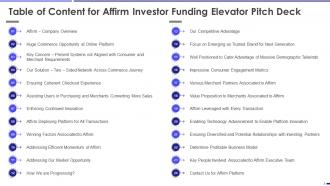
Slide 2: This slide presents Table of Content for the presentation.
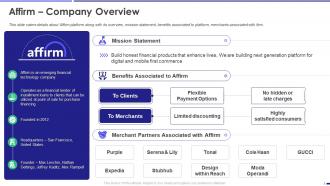
Slide 3: This slide caters details about Affirm platform along with its overview, mission statement, benefits, etc.
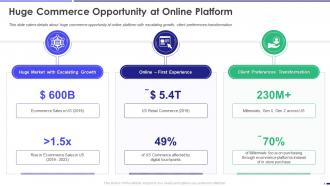
Slide 4: This slide displays Huge Commerce Opportunity at Online Platform.
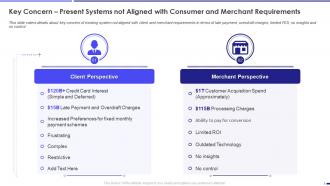
Slide 5: This slide represents details about key concern of existing system not aligned with client.
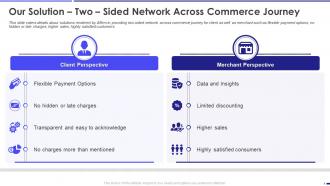
Slide 6: This slide showcases solutions rendered by Affirm in providing two-sided network across commerce journey.
Slide 7: This slide shows Affirm rendering coherent checkout experience.
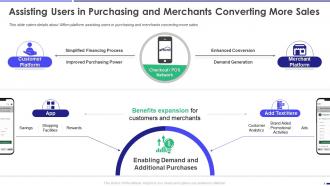
Slide 8: This slide presents platform assisting users in purchasing and merchants converting more sales.
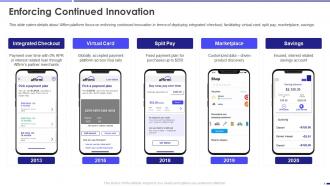
Slide 9: This slide caters details about Affirm platform focus on enforcing continued innovation.
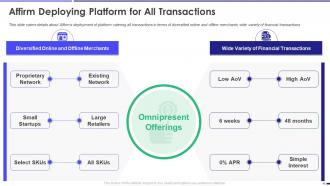
Slide 10: This slide displays Affirm Deploying Platform for All Transactions.
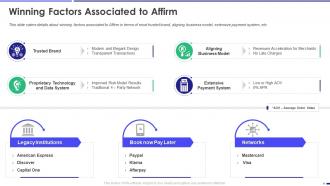
Slide 11: This slide represents winning factors associated to Affirm in terms of most trusted brand.
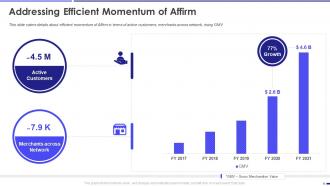
Slide 12: This slide showcases Addressing Efficient Momentum of Affirm.
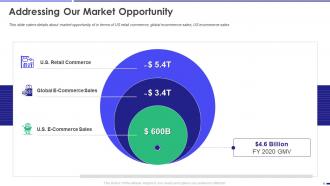
Slide 13: This slide shows market opportunity of in terms of US retail commerce, global ecommerce sales, etc.
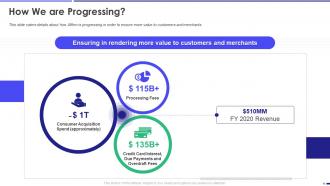
Slide 14: This slide presents how Affirm is progressing in order to ensure more value to customers and merchants.
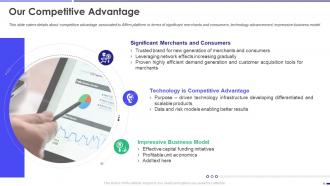
Slide 15: This slide displays competitive advantage associated to Affirm platform in terms of significant merchants.
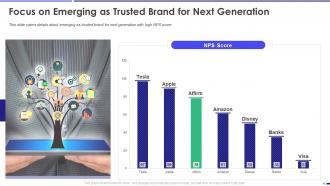
Slide 16: This slide represents Focus on Emerging as Trusted Brand for Next Generation.
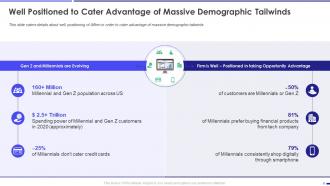
Slide 17: This slide displays Well Positioned to Cater Advantage of Massive Demographic Tailwinds.
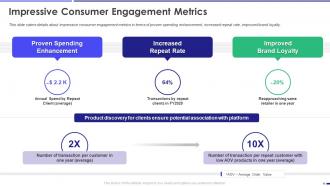
Slide 18: This slide represents Impressive Consumer Engagement Metrics.
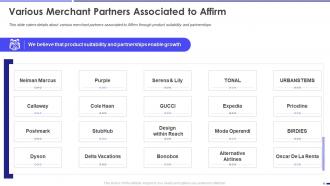
Slide 19: This slide showcases Various Merchant Partners Associated to Affirm.
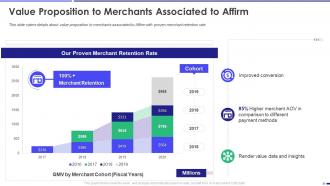
Slide 20: This slide shows Value Proposition to Merchants Associated to Affirm.
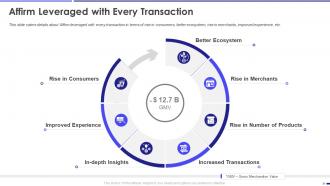
Slide 21: This slide presents Affirm leveraged with every transaction in terms of rise in consumers.
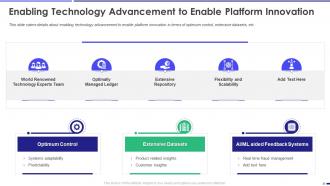
Slide 22: This slide displays Enabling Technology Advancement to Enable Platform Innovation.
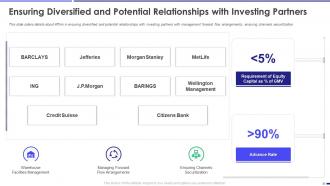
Slide 23: This slide represents Ensuring Diversified and Potential Relationships with Investing Partners.
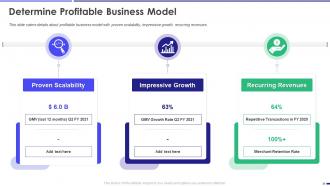
Slide 24: This slide showcases profitable business model with proven scalability, impressive growth, and recurring revenues.
Slide 25: This slide shows Key People Involved Associated to Affirm Executive Team.
Slide 26: This slide displays Icons for Investor Funding Elevator Pitch Deck.
Slide 27: This is Contact Us slide for Affirm Platform with address, contact numbers and email address.
Slide 28: This slide is titled as Additional Slides for moving forward.
Slide 29: This slide presents Roadmap with additional textboxes.
Slide 30: This slide provides 30 60 90 Days Plan with text boxes.
Slide 31: This slide contains Puzzle with related icons and text.
Slide 32: This slide shows Post It Notes. Post your important notes here.
Slide 33: This slide depicts Venn diagram with text boxes.
Slide 34: This is a Financial slide. Show your finance related stuff here.
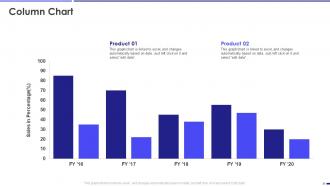
Slide 35: This slide displays Column chart with two products comparison.
Slide 36: This slide presents Bar chart with two products comparison.
Slide 37: This is a Thank You slide with address, contact numbers and email address.
Affirm Investor Funding Elevator Pitch Deck Ppt Template with all 42 slides:
Use our Affirm Investor Funding Elevator Pitch Deck Ppt Template to effectively help you save your valuable time. They are readymade to fit into any presentation structure.













FAQs for Affirm Investor Funding Elevator Pitch
Okay so you need the basics: problem, solution, market size, business model, traction, competition, team, financials, and your funding ask. Don't stress too much about order - just make sure it flows as a story. Keep it under 12 slides because honestly, investors zone out fast. Your problem/solution slides are absolutely critical though, so spend most of your time getting those right. Oh and definitely have backup slides ready for the appendix - they always ask follow-up questions you didn't expect. End with concrete next steps so they know exactly what you want from them.
Dude, skip the boring bullet points - nobody cares about feature lists. Tell a story instead. Show the actual problem your customers deal with, make investors feel that pain, then bring in your solution as the fix. I sat through a deck last week that was just charts and data points... wanted to fall asleep honestly. But when you drop in real customer stories and get emotional about it? That's when people put their phones down and actually listen. Try starting a slide with "Picture this..." and you'll see the difference. Stories stick way better than spreadsheets ever will.
Dude, two big ones I always see: way too much text crammed on slides, and founders jump straight into their solution without explaining the actual problem first. Like, slow down and make the pain point super obvious. Also avoid those crazy financial projections that make investors want to laugh you out of the room. Don't waste half your time on product features either - they care way more about market size and whether you have any real traction yet. Keep it visual, practice your timing so you're not speeding through the good stuff at the end. Oh and tell an actual story, not just bullet points.
Dude, you gotta tailor your pitch to what each type actually cares about. VCs? Hit them with growth numbers and market size - they want to see billion-dollar potential. Angels are more about backing YOU as a person, so emphasize your team and early wins. Strategic investors just want to know how you solve their headaches or fit their ecosystem. It's basically like dating - you wouldn't use the same approach on everyone, right? Research their previous investments first, then adjust your story. Oh, and don't completely change everything - same core pitch, just shift where you put the spotlight.
Dude, design matters SO much more than people think. Clean layouts with white space make your points pop - cluttered slides with tiny fonts will kill even the best pitch. I've watched solid startups bomb because their decks looked amateur. Stick to simple colors and high-quality images. Everything needs to be readable from across the room, obviously. Your design should back up your story without being distracting. Honestly? Think of it like having a silent partner up there with you. Poor visuals = investors mentally checkout, no matter how good your idea is.
Keep it to 8-10 minutes max, seriously. Investors zone out fast - I've seen people literally start scrolling Instagram during long pitches. You want them leaning in for more, not counting ceiling tiles. Hit your main stuff: the problem you're solving, your solution, market size, any traction you've got, team, and basic financials. That's it. Don't cram everything in there like you're writing a novel. Practice with a timer because running over just looks sloppy. Shows you can't figure out what actually matters. Leave 5 minutes for questions if they're interested enough to ask any.
Look, investors want to see real traction - so start with your user numbers like MAUs or DAUs, whatever fits your product best. Revenue metrics are gold if you've got them, plus your CAC and LTV ratios. Growth rate is probably the most important thing though - that upward trend gets VCs excited even at early stages. Oh and don't overwhelm them with like 15 different charts. Pick maybe 4-5 key metrics that actually tell your story and make the visuals clean. I've seen too many pitch decks where the slides are just cluttered messes.
Look, TAM/SAM/SOM is fine but don't just slap huge numbers on a slide thinking that'll wow people. What matters is showing you get the market and why your timing makes sense. I'd break it into actual segments and map out how you'll grab share - honestly, the "trillion dollar market" thing is so overdone. Focus on the real problem you're solving instead. Size that opportunity but be realistic about it. Prove there's demand through customer feedback or early sales. That beats generic market research every time.
Listen, investors need to see you actually get your market - they can smell the "we have no competition" BS from miles away. When competitors exist, it proves there's real demand worth going after. Your analysis should show what makes you different, not just list random companies. I'd keep it visual on one slide honestly. Investors want to know you've thought about positioning and won't be blindsided by challenges. The whole point is highlighting your unique advantages. Don't overthink it, but definitely don't skip it either.
Start with the problem you're solving and who you're solving it for - that's what really matters. Skip the jargon entirely (honestly, investors are so tired of hearing the same buzzwords). Try this format: "We help [specific customer] achieve [specific outcome] by [your unique approach]." Ask yourself "So what?" after every statement you write. Practice it out loud until it doesn't sound rehearsed. Here's the thing - if you can't explain your value in 15 seconds, it's too complicated. I know it's tempting to throw in everything you do, but one clear sentence beats a paragraph of fluff every time. Simplify until you can't anymore.
Look, investors want to see realistic revenue growth and how you'll actually make money. Cover 3-5 years with the basics - customer acquisition costs, lifetime value, burn rate. Honestly? Most early projections are wild guesses anyway, but that's totally fine. What really matters is showing you get your unit economics and can explain your thinking. Stick to maybe 4-5 key metrics instead of drowning them in spreadsheet hell (seriously, nobody wants that). The whole point is proving the math works and you've got a real plan to get there.
Honestly, customer stories are pure gold for your pitch. They prove your stuff actually works instead of you just saying it does. Investors have heard every BS claim in the book, but real testimonials? That's different. Always include actual numbers - "boosted sales by 40%" beats "customers loved it" every time. Keep them short and punchy too. Oh, and definitely lead with your biggest wins or most recognizable client names if you've got them. It's way more convincing than any fancy marketing speak you could come up with.
Honestly, you'll want to gather real market research and customer validation data before you pitch. Third-party reports work great, plus surveys that actually show demand. Competitive analysis with hard numbers is clutch too. Got any pilot results or testimonials? Those help a ton. Your revenue projections can't just be wishful thinking - base them on actual pricing models and realistic conversion rates. I've seen too many founders wing it with random stats, but investors spot fake data instantly. Oh, and stick to sources they'll recognize. Basically, every big claim needs solid proof behind it, so start collecting evidence now.
Do your homework first - dig into their portfolio and recent deals to get their vibe. Tech VCs want numbers and scale potential. Angels? They're more into your story and why you're passionate about this. Most pitch decks are drowning in buzzwords anyway (seriously, so annoying). Match their sophistication without being condescending. Got a tech-savvy investor? Industry terms are fine. Generalist? Keep it simple. Here's what actually works - test your tone on someone similar first. Maybe a friend in that space or another entrepreneur who's dealt with them. It'll save you from sounding either too casual or like a corporate robot.
Think through what they'll attack before you even walk in there. I always throw in a slide about "challenges we're facing" - investors actually respect the honesty more than you'd think. Hit the obvious stuff head-on: market size, competition, whether your team can actually pull this off. Keep extra slides handy for when they want to dig deeper into your numbers or tech specs. Oh, and practice with people who won't sugarcoat their feedback. Nothing worse than getting blindsided by a question you should've seen coming. The goal isn't avoiding objections - it's showing you've already thought about them.
-
Great templates that you can use in your next keynote or conference. They are perfect for quick and visually-engaging delivery.
-
A beautiful, professional design paired with high-quality images and content that is sure to impress. It is a must-use PPT template in my opinion.