


Agile And Waterfall Methodology Working Waterfall Project Management PM SS




Try Before you Buy Download Free Sample Product
 Impress Your
 Audience
 100%
100% Editable
 Save Hours
 of Time


Our Agile And Waterfall Methodology Working Waterfall Project Management PM SS are topically designed to provide an attractive backdrop to any subject. Use them to look like a presentation pro.
People who downloaded this PowerPoint presentation also viewed the following :
Agile And Waterfall Methodology Working Waterfall Project Management PM SS with all 9 slides:
Use our Agile And Waterfall Methodology Working Waterfall Project Management PM SS to effectively help you save your valuable time. They are readymade to fit into any presentation structure.








FAQs for Agile And Waterfall Methodology Working Waterfall Project
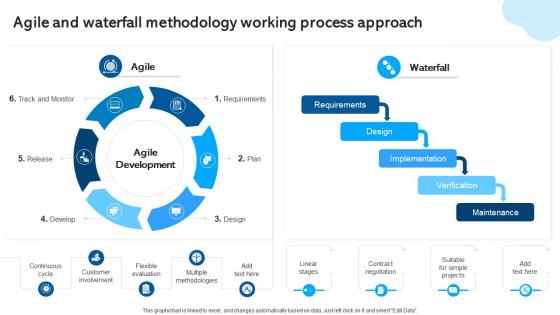
Agile emphasizes iterative development, continuous customer collaboration, adaptive planning, and cross-functional teams, while Waterfall follows sequential phases, comprehensive documentation, fixed requirements, and specialized roles. These contrasting approaches deliver different outcomes, with Agile enabling faster market responsiveness and flexibility, while Waterfall provides structured predictability and detailed planning, ultimately serving different organizational needs and project complexities.
Waterfall proves more beneficial in projects with fixed requirements, strict regulatory compliance, large-scale infrastructure development, or when working with distributed teams lacking Agile experience. Industries like aerospace, construction, and government contracting often find that Waterfall's structured phases, comprehensive documentation, and predictable timelines deliver better risk management and stakeholder confidence, ultimately ensuring regulatory adherence and measurable project outcomes.
Agile promotes continuous collaboration through daily standups, sprint planning, and cross-functional teams working together throughout development, while Waterfall follows sequential collaboration where teams work in isolation during specific phases. Agile's iterative approach enables real-time feedback, adaptive problem-solving, and shared accountability, ultimately delivering faster innovation and enhanced project outcomes compared to Waterfall's structured handoffs.
Agile methods typically deliver faster iterations and more flexible budget adjustments through shorter sprints and continuous feedback, while Waterfall provides more predictable timelines and upfront budget clarity through detailed planning phases. However, Agile often reduces overall project costs by catching issues early and adapting to changes, whereas Waterfall can face significant budget overruns if requirements change mid-project.
Transitioning from Waterfall to Agile requires gradual implementation through pilot projects, comprehensive team training, cultural mindset shifts toward collaboration, and establishing new feedback loops with iterative planning cycles. Organizations find success by starting with hybrid approaches, investing in Agile coaching, and restructuring communication processes, ultimately delivering faster project adaptability and enhanced stakeholder engagement across development teams.
Documentation in Waterfall projects is comprehensive and front-loaded, including detailed requirements, design specifications, and project plans before development begins. Agile emphasizes working software over extensive documentation, favoring lightweight artifacts like user stories, sprint backlogs, and retrospective notes that evolve continuously, with many development teams finding this approach accelerates delivery while maintaining essential project visibility.
Agile incorporates continuous customer feedback through iterative sprints, regular demos, and adaptive requirements gathering, while Waterfall relies on comprehensive upfront requirements collection with limited customer interaction during development phases. This fundamental difference means Agile projects can pivot quickly based on evolving customer needs, whereas Waterfall delivers predetermined specifications, with many organizations finding that Agile's responsive approach ultimately reduces project risks and enhances customer satisfaction.
Agile and Waterfall approaches fundamentally differ in risk management, with Agile enabling continuous risk identification and mitigation through iterative cycles, while Waterfall addresses risks through comprehensive upfront planning and structured phase gates. Agile's frequent deliveries and stakeholder feedback loops help teams quickly adapt to emerging risks, whereas Waterfall's sequential approach provides thorough documentation and predictable risk assessment, with many organizations finding that hybrid models effectively balance both methodologies' strengths.
Agile teams feature cross-functional roles like Scrum Masters, Product Owners, and self-organizing development teams with shared responsibilities, while Waterfall teams follow hierarchical structures with Project Managers, Business Analysts, and specialized developers working in sequential phases. These different approaches enable Agile teams to deliver faster iterations and enhanced collaboration, while Waterfall teams provide structured oversight and detailed documentation, with many organizations finding that role clarity ultimately determines project success.
Agile methodologies emphasize continuous metrics like sprint velocity, burn-down charts, and customer satisfaction scores, while Waterfall focuses on milestone completion rates, budget adherence, and final deliverable quality. Agile enables real-time performance tracking and rapid adjustments through iterative cycles, whereas Waterfall provides comprehensive end-to-end project visibility, with many organizations finding that combining both approaches delivers optimal transparency and strategic control.
Agile tools include Jira, Scrum boards, Trello, Azure DevOps, and Slack for iterative collaboration, while Waterfall relies on Microsoft Project, Gantt charts, SharePoint, and traditional documentation platforms. These technologies streamline project tracking by enabling real-time updates, resource allocation, and team coordination, with many organizations finding that tool selection significantly impacts delivery speed and stakeholder transparency.
Organizations scale Agile practices through cross-functional teams, iterative sprints, and continuous feedback loops, while Waterfall relies on sequential phases and centralized planning structures. Agile enables faster adaptation across departments by distributing decision-making and promoting collaboration, with many enterprises finding that iterative approaches deliver products more efficiently than traditional linear methods, ultimately enhancing responsiveness and competitive advantage.
Teams transitioning from Waterfall to Agile face challenges including cultural resistance to change, difficulty adapting to iterative planning cycles, struggles with cross-functional collaboration, and adjusting to continuous feedback loops. These implementation hurdles often involve retraining project managers, restructuring team dynamics, and shifting from detailed upfront documentation to adaptive planning, with many organizations finding that gradual adoption and strong leadership support ultimately delivers improved project flexibility and faster delivery cycles.
Agile implementations typically demonstrate higher project success rates than Waterfall, with studies showing Agile projects succeeding 64% of the time compared to Waterfall's 49%. This advantage stems from Agile's iterative feedback loops, adaptive planning, and continuous stakeholder engagement, while Waterfall's sequential approach can amplify early requirement errors, ultimately delivering greater flexibility and responsiveness in dynamic business environments.
Common misconceptions include believing Agile lacks documentation, requires no planning, or works for every project, while Waterfall is often viewed as inflexible, slow, or outdated for all scenarios. These methodologies each serve strategic purposes, with many organizations finding that Agile excels in dynamic environments requiring frequent adaptation, while Waterfall delivers efficiency for well-defined projects with stable requirements, ultimately enabling teams to choose approaches based on specific business contexts rather than universal preferences.
-
Informative design.
-
Commendable slides with attractive designs. Extremely pleased with the fact that they are easy to modify. Great work!