


Monthly Timeline For Waterfall Model Software Development Waterfall Project Management




Try Before you Buy Download Free Sample Product
 Impress Your
 Audience
 100%
100% Editable
 Save Hours
 of Time


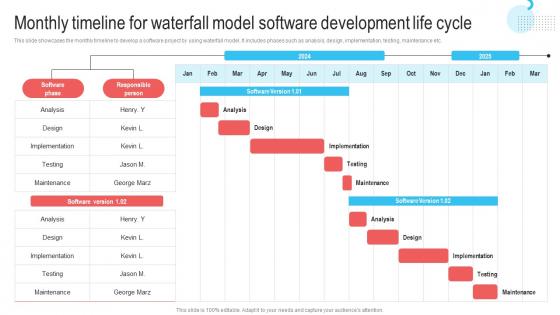
This slide showcases the monthly timeline to develop a software project by using waterfall model. It includes phases such as analysis, design, implementation, testing, maintenance etc.
People who downloaded this PowerPoint presentation also viewed the following :
Monthly Timeline For Waterfall Model Software Development Waterfall Project Management with all 6 slides:
Use our Monthly Timeline For Waterfall Model Software Development Waterfall Project Management to effectively help you save your valuable time. They are readymade to fit into any presentation structure.






FAQs for Monthly Timeline For Waterfall Model Software Development
So Waterfall has six phases you go through one by one: Requirements gathering, System design, Implementation, Testing, Deployment, and Maintenance. Can't skip around or go backwards - that's kinda the whole point. You've gotta finish each phase completely before moving on. There's tons of documentation, especially early on during requirements and design. Works great when you know exactly what the client wants from day one. But honestly? If they change their mind later, you're screwed because fixing stuff is a nightmare and costs a fortune.
So waterfall is super rigid - you do requirements, then design, then coding, then testing in that exact order. Can't really go backwards without major headaches. Agile's the opposite though, you work in these short sprints and constantly get feedback. Honestly, waterfall only makes sense if you know exactly what you're building from day one. Most projects aren't like that anymore. Agile lets you pivot when things change (and they always do). Really depends on how much uncertainty you're dealing with. Got crystal clear requirements? Maybe waterfall. Everything else? Go agile.
Honestly, Waterfall's perfect for stuff with rock-solid requirements that won't change - like government contracts or compliance projects where everything's locked down from day one. New teams love the clear structure too since there's no guessing what comes next. But skip it for anything innovative or customer-facing where things might shift around. Your stakeholders need to be the type who want tons of documentation and predictable timelines. The catch? You absolutely have to nail those requirements upfront. If there's even a chance they'll evolve, you're setting yourself up for pain later.
Look, the main thing is you get super clear structure - everyone knows what's happening when. Documentation is solid since you can't move forward until each phase is done, which is clutch for regulatory stuff. Stakeholders eat it up because they see exact milestones and budgets upfront. Yeah, it's rigid as hell, but honestly? For projects with stable requirements or experienced teams, especially in regulated industries, waterfall actually prevents way more problems than it causes. Short sentences work better here. The predictability alone makes it worth considering.
Honestly, Waterfall's main problem is how inflexible it is. Going backwards after you've finished a phase? Total nightmare and costs a fortune. Your requirements have to be perfect from the start, which - let's be real - almost never happens. Can't pivot when clients change their minds or the market shifts. Testing comes so late that if you find big problems, you might have to throw out months of work. Oh, and stakeholders get antsy because they won't see anything actually working until the very end. Just make sure your requirements are absolutely solid before you even think about using it.
Oh man, documentation in Waterfall is HUGE - like you can't even move forward without finishing all your docs first. Each phase has its own paperwork: requirements specs, design docs, test plans, the whole nine yards. It's honestly pretty tedious sometimes (feels like you're drowning in paperwork), but here's the thing - all that documentation becomes your lifeline later. Future maintenance? You'll thank yourself. Other developers joining the project? They'll actually know what's going on. Just plan for it to take forever because reviewing and writing this stuff eats up way more time than you'd expect.
For waterfall stuff, you'll need something that's good with sequential phases - Microsoft Project, Jira, or Asana are solid picks. They handle dependencies and timelines pretty well. Excel works fine too if you're not getting fancy with it, though it's obviously more basic. I'd actually go with whatever your team already uses because switching tools halfway through is such a pain. Monday.com and Smartsheet are decent options since they do Gantt charts without making you want to pull your hair out. Main thing is finding something that tracks progress step-by-step and spits out those reports that stakeholders always want.
Oh totally, Waterfall can work but you gotta bend it a bit. Break those huge phases down smaller and add feedback loops throughout - like client check-ins and prototype reviews. Some projects honestly still need that linear structure, especially in compliance-heavy stuff where documentation matters. Just don't get stuck on the "never go backwards" rule, that's kinda outdated now. You could even throw in some CI/CD during implementation. I'd probably try a hybrid approach first though - see what sticks. Way less risky than going full old-school Waterfall, you know?
Ugh, Waterfall and changing requirements? That's a nightmare combo. Once you move past the requirements phase, you can't really go back without major pain. Any changes become crazy expensive and mess up your whole timeline. I learned this the hard way on a project last year - we were locked into our original scope even when the client wanted tweaks. You end up having to redo completed work, which kills your budget. Short version: if there's any chance requirements might shift (and honestly, when don't they?), maybe look at something more flexible than Waterfall.
Don't use Waterfall if your requirements might change or aren't super clear from day one. Most software projects fall into this trap honestly - user needs shift constantly. Creative work? Forget about it. Fast-moving markets will eat Waterfall alive. Long projects need feedback loops, and Waterfall just... doesn't do that well. Teams that are figuring things out as they go will struggle big time. Got stakeholders who love changing their minds? (And let's be real, who doesn't?) Go Agile instead. Save Waterfall for those rare projects where requirements are genuinely set in stone.
So with Waterfall, you're basically stuck doing all your risk planning upfront during requirements. Once you move to the next phase, it's a nightmare to go back and deal with new problems that pop up. Everything gets documented early and you just cross your fingers it covers what happens later. Honestly, it's pretty inflexible - I've seen teams get burned when risks show up during testing and they can't easily pivot. My take? Go overboard on that initial risk analysis because you won't get many do-overs. It's old school but some places still use it.
Honestly, budget and timeline are the obvious ones - did you blow through your money or miss deadlines? But I'd also look at quality stuff like how many bugs you're finding and whether customers are actually happy with what you delivered. Scope creep is huge to track (though good luck avoiding it completely lol). Requirements traceability sounds boring but it's basically just checking you built everything you said you would. The trick is setting these benchmarks early so you're not scrambling later trying to figure out if things went well.
So with Waterfall, testing gets pushed to the very end after devs finish building everything. Pretty much means you're sitting around waiting for them to wrap up the whole system before you can even start. Quality assurance becomes this massive phase instead of happening throughout the project - which honestly feels backwards to me. Sure, you'll test a complete system, but finding big issues means backtracking through earlier phases. That gets pricey real quick. Better nail down your requirements and design super tight from the start, or you're gonna hate life later.
So phase gates are like checkpoints between waterfall stages - you need approval before moving on. Basically mandatory stop signs where stakeholders review your work and sign off. Can't go from requirements to design without passing through the gate first. They're super rigid compared to agile (honestly kind of a pain), but they do catch problems early before you build something totally wrong. The whole point is forcing everyone to actually document stuff and get aligned at each step. Fair warning though - once you're past a gate, backtracking gets messy and expensive fast.
Okay so with Waterfall you basically live or die by your upfront requirements - like, get everything nailed down before you start coding. Have stakeholders sign off on literally every detail, even the boring obvious stuff. Once development kicks off, any changes need to go through a formal review board that looks at timeline and budget impact. Your stakeholders might not love this, but they need to get that late changes = delays and way more money. Oh and set up checkpoints along the way to make sure you're still building what everyone originally wanted. It's honestly way less flexible than Agile but that's the trade-off.
-
Very unique and reliable designs.
-
I loved the hassle-free signup process. A few minutes and, I had this giant collection of beautiful designs.