


Agile project quarterly roadmap template for multiple teams




Try Before you Buy Download Free Sample Product
 Impress Your
 Audience
 100%
100% Editable
 Save Hours
 of Time


A cohesive work plan is essential for achieving the desired target. Communicate your vision and lay a firm ground in front of your audience with our PowerPoint layout. Align your project milestones, budgets, deliverables, deadlines, and all the requisite information for a dynamic presentation by employing this amazingly designed Agile Project Quarterly Roadmap Template For Multiple Teams. Maximize team efficiency and streamline a work plan efficiently by introducing our ready made roadmap PowerPoint theme. You can quickly establish coordination between different activities across the organization and present an insight to your colleagues by utilizing this useful business tool. Color code specific tasks, prioritize, and keep a close eye on the deadlines with the help of our eye catchy PowerPoint template. Download our Agile Project Quarterly Roadmap Template For Multiple Teams for excelling at productive management.
People who downloaded this PowerPoint presentation also viewed the following :
Content of this Powerpoint Presentation
Description:
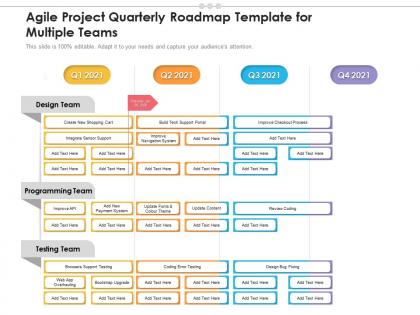
This image displays a PowerPoint slide titled "Agile Project Quarterly Roadmap Template for Multiple Teams." The slide is structured to present a roadmap of tasks and objectives laid out quarterly for different teams within a project.
The roadmap is divided into quarters (Q1 2021 to Q4 2021), with each quarter listing specific tasks for the Design Team, Programming Team, and Testing Team. For instance, in Q1 2021, the Design Team is to create a new shopping cart and integrate sensor support, the Programming Team is to improve API and add a new payment system, and the Testing Team is to ensure browsers support testing and perform web app overhauling.
Use Cases:
This slide can be used in various industries for tracking project progress, planning, and coordination among multiple teams. Here's how it can be applied:
1. Software Development:
Use: Planning and tracking software releases.
Presenter: Project Manager.
Audience: Developers, designers, testers.
2. Marketing:
Use: Outlining a marketing campaign's quarterly deliverables.
Presenter: Marketing Director.
Audience: Marketing teams, creative staff.
3. Construction:
Use: Mapping out phases of a construction project.
Presenter: Lead Architect.
Audience: Construction managers, contractors.
4. Healthcare:
Use: Implementing new healthcare IT systems.
Presenter: IT Project Manager.
Audience: IT staff, healthcare administrators.
5. Education:
Use: Deploying new educational technologies or curricula.
Presenter: Educational Technologist.
Audience: Faculty, instructional designers.
6. Automotive:
Use: Launching new car models or features.
Presenter: Product Manager.
Audience: Engineering teams, marketing teams.
7. Retail:
Use: Planning for new product launches and marketing strategies.
Presenter: Retail Operations Manager.
Audience: Product teams, sales teams.
Agile project quarterly roadmap template for multiple teams with all 2 slides:
Use our Agile Project Quarterly Roadmap Template For Multiple Teams to effectively help you save your valuable time. They are readymade to fit into any presentation structure.

FAQs for Agile project quarterly roadmap template
Key components include product vision, strategic themes, epics, features, release timelines, and success metrics. These elements work together by aligning development teams with business objectives, enabling stakeholder communication, and providing flexible planning frameworks, with many organizations finding that well-structured roadmaps streamline product delivery while maintaining adaptability.
An agile roadmap helps teams align with business objectives by providing strategic direction, clear prioritization frameworks, and regular alignment checkpoints that connect daily work to organizational goals. Through iterative planning and transparent communication, teams can adapt priorities based on market feedback, stakeholder requirements, and business performance metrics, ultimately delivering greater value and maintaining competitive advantage.
Key metrics for agile roadmap success include velocity tracking, sprint goal achievement rates, customer satisfaction scores, time-to-market improvements, and feature adoption rates. These measurements enable organizations to assess delivery efficiency, stakeholder value creation, and strategic alignment, with many teams finding that combining quantitative sprint data with qualitative customer feedback ultimately delivers enhanced product outcomes and competitive advantage.
Agile roadmaps should be reviewed quarterly and updated monthly, with major revisions occurring during sprint retrospectives, stakeholder feedback sessions, and market condition changes. This regular cadence enables development teams to respond to shifting priorities, incorporate customer insights, and maintain competitive advantage, with many organizations finding that frequent updates significantly improve product-market alignment and delivery outcomes.
Stakeholder feedback serves as the primary driver for agile roadmap prioritization, validation, and strategic direction, ensuring alignment between development efforts and business objectives. Through regular reviews, sprint demos, and continuous communication, organizations can adapt their roadmaps based on user needs, market changes, and strategic pivots, ultimately delivering higher value products while maintaining competitive advantage in rapidly evolving markets.
Teams prioritize features effectively by utilizing value-based scoring frameworks, stakeholder feedback analysis, business impact assessments, and user story mapping techniques. Through strategic combination of customer data, market research, and resource allocation models, organizations streamline decision-making processes, enhance product development cycles, and ultimately deliver higher customer satisfaction while maintaining competitive advantage in increasingly dynamic markets.
Tools best suited for visualizing agile roadmaps include Jira, ProductPlan, Aha!, Roadmunk, and Azure DevOps, along with collaborative platforms like Miro and Confluence. These solutions streamline sprint planning, feature prioritization, and stakeholder communication by enabling real-time updates, cross-functional visibility, and strategic alignment, with many development teams finding enhanced transparency and faster delivery cycles.
Agile roadmaps emphasize flexibility, iterative development, and adaptive planning rather than fixed timelines and rigid scope definitions found in traditional project plans. While traditional plans detail specific tasks and deadlines upfront, agile roadmaps focus on strategic themes and user outcomes, allowing teams to pivot based on feedback and changing market conditions, ultimately delivering greater responsiveness and customer value.
Common pitfalls include over-detailed planning, rigid timelines, stakeholder misalignment, lack of regular updates, and insufficient flexibility for changing priorities. These challenges can be minimized by maintaining strategic focus, establishing clear communication channels, and building in regular review cycles, with many organizations finding that quarterly roadmap refinements and cross-functional collaboration ultimately deliver better adaptability and stakeholder buy-in.
Agile roadmaps incorporate changes through regular sprint reviews, stakeholder feedback loops, and iterative planning cycles that allow for real-time adjustments. These flexible frameworks enable organizations to pivot strategies based on market shifts, customer insights, and competitive pressures, ultimately delivering more responsive products and maintaining competitive advantage in dynamic business environments.
**INPUT**: What techniques can be used to communicate the agile roadmap to non-technical stakeholders? **OUTPUT**: Effective communication techniques include visual storytelling through infographics, simplified timeline presentations, regular stakeholder demos, progress dashboards, and outcome-focused summaries that emphasize business value over technical details. These approaches streamline complex agile concepts by translating development milestones into tangible business outcomes, with many organizations finding that visual roadmaps and quarterly business reviews ultimately enhance stakeholder buy-in and strategic alignment. [Word count: 58 words]
Dependencies between teams significantly impact agile roadmap creation by requiring careful coordination of deliverables, shared resources, and timeline alignment across multiple workstreams. These interdependencies necessitate enhanced communication protocols, buffer time allocation, and strategic sequencing of initiatives, with many organizations finding that transparent dependency mapping and regular cross-team synchronization ultimately streamline delivery while minimizing bottlenecks.
Ensuring team buy-in for an agile roadmap requires transparent communication, collaborative planning sessions, regular feedback incorporation, clear role definitions, and consistent progress celebrations. Through inclusive workshops and iterative reviews, organizations streamline alignment across departments while enhancing ownership and accountability, with many teams finding that shared decision-making ultimately delivers stronger commitment and faster project execution.
An agile roadmap supports continuous improvement by providing structured feedback loops, regular retrospectives, iterative planning cycles, and data-driven decision points that enable teams to adapt quickly. Through these mechanisms, organizations streamline processes, enhance collaboration, and accelerate delivery timelines, with many finding that this approach ultimately delivers better customer experiences and sustained competitive advantage.
Best practices for agile roadmaps in cross-functional teams include establishing shared visibility through collaborative planning sessions, aligning diverse stakeholder priorities early, maintaining regular communication cadences, and creating flexible milestone structures that accommodate different team velocities. These approaches streamline coordination by reducing silos, enhancing transparency across departments, and enabling rapid pivots, with many organizations finding that integrated roadmaps ultimately deliver faster product iterations and stronger cross-team alignment.
-
Great product with highly impressive and engaging designs.
-
Excellent Designs.
-
Attractive design and informative presentation.
-
Great designs, really helpful.