


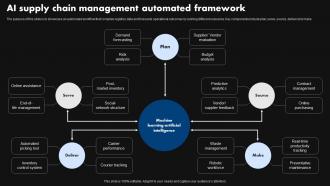
AI Supply Chain Management Automated Framework





Try Before you Buy Download Free Sample Product
 Impress Your
 Audience
 100%
100% Editable
 Save Hours
 of Time


The purpose of this slide is to showcase an automated workflow that compiles logistics data and forecasts operational outcomes by running different scenarios. Key components include plan, serve, source, deliver and make.
People who downloaded this PowerPoint presentation also viewed the following :
AI Supply Chain Management Automated Framework with all 6 slides:
Use our AI Supply Chain Management Automated Framework to effectively help you save your valuable time. They are readymade to fit into any presentation structure.





FAQs for AI Supply Chain
Honestly, start by mapping out what you're doing manually right now - that's where you'll see the biggest headaches. You'll need data pipelines to pull everything in, then automated training workflows that handle the model stuff. Validation systems are crucial too (learned that one the hard way). For deployment, you want infrastructure that can push models to production without you babysitting it. Oh, and monitoring dashboards are a lifesaver when things inevitably go sideways. Don't forget rollback capabilities because trust me, you'll need them. An orchestration layer basically runs the show and handles all the scheduling and dependencies between components.
So AI digs through all your old sales data and spots patterns you'd never catch - like how rainy weather boosts umbrella sales or holiday timing shifts. It crunches tons of variables at once, way more than regular forecasting. The smart part? It actually learns from when it screws up predictions and gets better each time. You can throw in outside stuff too - economic data, social media buzz, whatever. Honestly, I'd start with your most unpredictable products first since that's where you'll see the biggest difference. Those are usually the ones driving everyone crazy anyway.
So machine learning looks at your past sales data and figures out what you'll need and when. Way better than those crappy Excel formulas! The system keeps learning from new info, so it gets good at spotting demand spikes and which products are just sitting there. Plus it can factor in stuff like weather or promotions that you'd probably forget about. You'll want at least a year of solid sales data to start - honestly, the more you feed it, the better it works. Takes some of the guesswork out of ordering, which is nice.
So basically, AI analytics gives you a constant pulse on how your suppliers are actually doing - no more waiting for those quarterly check-ins that tell you nothing useful. You'll see delivery patterns, quality issues, financial red flags, all in real-time. The cool part? It spots problems brewing before they explode in your face. Look for your star performers too - the system will show you who's crushing it and how to work with them better. Honestly, just start with your top 5 suppliers and run predictive analytics on them. You'll notice the difference pretty fast.
Honestly? Data's gonna be your biggest pain point - it's scattered everywhere and way messier than you expect. Integration with current systems is brutal too. Your team will probably push back hard because nobody likes AI taking over their decision-making. Oh, and good luck finding people who actually get both supply chain stuff and AI tech. That skills gap is real. My take would be pick one tiny process first, nail some quick wins to show it works, then build from there. Way less overwhelming that way.
Yeah, so automation mostly changes jobs instead of just wiping them out. The boring stuff like data entry gets automated first. Your team ends up doing more strategic work - managing the AI systems, figuring out what all the data means, solving the weird problems machines can't handle yet. People freak out at first but honestly? It's way more interesting work. You do need to get your people trained up though - analytics, system management, that kind of thing. Oh, and creative problem-solving is huge. I'd start the training now before you're scrambling to catch up later.
Honestly, bias is probably your biggest headache - your AI might play favorites with certain suppliers based on wonky training data. The transparency thing is huge too. Nobody trusts a system they can't understand, and the "black box" problem kills stakeholder buy-in fast. Job displacement is obviously a concern when you're automating stuff people used to do. Oh, and you'll want to audit for bias pretty regularly - I've seen that bite companies hard later. Keep humans in the loop for big decisions. Trust me on that one.
So AI basically nails demand forecasting way better than we can, which means you're not stuck with tons of extra inventory rotting in storage. Routes get optimized automatically, inventory adjusts in real-time - honestly it's pretty wild how much transportation waste drops. The crazy part is it catches stuff you'd totally miss, like suppliers who always send crappy materials. Less waste obviously saves money too. I'd say start with whatever process is bleeding the most waste right now and see if AI can predict better results there.
RFID tags and IoT sensors are your best bet - they track everything in real time so AI systems can actually make smart decisions about inventory and shipping conditions. Blockchain keeps transaction records secure (honestly, it's pretty cool how tamper-proof it is). Your cloud platforms handle all the heavy data processing, while APIs connect different systems together. Without APIs, your AI is basically blind to half your supply chain data. Start by figuring out what data you're already collecting - you might have more than you think. Then see where these technologies fit in naturally.
So basically AI pulls data from all your sensors, RFID tags, and IoT devices throughout the supply chain. You get instant visibility into where everything is. Bottlenecks? You'll spot them before they wreck your day. It's honestly pretty wild - like having superpowers for tracking stuff. The algorithms will ping you about weird patterns and even suggest better routes automatically. Oh, and prediction is huge too - you can see delays coming from miles away. My advice? Figure out where you're most blind right now and start tracking there first. Don't try to do everything at once.
Look at cost savings first - you should see 10-20% reduction pretty quickly. Inventory turnover and order accuracy are huge too. The forecasting stuff is honestly where you'll see the biggest impact if it works well. Track how much faster everything runs compared to your old setup. Exception handling is key - aim for under 5% times when humans need to step in. That's the sweet spot. Set your baselines before you flip the switch, then check progress monthly. Makes it way easier to show leadership the ROI later. Speed improvements are usually the most obvious win people notice right away.
Three big things to nail down: encryption, access controls, and vetting your vendors. Everything needs to be encrypted - both when it's moving around and just sitting there. Supply chain data is juicy stuff (pricing, logistics) so don't mess around with that. Role-based access is clutch - people only see what they actually need. The vendor thing though? That's where most people screw up. You've gotta audit your AI providers constantly because one weak link kills everything. Oh, and map out your current data flows first - you'd be surprised how messy that gets.
You know Amazon's the obvious one - their warehouses are basically run by AI for everything from predicting demand to robots picking stuff and figuring out delivery routes. Walmart does similar things with inventory across all their stores. BMW uses AI to predict when machines will break before they actually do, which honestly saves them a fortune in downtime. Maersk completely changed shipping with AI container tracking and port stuff. Even Zara uses it to get fast fashion from concept to stores super quickly. I'd definitely check what the big players in your industry are doing though - you're probably missing some automation opportunities.
Honestly, start with demand forecasting tools - they're way cheaper than you'd think and don't need some massive IT team. Cloud-based AI platforms have packages made for smaller businesses that predict customer demand and automate reordering. Even basic AI crushes those Excel sheets most people are still stuck with (guilty as charged lol). Don't try automating everything at once though. Pick your worst bottleneck first. Tools like Llamasoft work great, or simpler stuff like Inventory Planner if you're just getting started. Warehouse layout optimization is huge too.
Dude, AI's about to completely change how supply chains work. You're looking at real-time demand forecasting and automated inventory - plus it'll catch supply disruptions before they actually mess up your operations. Most of this tech already exists, which is crazy. Autonomous warehouses are rolling out everywhere, AI handles logistics optimization, and systems automatically reroute shipments when problems hit. Honestly moves way faster than I expected. Look at where you're still making manual decisions in your supply chain - that's where you want to automate first.
-
Great product with effective design. Helped a lot in our corporate presentations. Easy to edit and stunning visuals.
-
The customer care of SlideTeam is very responsive. I was having a payment issue and they fixed it for me in no time.