


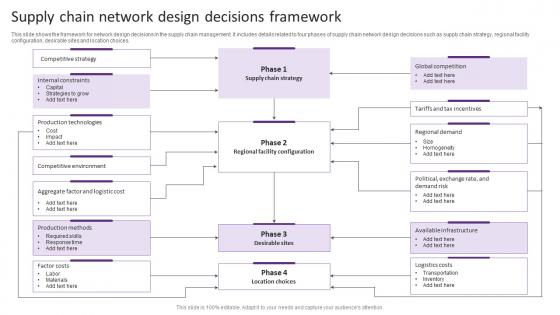
Supply Chain Network Design Decisions Framework




Try Before you Buy Download Free Sample Product
 Impress Your
 Audience
 100%
100% Editable
 Save Hours
 of Time


This slide shows the framework for network design decisions in the supply chain management. It includes details related to four phases of supply chain network design decisions such as supply chain strategy, regional facility configuration, desirable sites and location choices.
People who downloaded this PowerPoint presentation also viewed the following :
Supply Chain Network Design Decisions Framework with all 6 slides:
Use our Supply Chain Network Design Decisions Framework to effectively help you save your valuable time. They are readymade to fit into any presentation structure.





FAQs for Supply Chain Network
Honestly, start by figuring out where your customers are and how they buy - that's huge. Map out your suppliers, transportation costs, and what your facilities can actually handle. Regulatory stuff will absolutely screw you over if you skip it now, trust me. You've got to balance service levels against total costs while factoring in lead times. Build in flexibility too because demand shifts and disruptions happen. Natural disasters, political drama - all that matters more than people think. I'd map your current setup first, then run different scenarios to see what actually works for your constraints.
Honestly, where you put your distribution centers can totally make or break everything. Put them close to where most of your customers are and boom - way cheaper shipping costs plus faster delivery. Mess this up though? You're stuck paying crazy money for long-distance shipping and customers get pissed about late deliveries. I learned this the hard way at my last job actually. The trick is finding spots where your warehouse costs don't eat you alive but you're still positioned well for transport. Map out where your customers are clustered first, then work backwards from there.
You'll want to run scenario analysis to find that sweet spot - don't over-engineer just because you can. Define service targets for different customer segments first. Then model various network setups to see cost impacts. Most companies cut costs way too aggressively at first, which always bites them later. Test different warehouse locations, inventory policies, transportation modes with optimization tools. Here's where it gets interesting - segment products by velocity and margin. Fast movers can handle higher costs for better service. Also run sensitivity analysis on demand changes since networks need flexibility. The real magic happens with product segmentation honestly.
Honestly, AI can handle way more data than you'd ever want to sift through manually - demand patterns, shipping costs, supplier stats, all that stuff. It'll crunch thousands of scenarios super fast instead of you being stuck in Excel hell for weeks. The cool part is machine learning keeps getting smarter as new data comes in, so your network actually adapts on its own. My advice? Don't try to fix everything at once - that's a recipe for chaos. Figure out what's breaking the most right now and find tools that tackle those specific problems first.
Honestly, data analytics is a game-changer for network design - it takes your hunches and backs them up with actual numbers. Map out your current performance first, then dig into demand patterns, shipping costs, and where your customers actually are. This helps you figure out the best spots for warehouses and facilities. Running different scenarios is pretty smart too since you're not gambling with huge infrastructure investments. I'd also track supplier performance and spot bottlenecks before they become real headaches. The predictive stuff for future capacity is clutch - way better than scrambling later when you're overwhelmed.
For supply chain modeling, I'd go with AnyLogic or Arena - though honestly Excel with Monte Carlo add-ins works fine if you're just starting out. Map your current network first, then build scenarios around the usual suspects: demand swings, supplier issues, new warehouses, transportation headaches. Run thousands of iterations to see what breaks and what doesn't. Simple models are your friend here - they actually show you the big problems faster than fancy ones. Stick to metrics that actually move the needle: costs, service levels, risk. Don't overcomplicate it right away.
So basically, where you put your warehouses and how you ship stuff makes a massive difference for the environment. Longer routes = more fuel burned, which is pretty obvious when you think about it. I'd start by actually mapping out your current carbon footprint - that'll show you the worst offenders. Then focus on shorter shipping distances, find suppliers with green certs, and maybe switch to rail instead of trucks where it makes sense. Oh, and definitely set up reverse logistics for recycling returns. Consolidating shipments helps too. Honestly, locating near renewable energy sources is smart if you can swing it.
Honestly, global trends mess with your supply chain more than you'd think. Trade wars can make your Asian operations crazy expensive overnight. Consumer demand for sustainable stuff? Now you're scrambling to source locally and cut emissions. Currency swings are brutal too - what looked profitable last quarter might tank this one. Oh, and demographic shifts change everything - like how aging populations totally shift what people buy and where they buy it. The smart move is designing flexibility into your network upfront. That way you can adapt without starting from scratch every time the market throws you a curveball.
Hey! So basically you want to spread your suppliers around - don't put all your eggs in one basket. Build some extra capacity at the spots that matter most. Real-time tracking tools are clutch too. Most companies are obsessed with being "efficient" but honestly that just screws you when stuff breaks. Set up manufacturing that can switch between products fast, and make sure you've got multiple ways to get things to customers. I'd start by figuring out where you're most vulnerable and creating backups there first. A little redundancy now beats scrambling later.
So customer behavior data basically shows you where to put warehouses and how big they need to be. Map out your customer density first - that's where the magic happens. Look at buying patterns, when demand spikes seasonally, delivery preferences, all that stuff. It helps you spot the best locations for distribution centers. Honestly, it's way more interesting than it sounds - like SimCity but your mistakes cost actual money! The cool part is you can predict future demand shifts too, so you won't be stuck moving facilities later. Just start with order frequency and you'll see the gaps.
Most people mess up by only looking at current demand instead of what's coming down the pipeline. Transportation costs get crazy underestimated too. Don't just optimize for one thing - I've seen networks that had minimal facilities but shipping costs went through the roof. Risk planning is huge. Super-efficient setups sound great until one supplier goes down and everything breaks. Build in some backup even if it feels wasteful at first. Always run different demand scenarios and include every cost from the start. Sensitivity analysis on your main assumptions will save you headaches later.
Risk assessment has to be part of your network design from the start - can't just tack it on afterward. Map out what could go wrong first: natural disasters, suppliers going under, political stuff, crazy demand surges. Then test your network against those scenarios. COVID taught me that lesson the hard way! Diversify your suppliers, plan multiple shipping routes, maybe add some extra capacity in key spots. You're basically walking a tightrope between being cost-effective and not having everything fall apart when one thing breaks. Single points of failure will absolutely wreck you.
Dude, e-commerce basically broke the whole traditional supply chain thing. You used to ship huge orders to maybe a dozen stores, right? Now you're dealing with thousands of individual customers who all want their stuff tomorrow. Way more distribution centers needed, plus you've got to nail that last-mile delivery somehow. The old hub-and-spoke setup is pretty much dead at this point. Oh, and returns are a nightmare - like 3x higher than physical stores. Honestly, I'd start by figuring out where your customers actually live and build backwards from there. It's a whole different game now.
So here's the thing - partnerships let you split costs and risks instead of doing everything yourself. You get access to their supplier connections, can share shipping expenses, and see demand trends you'd never spot alone. Honestly? Way better than constantly putting out fires by yourself. Find partners whose strengths cover your weak spots - like if you suck at last-mile delivery, team up with someone who nails it. I'd start by figuring out where your biggest headaches are right now and hunt for partnership opportunities there. Makes life so much easier.
Honestly, start simple with like 3-4 key metrics that actually matter to your business. Cost per unit and total logistics costs are obvious ones. Service levels too - fill rates, delivery times, that stuff. Customer satisfaction is huge though, because who cares if you're efficient if people are pissed off at you? I'd also watch inventory turns and how well you handle demand spikes. Capacity utilization matters but don't get too in the weeds initially. Pick what aligns with your priorities first, then add more metrics once you've got those dialed in. Way easier than trying to track everything at once.
-
Their products can save your time, effort and money. What else you need. All in one package for presentation needs!
-
I want to thank SlideTeam for the work that they do, especially their customer service.