


AML Transaction Monitoring Open System Architecture For Anti Money Laundering




Try Before you Buy Download Free Sample Product
 Impress Your
 Audience
 100%
100% Editable
 Save Hours
 of Time


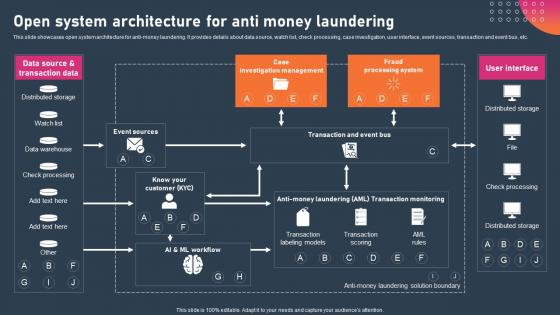
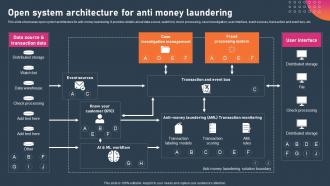
This slide showcases open system architecture for anti money laundering. It provides details about data source, watch list, check processing, case investigation, user interface, event sources, transaction and event bus, etc.
People who downloaded this PowerPoint presentation also viewed the following :
AML Transaction Monitoring Open System Architecture For Anti Money Laundering with all 6 slides:
Use our AML Transaction Monitoring Open System Architecture For Anti Money Laundering to effectively help you save your valuable time. They are readymade to fit into any presentation structure.





FAQs for AML Transaction Monitoring Open System Architecture For
Look for weird transaction patterns first - like someone depositing money then immediately pulling it out, or staying just under reporting limits (that's textbook structuring). Round numbers are sketchy too, honestly. Geographic stuff is big - sudden wires to risky countries or places that make no sense for them. Flag frequent cash deposits and anything with shell companies or politically connected people. If transactions don't match their normal behavior or have zero business purpose, that's your cue. Set up automatic monitoring but tweak your thresholds regularly based on what you're actually catching.
Honestly, ML is a game-changer for fraud detection. False positives drop like crazy, and it actually catches the sneaky stuff that rule-based systems totally miss. Train it on your historical data and it'll spot behavioral patterns that would take humans forever to notice. The cool part? It keeps learning and adapting - unlike those static rules that fraudsters figure out pretty quickly. Your compliance team will thank you since they won't be buried under useless alerts all day. I'd probably start with whatever transaction types you see the most volume on first, then expand from there.
For US stuff, you're looking at Bank Secrecy Act and USA PATRIOT Act mainly. EU has their 4th and 5th Anti-Money Laundering Directives if you're there too. FATF sets the global playbook that everyone basically copies from - though honestly, each country adds their own weird quirks. Canada's got PCMLTFA, UK has Money Laundering Regulations. It's kind of a mess when you're dealing with multiple countries. Figure out early which rules actually apply to you though, because monitoring requirements are all over the place depending where you operate.
So banks basically look at risk levels, regulations, and customer types when setting these thresholds. Cash transactions hit $10K because of CTR rules, but wire transfers and sketchy customers get way lower limits. The whole thing's a balancing act - you don't want to miss actual bad guys, but you also can't have your compliance team buried under a million pointless alerts every day. Most places do tiers where higher risk = lower thresholds. Honestly, I'd start by checking your current alert volume and tweaking from there. Focus on stuff that's actually suspicious, not just Mrs. Johnson's weekly grocery run.
Dude, CDD is literally everything for transaction monitoring. Without knowing your customers, you're just shooting in the dark. Say you've got solid data on someone's income, business stuff, normal spending habits - now your system can actually spot weird patterns instead of flagging random nonsense. Mrs. Johnson usually moves $500 a month, then boom - $50k transfer? That's worth a look. Bad CDD though? Either everything seems sketchy or nothing does, which honestly drives me crazy. Oh and don't forget to update those profiles regularly so your alerts actually mean something.
Stop treating everyone like they're suspicious - that's your biggest problem right now. Machine learning can cut down those annoying false positives where you're flagging grandma's grocery run as potential fraud. Set up real-time monitoring that clears normal stuff instantly. Risk-based segmentation is huge here. Your longtime customers shouldn't get the same scrutiny as brand new accounts, obviously. When you do need to investigate something, make it fast and painless - nobody wants to wait on hold for 20 minutes to verify their mortgage payment. Honestly? Start by checking your false positive rates first.
False positives are gonna drive you insane - your team will be drowning in useless alerts. Data quality is a nightmare too when you're pulling from different systems. Getting risk scoring dialed in takes forever. Real-time processing without crashes? Good luck with that integration mess. Oh, and your staff will constantly need retraining since everything changes so fast. Honestly though, fix your data foundation first. Clean, standardized data upfront saves you from like 90% of the headaches later when you're tweaking rules.
Honestly, you'll want to do quarterly updates minimum, but monthly reviews work way better. Criminals get creative fast - like, scary creative - so your detection needs to keep up. I'd set up a regular thing where you're checking false positives and tweaking thresholds based on your risk stuff. Also look at those regulatory alerts for new patterns. The whole point is staying ahead instead of playing catch-up after missing something sketchy. Maybe start with monthly reviews? Oh, and continuous monitoring beats everything if you can swing it.
So AML flags go off for stuff like big cash deposits, money jumping between accounts super fast, or transactions just below reporting limits - that's called structuring and it's sketchy as hell. Wire transfers to shell companies? Major red flag. Also watches for weird account behavior, like some dead account suddenly going crazy active or people doing transactions way outside their normal stuff. Payments to sanctioned countries obviously trigger alerts too. Honestly though, most of these end up being false alarms, so you gotta dig into each one to see if it's actually suspicious.
So basically, you can set up machine learning to watch transaction patterns and catch sketchy stuff automatically. Way better than checking everything by hand - that's just brutal. The algorithms actually learn as they go, which is honestly pretty neat. Start with your boring, high-volume transactions first since those are easy wins. You'll want rules-based scoring that looks at amounts, how often people transact, customer history, all that. Most places see false positives drop like 30-40%. The system gets smarter over time too, so it's worth the initial setup headache.
Look, data quality makes or breaks your transaction monitoring - garbage in, garbage out. Incomplete or outdated customer info means your system either misses sketchy stuff or drowns you in false alerts. Picture this: your records show someone's a broke college student, but they're actually running a business. Now every legit payment triggers warnings. Clean data helps spot real patterns and actual weird behavior. Oh, and audit that customer database regularly - trust me, it beats chasing down hundreds of pointless alerts later. Your future self will thank you.
So you'll want to track detection rates and false positive ratios - basically how many real suspicious activities you catch vs legitimate stuff getting flagged. Nobody wants analysts buried in alerts about normal transactions, trust me. Check your SAR filing quality and exam results too. Are you catching problems before regulators do? That's huge. Your alert-to-SAR conversion rate is a solid starting benchmark. Also look at detection coverage across different risk scenarios and how fast your team processes everything. The goal is efficiently spotting actual bad actors without drowning in noise.
Start with proper customer risk profiling - don't just use whatever generic industry settings came with your system. Your monitoring rules need to cover every transaction type and channel because fraudsters will absolutely find those gaps you missed. Training your analysts is critical; they've got to understand both the technology and what makes patterns actually suspicious. I'd say review your rules every quarter minimum, honestly. Tune the system based on your SAR outcomes and how many false positives you're getting. This isn't something you can set up once and walk away from - it's ongoing work that needs constant attention.
When Bank A catches a new money laundering scheme, they can tip off everyone else so you're all updating your detection rules together. That's huge for spotting stuff you'd miss alone. You can also cross-check transactions - something that looks normal by itself might expose a whole criminal network when other banks share their piece of the puzzle. Getting those data sharing agreements worked out is honestly such a headache though. Your analysts get better through joint training too. Set up partnerships with other institutions and jump into programs like FinCEN's 314(b). Trust me, the intel sharing makes your monitoring way stronger.
Yeah, false positives are seriously annoying in AML work. Your analysts end up wasting hours investigating totally normal customers while the actual sketchy stuff might slip through. It's like looking for a needle in a haystack, except someone keeps throwing more hay at you. When legitimate transactions get flagged, you're dealing with pissed off customers whose accounts got frozen for no reason. And honestly? Alert fatigue hits hard - analysts get so tired of seeing bogus alerts that they start rushing through everything. You've got to keep tweaking those monitoring rules to catch the real bad guys without drowning your team in garbage alerts.
-
Satisfied with the way SlideTeam resolved my query regarding the right business PPTs that I was having difficulty finding. I found the perfect match with their assistance.
-
Easily Editable.