

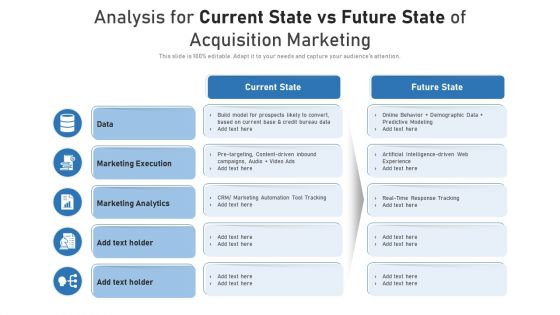
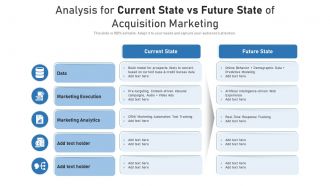
Analysis for current state vs future state of acquisition marketing




Try Before you Buy Download Free Sample Product
 Impress Your
 Audience
 100%
100% Editable
 Save Hours
 of Time


Our Analysis For Current State Vs Future State Of Acquisition Marketing are topically designed to provide an attractive backdrop to any subject. Use them to look like a presentation pro.
People who downloaded this PowerPoint presentation also viewed the following :
Analysis for current state vs future state of acquisition marketing with all 2 slides:
Use our Analysis For Current State Vs Future State Of Acquisition Marketing to effectively help you save your valuable time. They are readymade to fit into any presentation structure.
FAQs for Analysis for current state vs future state
Focus on the metrics that actually move the needle - CAC, conversion rates, ROAS, and your LTV:CAC ratio (shoot for 3:1 or higher). Cost per lead and time to conversion are solid indicators too. Break these down by channel because social will perform totally different from email. Most people get obsessed with vanity stuff like impressions, which is kinda pointless honestly. What matters is profitable growth. Oh, and don't try to track everything at once - start simple with these core ones then build from there. You'll thank yourself later.
So instead of blasting the same message to everyone, segmentation lets you actually speak to what different groups care about. Budget-conscious millennials need totally different messaging than high-income professionals - seems obvious but most people skip this step. You'll get way better conversion rates when your ads and landing pages hit the right pain points. Your cost per acquisition drops too since you're not wasting money on irrelevant messaging. Honestly, just start simple. Look at your current customers and find 3-4 clear groups, then build separate campaigns for each. Game changer.
Honestly, A/B testing is a game changer for acquisition stuff. Test different ad copy, headlines, landing pages - whatever you want. Just don't test everything at once or you'll have no clue what actually worked. I usually start super simple, like two email subject lines. Run it until you get enough data that actually means something (my boss always rushed this part and got garbage results). Once you know which one wins, scale that version. The numbers don't lie, even when your gut feeling was totally wrong about what would perform better.
Honestly, it's all about where your people actually spend time scrolling. LinkedIn works great for B2B lead gen, but if you're selling clothes or whatever, Instagram and TikTok are where the magic happens - people literally buy stuff right from those posts. Industries like healthcare have to be super careful with regulations, so they focus more on educational stuff first. Retail brands though? They get to do all the fun influencer collabs and user content. Some of those campaigns are actually pretty brilliant. Just figure out which platform your audience uses most, then match your content style to how people talk there.
Okay so first thing - your headline needs to scream "what's in it for me?" Make it crystal clear what they're getting. Break up your copy with bullets and short paragraphs because honestly, people's attention spans are shot these days. Your CTA button should be super specific like "Start My Free Trial" not some boring "Submit" nonsense. Oh, and kill the navigation menu so they can't bounce around your site. A/B test those headlines first - I can't stress this enough, they'll make or break you. Whatever brought them there (ad, email, whatever), your page messaging better match it exactly.
ROI is net profit divided by acquisition spend, times 100. So $10k spent, $15k in customer lifetime value = 50% ROI. The real pain is figuring out your attribution window though - 30 days? 90? I always go with 90-day revenue because waiting for full LTV takes forever. Track cohorts by channel too. Your Facebook campaigns might be killing it while Google's basically burning money. Oh and get UTM tracking set up first - without it you're just throwing darts blindfolded. Trust me on that one.
Start with Google Analytics and Google Ads - you can't really do digital marketing without those two. Facebook Ads Manager too if you're doing social stuff. Once you get the hang of those, Mixpanel or Amplitude are solid for tracking what users actually do on your site. I'm probably biased but I really like HubSpot for connecting everything to sales data, though Salesforce works too if your company's already using it. The tools don't matter as much as making sure they actually sync up properly. That's where most people mess up honestly. Build your stack slowly and fill in gaps as you find them.
Seasonal trends can totally screw up your campaigns if you're not watching. Pull last year's monthly data first - you'll probably see patterns like CAC spiking during Black Friday (everyone's bidding like crazy) or conversion rates tanking in summer. January's usually gold though - people love that "new year, new me" energy. I'd map this against your upcoming calendar, then shift budget away from dead months toward your peak times. Like if summer typically drops 30%, why burn cash then? Scale back and dump that money into months that actually convert.
Honestly, most people mess up by going way too broad with targeting. You're probably doing it too. Track cost per acquisition instead of getting excited about impressions - that stuff doesn't pay the bills. Don't dump everything into Facebook ads either, they get expensive fast. Oh, and set up attribution tracking right away or you'll be guessing which campaigns actually make money. I learned this the hard way lol. Focus on lifetime value over flashy metrics and you'll actually see what's working.
Here's the thing about content marketing - it works best when you create stuff people actually want to read, then make sure they can find it through Google or social media. Map everything back to getting customers though. SEO blog posts should target keywords your audience searches for. Lead magnets work great if you gate them behind email signups. Don't just publish random content and pray something sticks (I've seen too many companies do this). Every piece needs a clear next step - whether that's a CTA, a form, or whatever. Track what actually drives signups and sales. Oh, and definitely audit your existing content first to see what's already working.
Honestly, start with your CAC and LTV numbers - that's your foundation. From there, think about your audience size and what competitors are spending. Creative costs add up way faster than you'd expect, trust me on that one. You'll need room for testing too since nobody gets it perfect right away. Seasonal stuff can mess with your CPMs big time. I always tell people to add a 20-30% buffer for optimization and those random spikes that come out of nowhere. Oh, and don't just go with your gut - base everything on actual data but leave space to pivot when things don't work out.
Dude, customer feedback is like gold for acquisition marketing. You can figure out which channels actually convert people vs the ones that just burn budget. Most teams I know just wing it instead of asking customers what made them buy - big mistake honestly. Survey your recent customers about what caught their attention first. Which touchpoints pushed them over the edge? That intel helps you tweak your messaging and ad creative. Plus you might discover channels you never thought of. It's basically your cheat sheet for what actually works in the real world.
Look at which channels are actually bringing in your best customers first - the ones who stick around and spend more. Then just dump more money there instead of spreading it thin everywhere. Referral programs work crazy well too since people trust their friends way more than random ads. Your landing pages probably suck (most do), so fix those to convert better from traffic you're already getting. Sometimes that's way easier than chasing new visitors. I'd honestly just audit what's working now and stop wasting cash on channels that look good on paper but don't deliver for your specific business.
Honestly, data analytics is a game-changer because you'll actually know what's working instead of throwing money at random campaigns. Set up attribution tracking first - that's where you see the whole customer journey from their first click to buying. You can spot which audiences convert best and when they're most likely to purchase. Real-time testing means you can kill underperforming ads fast. The predictive stuff is pretty neat too - it flags prospects who are actually worth pursuing. I probably should've mentioned this earlier, but don't sleep on identifying your highest-value segments. Saves you from wasting budget on people who'll never convert.
Dude, just be straight with people - no sketchy tricks or fake urgency timers that manipulate them into buying. Get real consent before grabbing their data. Be upfront about pricing and what they're actually getting. I've watched so many companies torpedo themselves with shady stuff that works for like a month then backfires spectacularly. Also, don't spam random people who'll never buy anyway - waste of everyone's time. Target people who actually want your thing. Quick test: look at your current ads and ask yourself if you'd be annoyed getting them. If yes, fix it.
-
Unique research projects to present in meeting.