


Analysis of consumers perception towards dairy products case competition complete deck




Try Before you Buy Download Free Sample Product
 Impress Your
 Audience
 100%
100% Editable
 Save Hours
 of Time


In todays world of increasing competition, where numerous brands sell the same products, consumers have abundant choices, and many different factors affect their buying behavior. Consumer perception towards dairy products can be positive and negative, which are affected by the companys strategies. Here is a professionally designed pitch deck on Analysis of Consumers Perception towards Dairy Products to resolve all the issues faced by the industry. This will help the companies identify the new strategies, recommendations, and solutions to overcome the challenges, i.e. the decline in dairy product sales due to customers perception of dairy products. These strategies might help the company to positively shift the customers perception towards the companys dairy products and help boost the sales of the products. Using graphs and charts, one can mention total worldwide sales of their dairy product companys sales, revenue, and other elements data. This pitch deck covers company revenue and market share after successfully implementing the plan. It also covers the financial forecasts with dairy products sales forecasts for the next five years and dashboards related to dairy companies. Download the pitch deck and connect with us now. Talk to our experts for all your queries and access the pitch deck for consumer perceptions towards dairy products.
People who downloaded this PowerPoint presentation also viewed the following :
Content of this Powerpoint Presentation
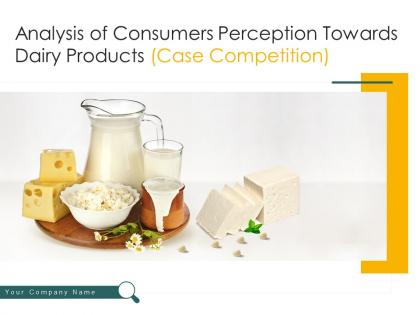
Slide 1: This slide introduces Analysis of Consumers Perception Towards Dairy Products. State Your Company Name and begin.
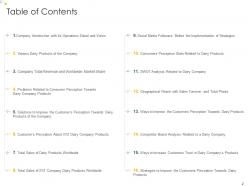
Slide 2: This slide shows Table of Content for the presentation.
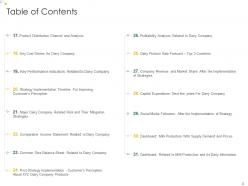
Slide 3: This is another slide continuing Table of Content for the presentation.
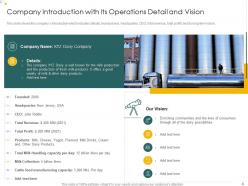
Slide 4: This slide shows the company’s introduction which includes details, founded year, headquarter, etc.
Slide 5: This slide presents Various Dairy Products of the Company.
Slide 6: This slide displays Company Total Revenue and Worldwide Market Share.
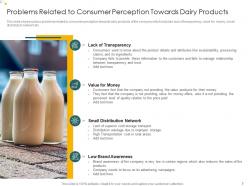
Slide 7: This slide shows various problems related to consumer perception including lack of transparency, value for money, small distribution network etc.
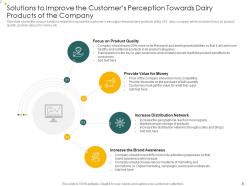
Slide 8: This slide represents Solutions to Improve the Customer’s Perception Towards Dairy Products of the Company.
Slide 9: This slide shows the various solutions related to improve the customer’s perception towards dairy products.
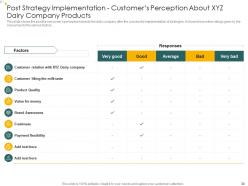
Slide 10: This slide presents Customer’s Perception About XYZ Dairy Company Products.
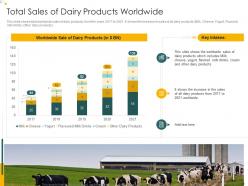
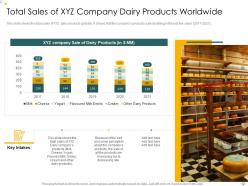
Slide 11: This slide displays total worldwide sales of dairy products.
Slide 12: This slide represents the total sales of XYZ dairy products globally.
Slide 13: This slide shows Social Media Followers: Before the Implementation of Strategies.
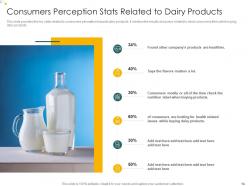
Slide 14: This slide provides the key stats related to consumers perception towards dairy products.
Slide 15: This slide shows the strength, weakness, opportunity and threats related to dairy company.
Slide 16: This slide presents Geographical Reach with Sales Turnover and Total Plants.
Slide 17: This slide displays Ways to Improve the Customers Perception Towards Dairy Products.
Slide 18: This slide represents Competitor Brand Analysis: By the Company’s Operations.
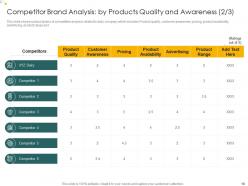
Slide 19: This slide shows various factors of competitive analysis related to dairy company.
Slide 20: This slide presents various factors of competitive analysis including Management, organizational structure, etc.
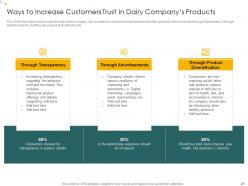
Slide 21: This slide displays Ways to Increase Customers Trust in Dairy Company’s Products.
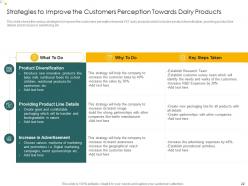
Slide 22: This slide represents Strategies to Improve the Customers Perception Towards Dairy Products.
Slide 23: This slide shows Product Distribution Channel and Analysis.
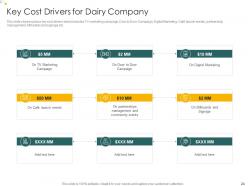
Slide 24: This slide presents Key Cost Drivers for Dairy Company.
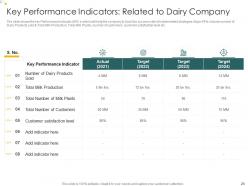
Slide 25: This slide shows Key Performance Indicators: Related to Dairy Company.
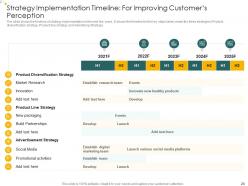
Slide 26: This slide represents Strategy Implementation Timeline: For Improving Customer’s Perception.
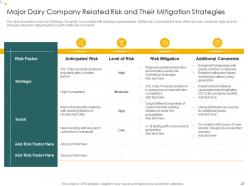
Slide 27: This slide shows Major Dairy Company Related Risk and Their Mitigation Strategies.
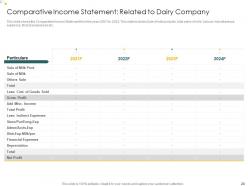
Slide 28: This slide shows Comparative Income Statement: Related to Dairy Company.
Slide 29: This slide presents Common Size Balance-Sheet: Related to Dairy Company.
Slide 30: This slide displays the positive consumer’s perception towards the dairy company after the successful implementation of strategies.
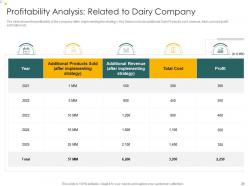
Slide 31: This slide shows Profitability Analysis: Related to Dairy Company.
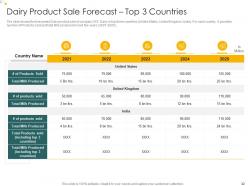
Slide 32: The slide represents the forecasted Dairy product sale of company XYZ Dairy in top three countries.
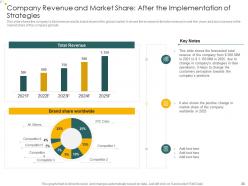
Slide 33: This slide shows Company Revenue and Market Share: After the Implementation of Strategies.
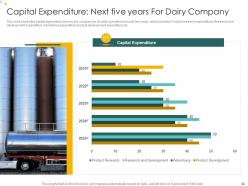
Slide 34: This slide presents the capital expenditure done by the company for its daily operations for next five years.
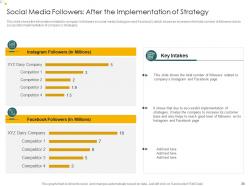
Slide 35: This slide displays Social Media Followers: After the Implementation of Strategy.
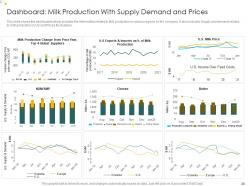
Slide 36: This slide shows Dashboard: Milk Production With Supply Demand and Prices.
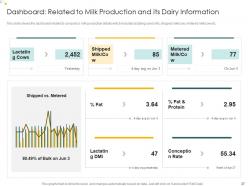
Slide 37: This slide represents the dashboard related to company’s milk production details.
Slide 38: This slide shows Analysis of Consumers Perception Towards Dairy Products Icons.
Slide 39: This slide is titled as Additional Slides for moving forward.
Slide 40: This is About Us slide to show company specifications etc.
Slide 41: This slide displays Column chart with two products comparison.
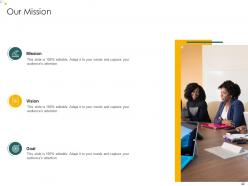
Slide 42: This is Our Mission slide with related imagery and text.
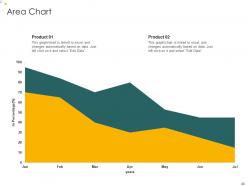
Slide 43: This slide displays Area chart with three products comparison.
Slide 44: This slide shows Post It Notes. Post your important notes here.
Slide 45: This slide represents Puzzle with related icons and text.
Slide 46: This slide shows Roadmap with text boxes.
Slide 47: This slide represents Venn diagram with additional textboxes.
Slide 48: This is a Timeline slide. Show data related to time intervals here.
Slide 49: This is Our Goal slide. State your firm's goals here.
Slide 50: This is a Thank You slide with address, contact numbers and email address.
Analysis of consumers perception towards dairy products case competition complete deck with all 50 slides:
Use our Analysis Of Consumers Perception Towards Dairy Products Case Competition Complete Deck to effectively help you save your valuable time. They are readymade to fit into any presentation structure.















FAQs for Analysis of consumers perception towards dairy products case
Honestly, it comes down to three main things. Reviews are huge - people check Google, scroll through your socials, ask friends. Everything creates this overall vibe about your brand. Speed matters too when stuff goes sideways online. Don't leave people hanging because silence looks sketchy. Your brand story helps, but people have BS detectors now - authenticity isn't just nice to have, it's survival. I mean, fake reviews and corporate speak? Dead giveaway. Focus on getting real positive feedback and actually responding when problems pop up. Quick responses can turn disasters into wins sometimes.
Dude, packaging is HUGE for sales decisions. It's literally the first thing people see on the shelf. Colors and fonts hit you emotionally before you even think about it - makes stuff look expensive or cheap instantly. I'm totally guilty of buying random products just because they looked sleek lol. But the practical stuff matters too. Good spacing and clear info help shoppers figure out what you're selling fast. If you're redoing your packaging, definitely test it in actual stores with real people. Something that looks amazing in your office might completely disappear next to competitors.
Dude, social media reviews are huge for how people see your stuff before buying. Trust me on this - I check reviews for literally everything, even toothpaste sometimes lol. People believe other customers way more than ads these days. One bad review going viral can totally wreck your reputation overnight. Volume matters, but so does how recent the reviews are and the overall vibe. You've gotta stay on top of monitoring what people say across platforms. Respond fast when complaints pop up, and don't forget to ask happy customers to actually leave reviews. It's basically word-of-mouth but amplified like crazy.
Honestly, quarterly brand surveys are your best bet - maybe twice a year if money's tight. Ask the same questions each time about awareness and how people feel about you, otherwise you can't track changes. Social listening tools are amazing for catching real conversations about your brand as they happen. NPS surveys help with the loyalty piece too. Pick your metrics early and don't switch them up constantly or you'll never see patterns. Oh and definitely set up some kind of dashboard to visualize everything - way easier than staring at spreadsheets all day.
Dude, storytelling changes everything for how people see brands. Instead of being just another company selling stuff, you become something they actually give a damn about. Look at the brands you remember - bet it's because of their story, not their product features. Stories stick in people's heads way better than specs do. They make customers feel like they're part of something bigger. Honestly, it's probably the easiest way to stand out when everyone's competing on price. Find your authentic stories first - maybe how you started, crazy customer wins, or what you're actually trying to change in the world. That's your gold right there.
Dude, culture totally changes how people read your marketing stuff. Like, Americans might love a hard sell, but try that in Japan? You'll come off as super aggressive since they're all about being subtle. Colors mean different things, humor doesn't always translate - I learned this the hard way once. Family values, communication styles, even symbols hit people completely different depending where they grew up. Those generic global campaigns usually bomb because they ignore this stuff. Short version: do your homework on each market or you're basically shooting in the dark.
Dude, start with social proof - testimonials and reviews are everything because people just copy what others do. There's also this thing called the halo effect where if someone likes one part of your product, they'll think the whole thing is amazing. Honestly works way better than you'd expect. Try anchoring too - show your expensive option first so everything else looks like a deal. I'd probably pick one of these and just test it out first though, since even tiny changes can totally shift how people see your brand.
Honestly, consistency might be the most underrated thing in branding. People get sketched out when your stuff looks different everywhere - makes you seem unprofessional or like you don't have your act together. I've seen brands totally confuse customers by switching up their look randomly. Your visuals and messaging should feel the same whether someone's on your website or seeing your Instagram. Even tiny inconsistencies mess with people's heads. Just do regular check-ins on how everything looks and give your team some actual guidelines they can follow without overthinking it.
Honestly, celebrity endorsements work because we're wired to trust people we look up to - there's real psychology there. Your brand instantly feels more credible when the right celebrity backs it. Purchase intent can jump like 4% when done right. But here's where it gets tricky - if your celebrity gets caught in some scandal, your brand goes down with them. I'd say pick someone whose vibe actually matches your company, not just whoever has the most Instagram followers. That authenticity thing really matters more than pure star power these days.
So here's the thing - people shop completely differently online vs in stores, and it messes with their heads in totally different ways. When they're online, they're basically doing homework - reading tons of reviews, comparing specs, because obviously they can't touch anything. But in stores? It's all about the feels. They want to squeeze the fabric, get help from someone, walk out with their stuff immediately. The risks they worry about are different too - online it's like "will this even show up and not be a scam?" In stores they're more worried about annoying salespeople or not finding what they want. You gotta hit these different buttons when you're marketing to them.
Be upfront about what went wrong - don't try to sugarcoat it. Actions matter way more than words, so you'll need to consistently prove things have changed over time. Get happy customers sharing their stories, that social proof is gold. Honestly, I've watched companies try to fast-track this and it never works. Trust takes forever to rebuild, which sucks but that's reality. Keep your messaging simple. Show concrete proof of improvements - stuff people can actually see and check for themselves. Small wins first, then build from there.
Dude, your visual stuff is literally your first impression - and you don't get do-overs. People see your logo and colors and instantly decide if you're trustworthy, cheap, or worth their time. Starbucks? You spot that green from a mile away. Blue makes people think "reliable," red screams urgency, green feels chill or natural. Honestly, your visuals can make someone assume you're premium or bargain-bin before they even know what you do. So look at your current logo and colors - do they actually match the vibe you want customers to feel?
Look, when people actually use your stuff, that becomes their truth about your brand. Way more powerful than any ad you could run. They'll remember if it worked or if it was a pain to figure out - and honestly, those memories stick way longer than whatever you told them it would do. There's this emotional piece too that's hard to shake once it's formed. I mean, think about it - you'd trust your own experience over some company's promise, right? Bottom line: nail those first interactions because they're basically doing all your marketing work after that.
Okay so here's the deal with pricing - people literally judge quality by price tags. Charge more? They think it's better. But if your product sucks and you're charging premium prices, you're screwed because trust disappears instantly. Low prices have the opposite problem though - customers assume you're selling garbage even when you're not. Honestly, I've seen great products fail because they priced themselves into the "cheap crap" category. Your best bet is figuring out what your customers actually value most, then matching your price to that. It's like dating - everything has to align or it gets weird fast.
Dude, ethical branding is honestly a game-changer for how people see your company. Consumers genuinely want to back brands that match their values - especially younger crowds who'll actually pay more for stuff they believe in. Authenticity is everything though. People can smell fake "we care about the planet" BS from a mile away, and it backfires hard. Focus on real initiatives that matter. When you nail it, customers develop serious loyalty and emotional connections. My cousin's startup saw this firsthand - once they started genuinely supporting local causes, their repeat business doubled.
-
Design layout is very impressive.