

Animal Camouflage PPT Graphics ACP





Try Before you Buy Download Free Sample Product
 Impress Your
Audience
 100%
Editable
 Save Hours
of Time


Enhance your presentations with our Animal Camouflage PowerPoint Graphics. This professionally designed deck features stunning visuals and informative slides that explore the fascinating world of animal camouflage. Perfect for educators, researchers, and wildlife enthusiasts, it captivates audiences while delivering impactful insights. Transform your presentations today.
People who downloaded this PowerPoint presentation also viewed the following :
Animal Camouflage PPT Graphics ACP with all 40 slides:
Use our Animal Camouflage PPT Graphics ACP to effectively help you save your valuable time. They are readymade to fit into any presentation structure.













FAQs for Animal Camouflage
Animal camouflage includes cryptic coloration, disruptive patterns, mimicry, counter-shading, and behavioral concealment techniques that enable survival advantages. These adaptive strategies enhance predator evasion and hunting success by blending with environments, breaking up body outlines, and mimicking dangerous species, with many wildlife researchers finding that effective camouflage ultimately delivers improved reproductive success and resource acquisition.
Background matching helps animals avoid predators by blending seamlessly with their surroundings through coloration, patterns, and textures that mirror their habitat. This adaptive strategy enables species like arctic foxes, tree frogs, and desert lizards to become virtually invisible to hunting predators, ultimately delivering enhanced survival rates and reproductive success across diverse ecosystems.
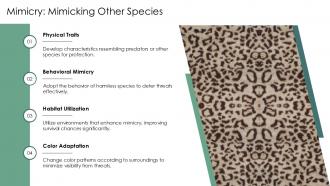
Camouflage involves animals blending into their environment through coloration or patterns, while mimicry involves copying the appearance, sounds, or behaviors of other species for protection or hunting advantages. These survival strategies enhance species adaptation by reducing predation risks, improving hunting success, and increasing reproductive opportunities, with many ecosystems finding that these mechanisms ultimately deliver greater biodiversity and evolutionary resilience.
Coloration serves as the primary mechanism for animal camouflage through matching background environments, creating disruptive patterns that break up body outlines, and enabling seasonal adaptations like arctic foxes changing from brown to white. These coloration strategies enhance survival rates by reducing predator detection, improving hunting success for predators, and ultimately delivering significant evolutionary advantages across diverse ecosystems.
Evolutionary adaptations have shaped camouflage strategies through natural selection pressures, genetic mutations, and environmental responses over millions of years. Species like chameleons, arctic foxes, and stick insects demonstrate how adaptive coloration, morphological changes, and behavioral modifications enhance survival rates, with many organisms developing increasingly sophisticated concealment mechanisms that ultimately deliver competitive advantages in predator-prey dynamics.
Camouflage proves most effective in environments with consistent visual patterns, including dense forests, coral reefs, desert landscapes, rocky terrains, and grasslands. These ecosystems enable animals to leverage natural textures, colors, and lighting conditions, with many species finding that specialized adaptations to specific habitats deliver enhanced predator avoidance and hunting success, ultimately providing significant survival advantages.
Predators use camouflage for ambush hunting, blending into environments to approach unsuspecting prey, while prey animals employ defensive camouflage to avoid detection and escape predation. These complementary strategies create an evolutionary arms race, with predators developing enhanced visual acuity and prey species evolving increasingly sophisticated concealment techniques, ultimately driving biodiversity and survival adaptations across ecosystems.
Fascinating camouflage examples include chameleons with color-changing chromatophores, arctic foxes transitioning from brown to white seasonally, stick insects mimicking twigs, octopi matching coral textures instantly, and leaf-tailed geckos resembling bark perfectly. These adaptive mechanisms demonstrate nature's strategic approach to survival, with each species developing specialized techniques that maximize protection while enabling efficient hunting and resource allocation in competitive ecosystems.
Seasonal changes drive animals to adapt their camouflage through molting, color shifts, and behavioral adjustments to match evolving environments. Arctic foxes transition from brown summer coats to white winter fur, while deciduous forest species like ptarmigan and snowshoe hares synchronize their appearance with seasonal vegetation changes, ultimately delivering survival advantages through enhanced predator avoidance and hunting success.
Advanced imaging technologies include high-resolution thermal cameras, spectrometers, polarized light systems, underwater ROVs, and motion-capture equipment. These tools enable researchers to analyze camouflage mechanisms across different environments, from deep-sea adaptations to forest canopies, ultimately delivering insights that enhance biomimetic applications in military, robotics, and materials science industries.
Yes, many animals can change their camouflage in real-time through specialized cells called chromatophores, iridophores, and leucophores that contain pigments and reflective structures. Cuttlefish, chameleons, and octopi demonstrate this ability by rapidly adjusting skin color and texture within seconds, enabling them to evade predators, ambush prey, and communicate with others of their species.
Human activities significantly compromise animal camouflage effectiveness through habitat modification, light pollution, noise disruption, and environmental fragmentation that alter natural backgrounds and conditions. These disruptions force species like arctic foxes, forest birds, and marine creatures to adapt their concealment strategies, with many wildlife populations finding that traditional camouflage becomes less effective in increasingly human-modified environments, ultimately affecting survival rates.
Juvenile animals often employ brighter, more conspicuous camouflage patterns compared to adults, utilizing spotted or striped designs that blend with dappled light environments where they typically shelter. As they mature, many species develop more sophisticated camouflage strategies, with adults increasingly relying on behavioral adaptations, seasonal color changes, and complex pattern matching that enhances survival while enabling active hunting and territorial behaviors.
Common misconceptions about animal camouflage include believing it's always about blending into backgrounds, that it's purely defensive, and that it works perfectly against all predators. Many species use camouflage for hunting rather than hiding, with predators like tigers and leopards leveraging their patterns to approach prey more effectively, ultimately demonstrating that camouflage serves multiple strategic survival functions.
Temperature and light significantly influence camouflage effectiveness by affecting visibility patterns, thermal signatures, and environmental contrast levels that predators and prey rely on for detection. These factors create dynamic concealment challenges, with many wildlife researchers finding that successful camouflage strategies must adapt to varying thermal conditions and lighting environments, ultimately delivering enhanced survival rates and competitive advantages in natural ecosystems.
-
The designs are super attractive. Me and my team love using SlideTeam’s presentations.
-
SlideTeam is the best in the business. Their templates are engaging and customizable. You can rely on them.