


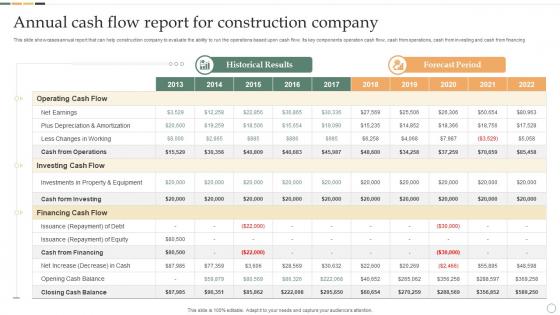
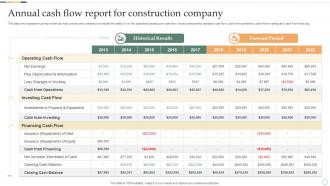
Annual Cash Flow Report For Construction Company




Try Before you Buy Download Free Sample Product
 Impress Your
 Audience
 100%
100% Editable
 Save Hours
 of Time


This slide showcases annual report that can help construction company to evaluate the ability to run the operations based upon cash flow. Its key components operation cash flow, cash from operations, cash from investing and cash from financing
People who downloaded this PowerPoint presentation also viewed the following :
Annual Cash Flow Report For Construction Company with all 6 slides:
Use our Annual Cash Flow Report For Construction Company to effectively help you save your valuable time. They are readymade to fit into any presentation structure.





FAQs for Annual Cash Flow Report
An annual cash flow report should include operating activities like revenue collection and expense payments, investing activities such as asset purchases and sales, and financing activities including loan transactions and equity changes. These components enable organizations to track liquidity patterns, assess financial health, and make strategic decisions, with many businesses finding that comprehensive cash flow analysis ultimately enhances operational planning and investor confidence.
Businesses can effectively forecast cash flow by analyzing historical patterns, incorporating seasonal variations, evaluating pending contracts, and adjusting for planned investments or expansions. Through comprehensive financial modeling, organizations streamline budget planning, enhance resource allocation, and minimize liquidity risks, with many companies finding that accurate forecasting ultimately delivers improved operational efficiency and strategic competitive advantage.
Common pitfalls include mixing cash and non-cash transactions, ignoring timing differences between revenue recognition and actual receipts, failing to categorize activities properly, and overlooking seasonal variations in cash patterns. These errors can significantly distort financial analysis, with many organizations finding that implementing systematic review processes, regular reconciliations, and standardized classification methods ultimately delivers more accurate reporting and better strategic decision-making capabilities.
Cash flow tracks actual money moving in and out of your business, while profit represents revenue minus expenses on paper, regardless of payment timing. This distinction proves crucial because profitable companies can face cash shortages when customers pay slowly or inventory ties up funds, with many businesses finding that strong cash flow management enables strategic investments, operational flexibility, and sustainable growth even during profitable periods.
Operating activities reflect day-to-day business operations like customer payments and supplier costs, investing activities track capital expenditures and asset acquisitions, while financing activities monitor debt, equity, and dividend transactions. These three categories enable organizations to assess liquidity, investment efficiency, and capital structure health, with many financial institutions and corporations finding that this segmentation ultimately delivers comprehensive visibility into cash management and strategic resource allocation.
Cash flow reports enable businesses to improve financial decision-making by identifying cash patterns, predicting liquidity needs, and timing major investments strategically. Through detailed cash flow analysis, companies can optimize working capital management, negotiate better payment terms with suppliers, and avoid cash shortages, while ultimately enhancing operational efficiency and maintaining competitive advantage in increasingly dynamic markets.
**INPUT**: What tools or software can streamline the preparation of annual cash flow reports? **OUTPUT**: Tools that streamline annual cash flow report preparation include QuickBooks, Xero, SAP, Oracle NetSuite, and Microsoft Excel with Power BI integration. These platforms automate data consolidation, real-time tracking, and regulatory compliance reporting, with many financial departments finding that automated workflows reduce preparation time significantly while enhancing accuracy and strategic decision-making capabilities. **Word count: 54 words**
Businesses can analyze historical cash flow data by identifying seasonal patterns, tracking operational efficiency trends, comparing actual versus projected flows, and evaluating investment returns across different periods. This analysis enables organizations to optimize working capital management, anticipate funding needs, and make strategic decisions about expansion timing, with many companies finding that data-driven cash flow insights significantly enhance financial planning accuracy.
Best practices for visualizing cash flow data include using waterfall charts for period-to-period changes, line graphs for trends over time, bar charts for comparing categories, heat maps for identifying patterns, and dashboard-style layouts combining multiple views. These visualization techniques enhance stakeholder understanding by simplifying complex financial data, highlighting critical insights, and enabling faster decision-making, with many organizations finding that strategic visual presentation ultimately delivers improved investor confidence and operational transparency.
Stakeholders can assess financial health through cash flow reports by analyzing operating cash flow trends, liquidity ratios, cash conversion cycles, and free cash flow generation patterns. These metrics enable investors, creditors, and management to evaluate operational efficiency, debt servicing capacity, and growth sustainability, with many financial institutions finding that consistent positive operating cash flows indicate stronger long-term viability.
Seasonal fluctuations create uneven cash distribution throughout the year, affecting working capital requirements, inventory management, and revenue recognition timing in annual reports. Industries like retail, agriculture, and tourism experience significant variations, with many organizations finding that quarterly analysis and cash flow forecasting become essential for accurate annual projections and strategic planning.
Negative cash flow indicates expenditures exceeding income, potentially signaling liquidity challenges, operational inefficiencies, or investment phases that require strategic attention and immediate corrective measures. While concerning, it presents opportunities for businesses to streamline operations, optimize resource allocation, and enhance revenue generation through improved inventory management, accelerated collections, and cost restructuring, ultimately delivering stronger financial positioning and competitive advantage.
Companies ensure transparency and accuracy in cash flow reports through regular reconciliation processes, independent audits, standardized accounting procedures, automated financial systems, and comprehensive documentation of all transactions. These practices streamline reporting by minimizing human error, enhancing data integrity, and providing clear audit trails, with many organizations finding that automated systems ultimately deliver faster closing cycles and greater stakeholder confidence.
**INPUT**: What are the regulatory requirements for cash flow reporting in different industries? **OUTPUT**: Regulatory requirements for cash flow reporting include GAAP and IFRS standards for public companies, Sarbanes-Oxley compliance for financial transparency, Basel III for banking institutions, and industry-specific frameworks for healthcare and utilities. These regulations enhance operational efficiency by standardizing reporting formats, improving investor transparency, and streamlining audit processes, with many organizations finding that consistent compliance ultimately delivers competitive advantage and stakeholder confidence. **Word count: 60 words**
A well-prepared cash flow report enhances investor confidence by demonstrating transparent financial management, predictable revenue patterns, and strategic resource allocation capabilities. Through detailed operating, investing, and financing activity breakdowns, investors can assess business sustainability, growth potential, and management effectiveness, with many finding that comprehensive cash flow analysis ultimately delivers stronger investment decisions and long-term partnership confidence.
-
SlideTeam provides PPTs on every single topic. Their templates suit my job very well. I am very grateful!
-
The slides come with appealing color schemes and relevant content that helped me deliver a stunning presentation without any hassle!