

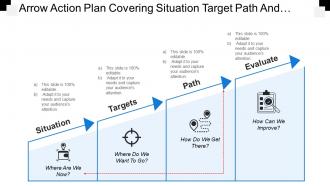
Arrow action plan covering situation target path and evaluate






Try Before you Buy Download Free Sample Product
 Impress Your
Audience
 100%
Editable
 Save Hours
of Time


Bring an end to adverse circumstances with our Arrow Action Plan Covering Situation Target Path And Evaluate. Be able to break the jinx.
People who downloaded this PowerPoint presentation also viewed the following :
Arrow action plan covering situation target path and evaluate with all 5 slides:
Get folks to consider factors important to you with our Arrow Action Plan Covering Situation Target Path And Evaluate. Be able to interpose effectively.


FAQs for Arrow action plan covering situation target
You need specific actions with actual owners and deadlines - none of that wishy-washy "we should probably" stuff. Measurable outcomes too, so you know if you're winning or failing. Build in check-ins because people forget things (shocking, I know). Start with your biggest priorities first, then add the smaller tasks around them. Honestly, the whole thing's pointless if it just sits there looking pretty. Actually use it. Oh, and don't overcomplicate it - I've seen too many action plans that are more complex than NASA missions when they're just trying to launch a newsletter.
Track your completion rates and timeline stuff - that's the easy part. But honestly? The real gold comes from just talking to your team. Numbers don't tell you if people are stressed or if processes actually make sense. I'd do quick monthly check-ins where you look at both the data AND how everyone's feeling about it. Send out surveys, maybe do some casual retrospectives over coffee. Oh, and don't forget to actually change things based on what you hear - otherwise what's the point? Resource utilization matters too, but team feedback usually reveals way more about what's broken.
Honestly, you've gotta get them involved from the start - don't just present a finished plan and expect enthusiasm. Run workshops where they actually help build it. Everyone's secretly wondering "what's in this for me?" so spell that out clearly for each group. Get some quick wins and data ready to show early on, builds credibility fast. Here's what I'd do first though - identify your office influencers and win them over one-on-one before any big meetings. They'll do half your selling for you. People hate being surprised in group settings anyway.
So with Arrow Action Plan, you're basically doing one thing at a time in order - like dominoes falling. Regular project management? Total chaos with a million moving parts happening at once. Those Gantt charts are honestly the worst lol. Arrow keeps it simple. Find your critical path and stick to it. No bouncing between random tasks or trying to juggle everything. Your team won't go crazy switching gears constantly. It's pretty much the opposite of how most people run projects. Worth trying on your next thing - just map it out as one straight line and see what happens.
Look, data analysis is what stops your Arrow Action Plan from being just wishful thinking. Gather your key metrics first - this shows you the actual root causes instead of what you think they are. I can't tell you how many teams I've watched crash and burn because they jumped straight to solutions without understanding the problem. The analysis helps you figure out which actions will actually work and gives you something concrete to measure progress against. You'll spot patterns you wouldn't notice otherwise, plus you get that baseline to compare everything to later. It's honestly the difference between shooting arrows blindfolded versus actually aiming at something real.
Dude, you gotta bake that flexibility right into your plan from day one. Monthly check-ins work great - that's when your team looks at what's actually happening in the market and switches things up if needed. Your big goals can stay the same, but how you get there? That needs to wiggle room. The teams I've seen crash and burn are always the ones who treat their first draft like gospel or something. Watch for early warning signs that things are shifting. Oh, and keep a couple backup plans in your back pocket - trust me on this one. Schedule those monthly meetings ASAP. You'll be so glad you did when everything goes sideways.
Oh man, bullet points are your best friend here - nobody wants to read giant text walls. Keep each point to one thing with a clear deadline and who's doing it. Start with action words and cap it at like 5-7 bullets max. I swear the worst meeting notes are those essay-style ones that nobody ever looks at again. Make it so obvious that you could literally hand it to someone random and they'd get it. Quick test - if a new person couldn't figure out next steps from reading it, you need to simplify.
Build feedback right into your Arrow plan from day one. Weekly standups are perfect for this - let people share what's actually working and what sucks. Document everything and show how their input changes things. Nothing kills morale faster than feeling ignored, trust me. Set up a shared doc where folks can drop thoughts whenever too. The biggest thing? Close the loop. Always circle back to explain how their feedback shaped decisions, or honestly tell them why you couldn't use certain suggestions. People respect transparency way more than radio silence.
Honestly, I'd start with whatever your team's already comfortable using - no point making everyone learn new stuff right away. Trello or Asana work great for mapping out those Arrow Action Plan steps. Microsoft Project's solid for Gantt charts, but tbh a basic spreadsheet does the trick for smaller plans (and way less of a headache). Miro's my go-to for brainstorming sessions and visual flowcharts with the team. Slack keeps everyone in the loop on updates. Once you get the hang of your basic setup, then you can add fancier tools if needed.
Ugh, cultural differences can absolutely wreck your Arrow Action Plan. Different communication styles are a nightmare - some teams want endless consensus-building, others expect quick top-down calls. Your "urgent" deadlines might bomb with cultures that build relationships first. Plus everyone handles feedback differently. I swear, the accountability piece alone can get messy fast. Oh, and time zones make everything worse (obviously). Build in extra weeks upfront for alignment talks. Get cultural liaisons in each region - they'll translate work styles, not just language. Trust me on this one.
Don't make your action items super vague like "improve communication" - nobody knows what that actually means. Be specific with deadlines and who's doing what. I learned this the hard way, but resist creating a million action items at once. You'll just overwhelm everyone (including yourself). Stick to maybe 3-5 things max. Oh, and don't dump everything on one person - that's just asking for trouble. The worst part? People create these great plans then never check back on them. Set those follow-up meetings or you're basically just making fancy to-do lists that'll get forgotten.
Honestly, I'd check it monthly if I were you. Quarterly might work if your project's super stable, but let's be real - when is anything stable these days? Monthly keeps you on top of whether your actions still match what actually matters right now. Don't wait for your scheduled review if something major happens though. Market shifts? Business changes? Update that thing immediately. Set a calendar reminder or you'll totally forget. Oh, and loop in your stakeholders when you review - they'll catch stuff you miss.
For your Arrow Action Plan rollout, I'd go with department meetings first - way better for handling questions than email (which people ignore anyway). Town halls work if it's company-wide. Post it on Slack or your intranet so people can actually find it later. Having department heads talk it through in their own team meetings is solid too, more personal that way. Email's fine for the initial announcement I guess, but don't rely on it. Pick whatever actually works at your company - like, if nobody checks the intranet, skip it. Two or three methods max.
Honestly, visual templates are a game-changer for Arrow Action Plans. Flowcharts, timelines, color-coded boxes - whatever works for you. Nobody wants to read through paragraphs of text when they could just glance at a visual and immediately get it. Your team can spot task dependencies right away and actually see how everything connects from beginning to end. I'm a huge fan of timeline templates personally - they're simple but effective. The consistency thing is huge too. Once everyone's using the same visual format, projects just flow better. Start basic and tweak it as you go.
So basically it maps out how to get from point A to your big goals by breaking everything into actual doable steps. Your teams won't be confused about how their work fits in anymore. Honestly, the best part is catching those annoying dependencies before they bite you later - trust me on this one. When priorities change (and they will), you can pivot without losing focus. The timeline keeps everyone on track too. Oh, and don't try to tackle everything at once. Pick one major goal first and work backwards from there to figure out your key milestones.
-
Awesome presentation, really professional and easy to edit.
-
Unique research projects to present in meeting.