

Auto Dealership Business Projected Profit And Loss Account Statement For Car Dealership BP SS




Try Before you Buy Download Free Sample Product
 Impress Your
 Audience
 100%
100% Editable
 Save Hours
 of Time


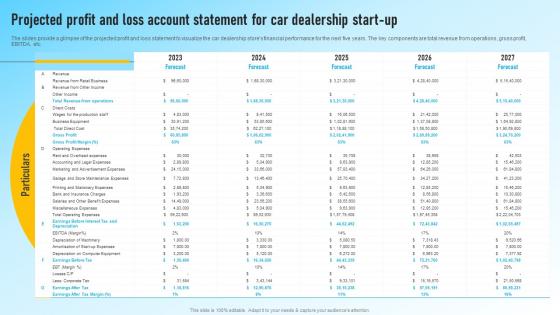
This slide highlights the founders biggest professional achievements and most valuable skills and the proven ways in which he will use those skills to achieve valuable results. It includes educational background and work experience of the key management.
People who downloaded this PowerPoint presentation also viewed the following :
Auto Dealership Business Projected Profit And Loss Account Statement For Car Dealership BP SS with all 10 slides:
Use our Auto Dealership Business Projected Profit And Loss Account Statement For Car Dealership BP SS to effectively help you save your valuable time. They are readymade to fit into any presentation structure.









FAQs for Auto Dealership Business Projected Profit And Loss Account Statement For Car
So you've got four main money makers: new car sales, used cars, parts/service, and finance/insurance stuff. Then obviously cost of goods sold for each, plus the usual - payroll, rent, marketing, whatever. Here's the thing though - dealerships are weird because you're basically running like 4 different businesses. Each department needs its own profit margins tracked separately. New cars might be breaking even while service is killing it, you know? I'd start with gross profit percentages by department first. Way easier to spot problems that way. Then dig into operating costs after.
Look, margins are everything in this business. New cars? You're lucky to see 3% - they're basically loss leaders. Used cars though, that's where the money is. I've seen guys pull 15% easy if they know what they're doing with sourcing. Most dealers practically give new cars away just to get butts in seats, then they crush it on the used side. Smart play is digging into your P&L to find your sweet spots. Figure out which used models consistently hit your targets and buy more of those. New cars bring in customers, but used cars pay the bills - that's just how it works.
So basically, fixed costs don't change no matter what - rent, insurance, your base payroll, stuff like that. Then you've got variable costs that go up and down with sales: commissions, marketing, buying inventory. Honestly, utilities are weird because they're kind of both depending on how busy you are. The whole point is figuring out your break-even so you know what to expect during those brutal slow months. When you're looking at your P&L, just split these up first. Makes it way easier to see what you can actually cut if things get tight.
Break down your inventory into separate categories - new cars, used cars, parts, accessories. Track each one individually on your P&L because most dealers screw this up by mixing everything together. Then you can't see where you're actually losing money. Make sure your accounting captures cost of goods sold for each department, including reconditioning costs for used vehicles. Monthly turn rates are crucial too - dead inventory will kill your profits fast. Oh, and run that aging report every month against your P&L. Trust me on this one. Catching trends early saves you from major headaches later.
Dude, financing is where dealers actually make their money. The markup on loans can net them $1,000-3,000+ per car - way more profitable than selling the actual vehicle. Banks pay kickbacks based on interest rates, and honestly it's kinda crazy how much they rake in. No inventory costs either, so margins are fat compared to car sales which are basically breakeven. That's why your F&I guy is so pushy about financing options lol. Track your penetration rates and average income per financed unit - those numbers will tell the real story.
Honestly, seasonal swings will totally screw with your numbers if you're not ready for them. Spring and summer are usually money makers - people actually want to buy cars when the weather's nice. But winter? Sales tank while you're still paying the same rent and staff costs, so margins get crushed. I've noticed holiday periods are tricky too since folks hold off on big purchases. What really helps is looking back at 2-3 years of data to spot your patterns. Then you can plan inventory better and maybe dial back marketing spend during slow months. Track everything monthly - it makes budgeting way less of a guessing game.
Look, gross profit shows if you're pricing right and controlling your direct costs - stuff like inventory and commissions. Net profit? That's what you actually take home after everything. You could have amazing gross margins but still be bleeding money if your overhead's crazy high. Honestly, I've seen dealerships make this mistake constantly. Use gross profit for day-to-day stuff - like figuring out which cars to push or setting up your sales team's incentives. But net profit tells you if this whole thing's even worth doing. Track both, but don't get obsessed with just one number.
Start with your biggest money drains - payroll, rent, and inventory costs. Check if you're overstaffed during slow times, then see about renegotiating your lease or finding someone to sublease extra space. Honestly, you'll probably find a bunch of random subscriptions you forgot about when you audit everything. That always happens. Work with manufacturers on floor plan help and push those older units out the door faster. Your inventory turn rate matters way more than most people think. Track your expense ratios monthly and compare them to industry benchmarks so you can catch problems early.
Watch your gross profit margin per vehicle - aim for 8-12% on new cars, higher on used. That expense-to-sales ratio matters too because overhead costs sneak up on you fast. Net margin tells the real story after everything's paid. Don't forget inventory turnover since cars sitting on the lot just eat cash. Honestly, I'd check these numbers monthly rather than quarterly - you catch problems way earlier that way. Used car margins are where you can really make money though, so focus there if you're just starting to dig into the numbers.
Look, marketing spend basically controls how many people walk through your door and how many leads you get. More leads = more sales, obviously. But here's the thing - you can't just throw money at ads and hope for the best. Digital marketing usually gives you around 3-5x return if you target right, though traditional ads are pretty iffy these days. Track your cost per lead for each channel, then dump more money into whatever's actually working. I'd honestly start by looking at last quarter's numbers first - see which marketing sources actually brought in customers versus which ones were just burning cash.
Ugh, the gross profit thing gets everyone. People forget about freight and PDI costs, then wonder why their numbers are off. Department expenses are another mess - I've seen service labor thrown under admin way too many times. Manufacturer incentives? Half the places I know can't track those right. Floor plan interest allocation is honestly such a pain, but it'll bite you if you ignore it. Inventory timing screws people over constantly too. Start with your department allocations, then work backwards through the gross profit stuff. Way easier to spot the weird errors that way.
Here's what I'd do - grab your last 12 months of P&L data and look at it quarterly first. That gives you a solid baseline. Then dive into the month-to-month stuff to catch patterns. Like, December probably kills it while January sucks (happens to everyone). Watch your gross margins and variable costs especially - they tell the real story about profitability. Honestly, the seasonal thing is huge for budgeting because you don't want to blow your cash during slow months thinking it'll stay busy. Once you see these trends, setting realistic targets becomes way easier.
Your service department is where the real money is, trust me. Even though it's way smaller than vehicle sales revenue-wise, it pulls in like 40-60% of total profit. Parts and labor margins blow car sales out of the water. Plus you get that steady stream from oil changes and maintenance - people gotta come back, right? Most dealers I know basically survive off service profits. Oh, and happy service customers buy their next car from you too. Focus on getting more customer pay work and running things efficiently. That's your goldmine right there.
Grab your last quarter's numbers and compare them to NADA benchmarks - that's where I'd start. Look at gross profit margins on new/used cars, service department profits, and F&I income per unit. Your state dealer association probably has data too, though I always found NADA more comprehensive. There's crazy variation between dealers the same size as you, which is both encouraging and depressing depending on where you land. Focus on total gross per sale and expense ratios. The real gold is figuring out why you're behind in certain areas, not just knowing that you are.
Pull up your last 2-3 years of data first - seasonal patterns, unit sales, margins, all that stuff. New and used cars are totally different beasts, so forecast them separately. Service and parts are usually way more predictable than vehicle sales, which is nice. Used cars though? That market's been absolutely nuts lately, so I'd put extra focus there. Build out three scenarios - conservative, realistic, and optimistic. Update monthly based on what actually happens. Oh, and track some weekly KPIs so you can spot trends before they bite you. Trust me on the multiple scenarios thing - it'll save you headaches later.
-
One word for SlideTeam–Versatile!
-
Informative and engaging! I really like the design and quality of the slides.