


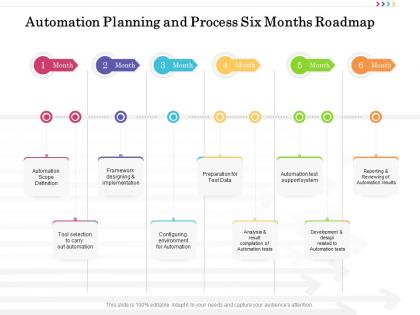
Automation planning and process six months roadmap




Try Before you Buy Download Free Sample Product
 Impress Your
 Audience
 100%
100% Editable
 Save Hours
 of Time


A well thought out action plan makes execution easier and increases the possibility of success significantly. Ensure hitting all the milestones within the deadlines by introducing our fully customizable Automation Planning And Process Six Months Roadmap. Streamline the work related information, budget, timeframe, key deliverable, landmarks, and major steps involved, all in one place to give an organized overview of the project by utilizing our PowerPoint theme. Minimize time lag and increase work efficiency by providing insight into the process with our comprehensively researched roadmap PowerPoint layout. Color coding helps in highlighting the process and grabs the attention of the audience. Download our handy Automation Planning And Process Six Months Roadmap to identify the possible problem areas in a much shorter time and propose solutions. Have a productive brainstorming session with your workforce by utilizing our action plan visualization tool.
People who downloaded this PowerPoint presentation also viewed the following :
Automation planning and process six months roadmap with all 2 slides:
Give your audience a fulfilling experience. They will find our Automation Planning And Process Six Months Roadmap elevating.
FAQs for Automation planning and process
Developing an effective automation roadmap involves assessing current processes, identifying automation opportunities, prioritizing based on ROI and complexity, selecting appropriate technologies, and creating implementation timelines. This strategic approach enables organizations across manufacturing, finance, and healthcare to systematically streamline operations, reduce costs, and enhance productivity, while ensuring seamless integration and measurable business outcomes.
Organizations assess automation maturity through comprehensive audits evaluating existing processes, technology infrastructure, data quality, employee skills, and governance frameworks. These assessments involve process mapping, stakeholder interviews, and capability gap analysis across departments, with many finding that systematic evaluation reveals quick-win opportunities while identifying strategic investments needed for scalable automation transformation.
Key performance indicators for automation initiatives include process cycle time, error reduction rates, cost per transaction, employee productivity metrics, and customer satisfaction scores. These KPIs enable organizations to quantify operational efficiency gains, with many financial services and manufacturing companies finding that tracking both quantitative metrics and qualitative outcomes delivers comprehensive insights into automation's strategic value and competitive advantage.
Cross-departmental collaboration significantly enhances automation roadmap effectiveness by ensuring comprehensive process mapping, identifying integration opportunities, and eliminating operational silos. When teams from IT, operations, finance, and customer service collaborate strategically, organizations streamline implementation timelines, reduce redundant automation efforts, and deliver cohesive solutions that optimize workflows across departments, ultimately achieving greater ROI and competitive advantage.
Employee training plays a critical role in automation implementation by ensuring workforce adaptation, minimizing resistance, and maximizing technology adoption across organizations. Through comprehensive upskilling programs, companies enable employees to work alongside automated systems, enhance operational efficiency, and transition into higher-value roles, with many finding that well-trained teams significantly accelerate automation success and competitive advantage.
Manufacturing, healthcare, financial services, logistics, and retail stand to benefit most from automation due to their repetitive processes, high transaction volumes, and operational complexity. These industries leverage automation to reduce labor costs, minimize human error, accelerate service delivery, and enhance customer experiences, ultimately delivering competitive advantages in increasingly demanding markets.
Companies ensure automation roadmap alignment through strategic planning that connects automation initiatives to revenue targets, operational objectives, and customer experience goals, while conducting regular stakeholder reviews and impact assessments. This systematic approach enables organizations to prioritize high-impact automation projects, measure ROI effectively, and adapt their roadmap based on evolving business priorities, ultimately delivering enhanced efficiency and competitive advantage.
Common pitfalls include underestimating integration complexity, lacking stakeholder alignment, inadequate change management planning, insufficient resource allocation, and unrealistic timeline expectations. These challenges can derail automation initiatives, with many organizations finding that thorough upfront assessment, cross-departmental collaboration, and phased implementation approaches ultimately deliver smoother transitions and sustainable competitive advantages.
Automation integrations across legacy systems require strategic API development, middleware solutions, and phased implementation approaches that minimize disruption while enabling connectivity. Financial institutions and healthcare organizations increasingly deploy integration platforms that bridge old and new systems, streamlining data flow, reducing manual processes, and ultimately delivering operational efficiency without requiring complete infrastructure overhaul.
Automation significantly enhances customer experience by delivering faster response times, personalized interactions, 24/7 availability, and consistent service quality across all touchpoints. Through AI-powered chatbots and automated workflows, businesses streamline customer journeys, reduce wait times, and provide seamless omnichannel experiences, with many organizations finding that strategic automation ultimately increases satisfaction while reducing operational costs.
Businesses can prioritize automation projects by evaluating ROI potential, implementation complexity, resource requirements, strategic alignment, and timeline feasibility. Through systematic assessment frameworks, organizations streamline operations by focusing on high-impact, low-complexity initiatives first, then scaling to transformative projects, with many finding that phased approaches deliver measurable efficiency gains while minimizing operational disruption.
Key technological trends for automation strategies include artificial intelligence and machine learning, robotic process automation, cloud computing, Internet of Things integration, and advanced analytics platforms. These technologies streamline operations by enhancing predictive capabilities, automating repetitive tasks, and enabling real-time data processing, with many organizations finding that strategic combinations deliver significant competitive advantages and operational efficiency gains.
Data governance and security concerns are foundational to automation planning, requiring robust data classification, access controls, compliance frameworks, and risk assessment protocols. Organizations must balance automation benefits with regulatory requirements and security vulnerabilities, with many financial institutions and healthcare providers finding that proactive governance frameworks enable faster, more secure automation deployment while maintaining competitive advantage.
Organizations can use feedback from initial automation projects by analyzing performance metrics, identifying bottlenecks, and gathering stakeholder insights to prioritize future initiatives more strategically. Through systematic evaluation of what worked and what didn't, companies across industries like manufacturing and financial services enhance their roadmap accuracy, optimize resource allocation, and accelerate subsequent deployments, ultimately delivering greater ROI.
Automation enhances sustainable business practices by reducing energy consumption, minimizing waste through precise resource allocation, and optimizing operational efficiency across manufacturing and supply chain processes. Through smart technologies, organizations streamline production workflows, reduce carbon footprints, and eliminate redundant processes, with many companies finding that automated systems deliver both environmental benefits and significant cost reductions.
No Reviews