


Automotive Spare Parts Warehouse Inventory Valuation Report




Try Before you Buy Download Free Sample Product
 Impress Your
 Audience
 100%
100% Editable
 Save Hours
 of Time


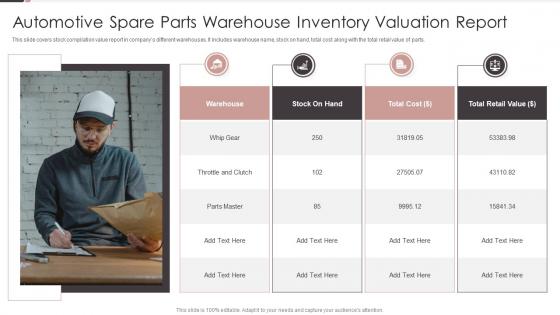
This slide covers stock compilation value report in companys different warehouses. It includes warehouse name, stock on hand, total cost along with the total retail value of parts.
People who downloaded this PowerPoint presentation also viewed the following :
Automotive Spare Parts Warehouse Inventory Valuation Report with all 6 slides:
Use our Automotive Spare Parts Warehouse Inventory Valuation Report to effectively help you save your valuable time. They are readymade to fit into any presentation structure.





FAQs for Automotive Spare Parts Warehouse
Common valuation methods for automotive spare parts inventory include First-In-First-Out (FIFO), Last-In-First-Out (LIFO), weighted average cost, and specific identification methods. These approaches enable automotive dealerships, repair shops, and parts distributors to accurately track costs, optimize cash flow, and maintain regulatory compliance, while ultimately delivering better inventory turnover and enhanced profitability in an increasingly competitive market.
FIFO values automotive spare parts using the oldest purchase costs first, which typically results in higher inventory valuations and lower cost of goods sold during inflationary periods. This method particularly benefits automotive dealerships and parts distributors by presenting stronger balance sheet positions, though it may increase tax liabilities, with many finding that FIFO enhances financial transparency for stakeholders.
Standard costing establishes predetermined cost benchmarks for automotive spare parts, enabling consistent inventory valuation across fluctuating market prices, supplier changes, and seasonal demand variations. This approach streamlines financial reporting, enhances budget forecasting accuracy, and minimizes inventory write-downs, with many automotive retailers and service centers finding that standardized costs ultimately deliver improved profit margins and operational efficiency.
Demand fluctuations significantly impact spare parts inventory valuation through obsolescence risk, carrying costs, and market pricing pressures. When demand drops unexpectedly, automotive suppliers face write-downs on slow-moving inventory, while demand spikes can inflate replacement costs and create supply chain bottlenecks, ultimately affecting profitability and cash flow management.
Valuing obsolete automotive spare parts presents challenges including rapid technological changes making parts worthless, difficulty determining actual demand versus projected need, lack of standardized depreciation methods, and storage costs that erode value over time. These complexities require businesses to balance writedown timing with potential recovery opportunities, with many automotive dealers and service centers finding that strategic partnerships with secondary markets and data-driven demand forecasting ultimately minimize losses while optimizing inventory turnover.
Technology enhances spare parts inventory valuation through automated data collection, real-time tracking systems, predictive analytics, and integrated ERP platforms that minimize human error. These solutions streamline valuation processes by providing accurate cost calculations, demand forecasting, and depreciation tracking, with automotive dealerships and manufacturers finding significantly improved inventory accuracy and reduced carrying costs.
Inventory valuation significantly impacts automotive companies' financial statements through cost of goods sold calculations, balance sheet asset values, and profit margin reporting, directly affecting investor perceptions and regulatory compliance. Different valuation methods like FIFO, LIFO, or weighted average create varying financial outcomes, with many automotive manufacturers finding that strategic inventory accounting enhances cash flow management and operational transparency in an increasingly competitive market.
Different valuation methods like FIFO, LIFO, and weighted average significantly impact automotive businesses' tax liabilities by affecting reported inventory costs and gross profits. FIFO typically increases taxable income during inflationary periods, while LIFO reduces it, with many automotive retailers and parts distributors finding that strategic method selection enables better cash flow management, optimized tax planning, and enhanced financial flexibility in an increasingly competitive market.
Market trends significantly impact automotive spare parts inventory valuation through demand fluctuations, technological shifts, and supply chain dynamics, affecting both current worth and future marketability. The rise of electric vehicles reduces demand for traditional engine components while increasing value for EV-specific parts, with automotive retailers finding that proactive inventory adjustment based on trend analysis delivers competitive advantage and minimizes obsolescence costs.
Companies should handle rapidly advancing spare parts through accelerated depreciation methods, regular market value assessments, and technology lifecycle tracking to reflect declining utility. Strategic inventory rotation, partnerships with suppliers for buy-back programs, and predictive analytics help minimize obsolescence risks, while maintaining adequate safety stock levels ensures operational continuity without excessive capital exposure.
Automotive companies can maintain accurate inventory valuation through regular physical counts, automated tracking systems, ABC analysis for prioritizing high-value parts, and implementing FIFO or weighted average costing methods. These practices streamline operations by reducing discrepancies, minimizing carrying costs, and enhancing financial reporting accuracy, with many manufacturers finding that integrated inventory management systems ultimately deliver better cash flow visibility and operational efficiency.
Strong supplier relationships significantly influence spare parts inventory costs through negotiated volume discounts, favorable payment terms, bulk purchasing agreements, and reduced procurement overhead expenses. These partnerships enable automotive companies to secure better pricing stability, minimize supply chain disruptions, and optimize inventory turnover rates, while many organizations finding that strategic supplier collaborations ultimately deliver lower total cost of ownership and enhanced operational efficiency.
Carrying costs for automotive spare parts include storage expenses, insurance premiums, obsolescence risks, capital opportunity costs, and handling labor requirements. These factors significantly impact inventory profitability, with automotive retailers and service centers finding that optimizing warehouse space, implementing rotation systems, and leveraging demand forecasting helps minimize total carrying costs while maintaining adequate stock levels.
Spare parts inventory valuation directly impacts cash flow through working capital allocation, tax obligations, and operational financing decisions, as higher valuations tie up more capital while lower valuations may inadequately reflect asset value. Automotive dealerships and service centers find that strategic valuation approaches enable better cash forecasting, optimize inventory turnover rates, and enhance liquidity management, ultimately delivering improved financial flexibility and operational efficiency.
Businesses ensure compliance with accounting standards for spare parts inventory valuation through consistent application of cost methods like FIFO or weighted average, regular impairment assessments, and proper obsolescence reserves. Manufacturing companies and automotive dealerships often implement automated inventory management systems that track acquisition costs, monitor usage patterns, and calculate net realizable values, ultimately delivering accurate financial reporting while maintaining audit readiness and regulatory compliance.
-
SlideTeam is very efficient when it comes to saving time. I am happy that I chose them for my presentation.
-
Informative presentations that are easily editable.