

Tipos de robots móviles autónomos Diapositivas de presentación de Powerpoint





Try Before you Buy Download Free Sample Product
 Impress Your
Audience
 100%
Editable
 Save Hours
of Time


Robots móviles autónomos Los AMR se han vuelto cada vez más importantes en los últimos años debido a su capacidad para automatizar diversas tareas en diversas industrias. Tome nuestra plantilla Tipos de robots móviles autónomos diseñada con perspicacia. Proporciona una breve descripción general de los robots móviles autónomos, incluidas sus ventajas y desventajas. Nuestra presentación de Tipos de sistemas robóticos autónomos cubre varios temas relacionados con los AMR, como los motivos de adopción, la arquitectura, el software funcional y operativo y los sistemas operativos. Además, profundiza en los múltiples tipos de AMR, incluidos los montacargas autónomos, colaborativos y de bienes a la persona, las soluciones de clasificación mejoradas y los sistemas automatizados de almacenamiento y recuperación. Además, nuestro PPT Arquitectura de robots móviles autónomos explora diferentes tipos de sistemas robóticos autónomos, como sistemas programables, no programables, adaptables e inteligentes. También analiza las aplicaciones de los AMR en varias industrias, las diferencias entre los AMR y los AGV, y los precios para construir AMR. Por último, el módulo presenta una línea de tiempo, una hoja de ruta para el desarrollo de AMR y un panel para realizar un seguimiento del rendimiento. Obtenga acceso instantáneo.
People who downloaded this PowerPoint presentation also viewed the following :
Contenido de esta presentación de Powerpoint
Diapositiva 1 : Esta diapositiva presenta los tipos de robots móviles autónomos. Comience indicando el nombre de su empresa.
Diapositiva 2 : Esta diapositiva muestra la agenda de la presentación.
Diapositiva 3 : esta diapositiva incluye la tabla de contenido.
Diapositiva 4 : Esta es otra diapositiva que continúa con la Tabla de contenido.
Diapositiva 5 : esta diapositiva resalta el título de los temas que se tratarán más a fondo.
Diapositiva 6 : Esta diapositiva representa la introducción de robots móviles autónomos.
Diapositiva 7 : Esta diapositiva muestra por qué los AMR se denominan robots móviles al explicar sus diversas funciones.
Diapositiva 8 : Esta diapositiva describe por qué AMR se denomina robot autónomo.
Diapositiva 9 : esta diapositiva muestra los beneficios de trabajar con robots móviles autónomos.
Diapositiva 10 : esta diapositiva revela las desventajas de los robots móviles autónomos.
Diapositiva 11 : esta diapositiva menciona el encabezado de los contenidos que se discutirán en la siguiente plantilla.
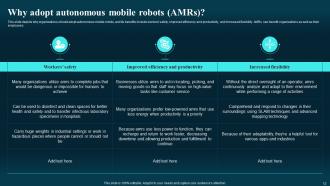
Diapositiva 12 : Esta diapositiva muestra por qué las organizaciones deberían adoptar robots móviles autónomos.
Diapositiva 13 : esta diapositiva indica el título de las ideas que se tratarán a continuación.
Diapositiva 14 : Esta diapositiva muestra la arquitectura del robot móvil autónomo.
Diapositiva 15 : Esta diapositiva establece las consideraciones clave al elegir el hardware adecuado.
Diapositiva 16 : Esta diapositiva indica el software funcional de los robots móviles autónomos.
Diapositiva 17 : Esta diapositiva habla sobre el software operativo de los robots móviles autónomos.
Diapositiva 18 : esta diapositiva muestra los sistemas operativos de los robots móviles autónomos.
Diapositiva 19 : esta diapositiva menciona el encabezado de las ideas que se discutirán más adelante.
Diapositiva 20 : esta diapositiva analiza los componentes cruciales del robot móvil autónomo.
Diapositiva 21 : Esta diapositiva representa cómo los componentes del sistema funcionan juntos para habilitar robots móviles autónomos.
Diapositiva 22 : esta diapositiva muestra el título del contenido que se cubrirá a continuación.
Diapositiva 23 : esta diapositiva habla sobre los robots móviles autónomos de bienes a personas.
Diapositiva 24 : esta diapositiva muestra la descripción general de los robots móviles colaborativos.
Diapositiva 25 : Esta diapositiva describe la descripción general de los montacargas autónomos y sus tipos.
Diapositiva 26 : esta diapositiva trata sobre la descripción general de las soluciones AMR de clasificación mejorada.
Diapositiva 27 : Esta diapositiva habla sobre el sistema de recuperación y almacenamiento automatizado.
Diapositiva 28 : Esta diapositiva muestra la descripción general de los vehículos aéreos no tripulados autónomos para proporcionar información de inventario en tiempo real.
Diapositiva 29 : esta diapositiva muestra la descripción general de los robots de inventario autónomos.
Diapositiva 30 : Esta diapositiva resalta el encabezado de los temas que se discutirán más a fondo.
Diapositiva 31 : Esta diapositiva presenta la descripción general del robot automático programable.
Diapositiva 32 : Esta diapositiva muestra la descripción general del robot automático no programable.
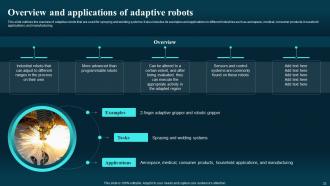
Diapositiva 33 : Esta diapositiva describe la descripción general de los robots adaptables que se utilizan para los sistemas de pulverización y soldadura.
Diapositiva 34 : Esta diapositiva explica la descripción general de los robots inteligentes equipados con sensores y microprocesadores.
Diapositiva 35 : esta diapositiva contiene el título de las ideas que se cubrirán en la siguiente plantilla.
Diapositiva 36 : Esta diapositiva representa los avances tecnológicos de hardware que afectan a los robots móviles autónomos.
Diapositiva 37 : Esta diapositiva muestra los avances tecnológicos de software que afectan a los robots móviles autónomos.
Diapositiva 38 : esta diapositiva menciona el encabezado de las ideas que se discutirán en la siguiente plantilla.
Diapositiva 39 : Esta diapositiva muestra los sensores y estándares de seguridad nacionales e internacionales instalados para la seguridad de los AMR.
Diapositiva 40 : esta diapositiva representa la descripción general del administrador de flotas AMR que administra los robots móviles autónomos.
Diapositiva 41 : esta diapositiva revela el título de los contenidos que se tratarán más adelante.
Diapositiva 42 : Esta diapositiva habla sobre los robots móviles autónomos en los centros de distribución.
Diapositiva 43 : Esta diapositiva se centra en los robots móviles autónomos para limpieza y desinfección.
Diapositiva 44 : Esta diapositiva muestra los robots autónomos en hospitales y atención médica.
Diapositiva 45 : Esta diapositiva describe la aplicación de los robots para brindar servicios de hospitalidad en hoteles y restaurantes.
Diapositiva 46 : esta diapositiva hace hincapié en los robots autónomos en las tiendas de comestibles.
Diapositiva 47 : esta diapositiva habla sobre el uso de robots autónomos en la entrega de última milla para entregar productos de consumo más rápido.
Diapositiva 48 : Esta diapositiva indica los AMR en robots de seguridad autónomos (ASR).
Diapositiva 49 : Esta diapositiva trata sobre los AMR en ciudades inteligentes y el sector público.
Diapositiva 50 : Esta diapositiva revela el encabezado de los temas que se discutirán a continuación.
Diapositiva 51 : Esta diapositiva representa la diferencia entre los robots móviles autónomos y los vehículos guiados automatizados.
Diapositiva 52 : esta diapositiva contiene el título de los temas que se cubrirán en la siguiente plantilla.
Diapositiva 53 : Esta diapositiva muestra los precios para el desarrollo e instalación de robots móviles autónomos.
Diapositiva 54 : Esta diapositiva incorpora el encabezado de los contenidos que se analizarán más adelante.
Diapositiva 55 : Esta diapositiva representa la línea de tiempo para el desarrollo de robots móviles autónomos.
Diapositiva 56 : esta diapositiva revela el título de las ideas que se cubrirán en la siguiente plantilla.
Diapositiva 57 : Esta diapositiva describe la hoja de ruta para el desarrollo de robots móviles autónomos.
Diapositiva 58 : Esta diapositiva muestra el encabezado de las ideas que se analizarán más adelante.
Diapositiva 59 : esta diapositiva representa el panel para realizar un seguimiento del rendimiento de AMR en el almacén.
Diapositiva 60 : esta es la diapositiva de iconos que contiene todos los iconos utilizados en el plan.
Diapositiva 61 : esta diapositiva muestra información adicional.
Diapositiva 62 : Esta es la diapositiva del gráfico de columnas.
Diapositiva 63 : Esta es la diapositiva del plan de 30 60 90 días para una planificación eficaz.
Diapositiva 64 : Esta es la diapositiva Nuestro objetivo. Indique los objetivos de su empresa aquí.
Diapositiva 65 : esta diapositiva contiene las notas Post-it para recordatorios y fechas límite.
Diapositiva 66 : esta es la diapositiva del rompecabezas con imágenes relacionadas.
Diapositiva 67 : Esta diapositiva muestra el diagrama de Venn.
Diapositiva 68 : Esta diapositiva aclara la línea de tiempo de la empresa.
Diapositiva 69 : Esta es la diapositiva de generación de ideas para fomentar nuevas ideas.
Diapositiva 70 : Esta diapositiva se utiliza con fines de comparación.
Diapositiva 71 : Esta es la diapositiva de agradecimiento por el reconocimiento.
Tipos de robots móviles autónomos Diapositivas de presentación de Powerpoint con las 76 diapositivas:
Utilice nuestras diapositivas de presentación de Powerpoint de tipos de robots móviles autónomos para ayudarlo a ahorrar su valioso tiempo. Están listos para encajar en cualquier estructura de presentación.












FAQs for Autonomous Mobile Robots Types
AMRs are everywhere now - warehouses use them for picking orders and moving inventory around. Amazon's whole thing is basically built on these robots. Manufacturing plants have them transporting materials and helping with assembly lines. Hospitals are probably where they make the most sense though - delivering meds and supplies without human error. Retail stores use them too for scanning shelves and restocking. Best spots are anywhere with repetitive moving tasks or places that run 24/7. If you're thinking about getting them, just map out what takes your team the most time moving stuff around first.
So these robots use something called SLAM - they're literally building maps while trying to figure out where they are at the same time. Pretty wild when you think about it. They pull data from LiDAR, cameras, all that sensor stuff to map everything out. The map and their location both get updated constantly as they move around. Modern ones run probabilistic algorithms that handle uncertainty well, which is huge because real environments are chaotic. Oh, and if you're dealing with these things - sensor fusion quality is what'll make or break your navigation accuracy. That's where I'd focus my energy.
So these robots basically use a mix of sensors to avoid crashing into stuff. LiDAR is probably the most important - gives them crazy accurate 3D maps of everything around them. Then you've got cameras for recognizing what objects actually are, plus ultrasonic sensors for really close-up detection. Honestly, the ultrasonic ones remind me of those beeping things in cars but way more advanced. The real trick is combining all this data with AI that processes everything instantly to figure out safe routes. When you're looking at options, definitely go for robots that use multiple sensor types together - way more reliable than putting all your eggs in one basket.
So these robots have tons of sensors - lidar, cameras, ultrasonic stuff that basically maps everything around them. They'll automatically slow down or stop when they detect people nearby. Pretty neat to watch honestly. Most have emergency stop buttons too, and they're programmed to keep a safe distance from humans. The biggest thing for your workplace though? Make sure everyone knows where the robots operate and what to do if someone needs to walk through those areas. Oh, and they can reroute themselves which is way smarter than I expected when I first saw them working.
So basically the AI is what makes these robots actually smart - it processes all the sensor data and figures out the best routes in real time. Pretty cool how they adapt when something unexpected pops up. The machine learning handles collision avoidance, task priorities, all that stuff without needing people to babysit them. When you're shopping around, definitely go for ones with solid AI that'll actually learn your facility's layout over time. Makes a huge difference. Oh and the pattern recognition is insane - they get better at navigating your specific workflows the more they run.
Start by mapping out what your warehouse team does daily - focus on the boring, repetitive stuff like moving pallets around. That's honestly where these robots make the biggest difference. Your current inventory system can probably talk to them through APIs, which is nice since you won't have to scrap everything. I'd begin small though - maybe just receiving to storage runs first. Then build up to the trickier routes once everyone's comfortable. Most places I know see payoff pretty quick with picking support and cross-docking. Oh, and double-check your Wi-Fi can handle it before you commit to anything.
Weather's gonna be your biggest headache - rain, snow, mud, all that fun stuff. GPS gets wonky under trees or near buildings, which is super annoying for navigation. Battery life becomes way more critical since rough terrain drains power faster than you'd expect. There's just so much more chaos outside - debris everywhere, people walking around, cars. Honestly, I'd start with easier outdoor tasks first, maybe in a parking lot or something controlled. The lighting changes throughout the day mess with sensors too. Indoor robotics suddenly seems pretty cushy compared to dealing with actual nature.
So basically your robot's sensors are like its eyes and ears - they totally make or break how it moves around. LiDAR's amazing for 3D mapping but yeah, it'll cost you. Ultrasonic sensors won't break the bank but honestly they're pretty limited. Cameras are solid for recognizing stuff, though they're useless in the dark (learned that one the hard way). IMUs track orientation and movement. Mix different sensors together and you'll get way better results since they cover each other's weaknesses. Really depends on what environment you're working in and how much cash you've got to spend.
Dude, the battery tech in robots has gotten so much better lately. You're getting like 30-40% more runtime now, plus they charge way faster. Those solid-state batteries are starting to pop up too - honestly about time because I'm sick of batteries crapping out after two years. The wireless charging thing is actually pretty cool, robots just cruise over to their pad when they hit 20%. Oh and the newer ones can tell you when maintenance is coming up before they just die on you mid-job. If you're buying new robots, definitely go for the models with updated battery tech. The productivity boost is legit worth it.
Track the obvious stuff first - labor costs, fewer injuries, operational expenses going down. But honestly? The efficiency gains are where you'll really see it pay off. Measure order fulfillment speed, inventory accuracy, throughput increases. Implementation costs and training time will eat into your ROI initially, obviously. Most places hit payback around 12-18 months if they're actually measuring everything properly. Oh, and definitely get your baseline metrics locked down before you deploy anything - you'll need that comparison data later. The maintenance costs aren't huge but they add up over time.
Oh man, there's so much to think about here. Privacy is massive - these things are basically rolling surveillance cameras collecting data on everyone. Safety worries me too, especially around vulnerable people like kids or seniors. What if something goes wrong? Then there's the job thing which honestly feels inevitable but still sucks. Also gotta think about accessibility - can people with disabilities actually use these things properly? I'd definitely build in human oversight from day one. And whatever you do, don't bury your privacy stuff in fine print.
Yeah, so companies are finally getting their act together on this. They're baking security right into the robots now - encrypted communications, secure boot-up, regular patches, the whole deal. Boston Dynamics and those MiR robots especially are going hard with multi-factor auth and intrusion detection. Honestly makes sense since everyone freaked out about robot hacking a while back. Network segmentation is huge too - keeps the bots isolated from your important stuff. But real talk, you've still gotta stay current with firmware updates and actually set up your network right. Best security in the world won't help if your IT setup is garbage.
Dude, AMRs are about to get crazy good. AI's making them way smarter at navigating stuff, and the computer vision improvements mean they can handle messier environments. The swarm robotics thing is wild too - basically fleets that work together like bees or whatever. 5G will let you monitor them in real-time from anywhere. Honestly, the tech's moving faster than most companies are keeping up with. You should probably start figuring out which of your current headaches these things could actually fix, because this stuff's coming whether we're ready or not.
Yeah, so AMRs are pricey upfront - like $50K to $200K+ depending on what you need. But honestly? You'll probably save money in the long run since you don't need all that expensive conveyor belt infrastructure that traditional robots require. They're super flexible too if your operations shift around. Most people see ROI in 12-18 months because you can just move them wherever without tearing up your whole facility. Oh, and definitely look at the 3-5 year total cost instead of just the sticker shock. That's where the real savings show up.
So AMRs are actually really good for sustainability. They optimize routes which cuts energy use, plus they handle materials way more precisely so less waste. You can run them on renewable energy too. The efficiency thing is huge though - they're going 24/7 without needing heated break rooms or parking lots for workers commuting in. Honestly, that's probably where most facilities see the biggest environmental impact. They last longer than conveyor systems and you can just reprogram them instead of ripping everything out when things change. Track your energy per completed task before and after - that'll show you the real difference.
-
Definitely a time saver! Predesigned and easy-to-use templates just helped me put together an amazing presentation.
-
They guys always go the extra mile to meet the expectations of their customers. Almost a year has been associated with them.