

Autonomous Mobile Robots IT Powerpoint Presentation Slides





Try Before you Buy Download Free Sample Product
 Impress Your
Audience
 100%
Editable
 Save Hours
of Time


This PowerPoint presentation briefly explains autonomous mobile robots, and the advantages and disadvantages of working with AMRs. In this Autonomous Mobile Robots PowerPoint Presentation, we have covered the reasons to adopt autonomous robots, its architecture section, functional and operational software, and the operating system of autonomous mobile robots. In addition, this Autonomous Mobile Robots Types PPT contains the crucial system components of autonomous mobile systems, types of AMRs, including goods-to-person, collaborative, autonomous forklifts, enhanced sortation solutions, automated storage, and retrieval system, and so on. Also, the Types of Autonomous Robotic System PPT presentation includes programmable, non-programmable, adaptive, and intelligent types of systems. Furthermore, this Autonomous Mobile Robots Architecture template caters to technological software and hardware advances impacting autonomous mobile robots. It also includes the safety of AMRs and a fleet manager overview. Moreover, this Autonomous Mobile Robots deck comprises applications of AMRs in various industries, the difference between AMR and AGVs, and pricing for AMRs building. You can also utilize the slides that depict a timeline, a roadmap for AMR development, and a dashboard to track the performance of autonomous mobile robots. Download our 100 percent editable and customizable template, which is also compatible with Google Slides.
People who downloaded this PowerPoint presentation also viewed the following :
Content of this Powerpoint Presentation
Slide 1: This slide displays the title Autonomous Mobile Robots (IT).
Slide 2: This slide displays the title Agenda for autonomous mobile robots.
Slide 3: This slide exhibit table of content.
Slide 4: This slide exhibit table of content.
Slide 5: This slide exhibit table of content- Overview of AMRs
Slide 6: This slide represents the introduction of autonomous mobile robots, and it also includes the market value in 2021 and the estimated CAGR rate by 2027.
Slide 7: This slide depicts why AMRs are called mobile robots by explaining their various features.
Slide 8: This slide describes why AMR is called an autonomous robot, as they do not need human assistance to navigate through the production area.
Slide 9: This slide represents the benefits for organizations working with AMRs for more profitable operations.
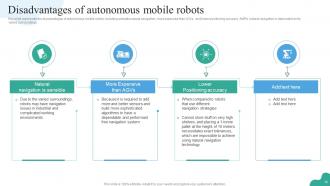
Slide 10: This slide represents the disadvantages of autonomous mobile robots, including sensible natural navigation, more expensive than AGVs, and lower positioning accuracy.
Slide 11: This slide exhibit table of content- Why adopt autonomous mobile robots (AMRs)?
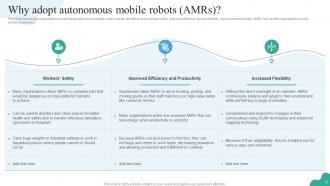
Slide 12: This slide depicts why organizations should adopt autonomous mobile robots, and its benefits.
Slide 13: This slide exhibit table of content- AMR architecture.
Slide 14: This slide depicts the autonomous mobile robot's architecture.
Slide 15: This slide represents the key considerations while choosing the proper AMR solution hardware.
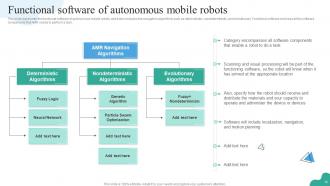
Slide 16: This slide represents the functional software of autonomous mobile robots.
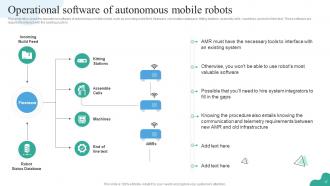
Slide 17: This slide talks about the operational software of autonomous mobile robots.
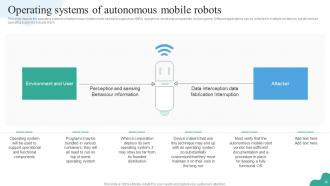
Slide 18: This slide depicts the operating systems of autonomous mobile robots needed to support an AMR's operations, functional components, and programs.
Slide 19: This slide exhibit table of content- Essential and system components.
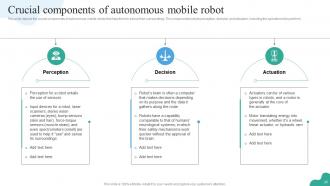
Slide 20: This slide depicts the crucial components of autonomous mobile robots that help them to sense their surroundings.
Slide 21: This slide represents how system components work together to enable autonomous mobile robots.
Slide 22: This slide exhibit table of content- Types of AMRs.
Slide 23: This slide represents the goods-to-person autonomous mobile robots that are further divided into two categories.
Slide 24: This slide outlines the collaborative mobile robots overview that assists the workers during each activity or operation.
Slide 25: This slide talks about the overview of autonomous forklifts and their types.
Slide 26: This slide represents the overview of enhanced sortation AMR solutions used for sorting in the warehouse.
Slide 27: This slide depicts the automated storage and retrieval system overview, a type of AMR.
Slide 28: This slide outlines the overview of autonomous unmanned aerial vehicles to provide real-time inventory information in the warehouse.
Slide 29: This slide depicts the overview of autonomous inventory robots that reduces manual inventory checks.
Slide 30: This slide exhibit table of content- Types of autonomous robotic system.
Slide 31: This slide talks about the overview of programmable automatic robots that are fist generation robots.
Slide 32: This slide represents the non-programmable automatic robot overview that is used for mass production in industries.
Slide 33: This slide outlines the overview of adaptive robots that are used for spraying and welding systems.
Slide 34: This slide explains the overview of intelligent robots equipped with sensors and microprocessors.
Slide 35: This slide exhibit table of content- Technological advances impacting AMRs.
Slide 36: This slide represents the hardware technological advances impacting autonomous mobile robots.
Slide 37: This slide depicts the software technological advances impacting the autonomous mobile robots.
Slide 38: This slide exhibit table of content- AMR safety and fleet manager.
Slide 39: This slide depicts the national and international safety standards and sensors installed for the safety of AMRs.
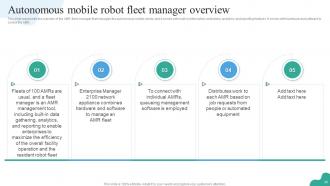
Slide 40: This slide represents the overview of the AMR fleet manager that manages the autonomous mobile robots.
Slide 41: This slide exhibit table of content- Applications of AMRs.
Slide 42: This slide describes the application of autonomous mobile robots in distribution centers.
Slide 43: This slide depicts the usage of autonomous mobile robots for cleaning and disinfection to eliminate the problems of the manual cleaning process.
Slide 44: This slide talks about applying autonomous robots in hospitals and the healthcare industry to fulfill tight budgets.
Slide 45: This slide outlines the application of robots to provide hospitality services in hotels and restaurants.
Slide 46: This slide represents the application of AMRs in grocery stores to help customers guide them to the location of the products they want.
Slide 47: This slide talks about using autonomous robots in last-mile delivery to deliver consumer products faster.
Slide 48: This slide describes the application of autonomous security robots to help security personnel.
Slide 49: This slide represents the application of AMRs in smart cities and public sectors to uplift the lifestyle.
Slide 50: This slide exhibit table of content- Difference between autonomous mobile robots and AGVs.
Slide 51: This slide represents the difference between autonomous mobile robots and automated guided vehicles.
Slide 52: This slide exhibit table of content- Pricing for AMRs building and installation.
Slide 53: This slide depicts the pricing for autonomous mobile robot development and installation.
Slide 54: This slide exhibit table of content- Timeline for autonomous mobile robots development.
Slide 55: This slide represents the timeline for autonomous mobile robot development, including the steps to be performed.
Slide 56: This slide exhibit table of content- Roadmap for autonomous mobile robots.
Slide 57: This slide describes the roadmap for autonomous mobile robot development, including the steps to be performed.
Slide 58: This slide exhibit table of content- Dashboard to track autonomous mobile robot performance.
Slide 59: This slide represents the dashboard to track the AMR’s performance in the warehouse.
Slide 60: This slide presents title for additional slides.
Slide 61: This is the icons slide.
Slide 62: This slide display Venn.
Slide 63: This slide shows puzzle for displaying elements of company.
Slide 64: This slide display Mind map.
Slide 65: This slide exhibits ideas generated.
Slide 66: This slide display Magnifying glass.
Slide 67: This slide display Target.
Slide 68: This slide display Financial.
Slide 69: This slide depicts 30-60-90 days plan for projects.
Slide 70: This slide depicts posts for past experiences of clients.
Slide 71: This is thank you slide & contains contact details of company like office address, phone no., etc.
Autonomous Mobile Robots IT Powerpoint Presentation Slides with all 76 slides:
Use our Autonomous Mobile Robots IT Powerpoint Presentation Slides to effectively help you save your valuable time. They are readymade to fit into any presentation structure.















FAQs for Autonomous Mobile Robots IT
Dude, the cost of LiDAR has dropped like crazy lately, plus it's way more accurate now. Computer vision is finally decent too - cameras can tell the difference between actual people and random objects (took long enough, right?). IMUs are getting super precise for balance stuff. But honestly? The coolest part is mixing all these sensors together. When you combine them, robots can map out spaces way better than before. If you're building something new, check out those solid-state LiDAR units - they're pretty solid.
So these robots basically combine sensors with smart algorithms to move around independently. LIDAR and cameras scan everything around them, building maps in real-time. They use this thing called SLAM - sounds fancy but it just means they're figuring out where they are while mapping new areas at the same time. Pretty neat stuff. Path-planning algorithms handle the route calculations to dodge obstacles efficiently. Oh, and indoor vs outdoor environments totally change which sensors you'll want to use - that's probably your first decision right there. The mapping tech has gotten really good lately too.
Warehousing is where the money's at right now - Amazon's fulfillment centers are basically robot cities at this point. Manufacturing's solid too, especially auto plants using them for parts and assembly stuff. Healthcare's been blowing up lately with bots delivering meds and supplies through hospitals (kinda wild watching them navigate those crazy hallways). Retail's finally getting on board with inventory bots, though they're still figuring it out. My cousin works in logistics and says the warehouse space is your best bet - clearest ROI and you won't have to convince anyone it works.
So basically, ML helps robots learn from what they encounter instead of just running on hardcoded instructions. They can figure out new stuff on the fly - dodging random obstacles or finding better routes when traffic sucks. What's pretty wild is how they process all that sensor data at once and make instant decisions. Oh, and if you're dealing with AMRs specifically, you'll definitely want diverse training data. Otherwise your robots might freak out when they hit something they haven't seen before in the real world.
Oh, they're actually pretty smart about safety! These robots use tons of sensors - LiDAR, cameras, ultrasonic stuff - to spot people and obstacles instantly. Speed limits are built right in, plus emergency stops and collision avoidance tech. Physical bumpers too, just in case. They stick to designated areas through geofencing (basically invisible boundaries), and there's always someone monitoring remotely who can jump in if things get weird. The whole system's built with backups for backups, which honestly makes me trust them more than most rideshare drivers I've had.
So they basically use wireless stuff like Wi-Fi or Zigbee to constantly chat with each other about where they are and what they're doing. Pretty much like a group text but for robots, which is kind of wild when you think about it. Some systems have a central "boss" coordinating everything, others let the robots figure it out themselves through consensus algorithms. The tricky part is making sure different robot brands can actually talk to each other - you need standardized protocols for that. Oh, and definitely figure out your bandwidth and latency needs first since that'll determine which wireless protocol actually works for your setup.
Honestly, the warehouse layout thing is probably gonna be your biggest headache. Most places weren't built with robots in mind, so you're looking at adding charging stations and safety zones everywhere. Integration with your current systems can be brutal too - those APIs rarely cooperate like they're supposed to. Your team will need solid training on working alongside the bots safely. Oh, and the ROI math gets messy when you account for all the downtime during setup. I'd definitely test it in just one section first before going all-in.
So basically your robot's sensors - lidar, cameras, ultrasonic stuff - are constantly watching for obstacles. When something new pops up (like someone walking by or furniture getting moved), it instantly recalculates the path. The robot can navigate around it, wait it out, or find a totally different route. It's honestly pretty impressive how fast this all happens in real-time. Oh and definitely keep those sensors clean - dirty sensors are like trying to drive with a muddy windshield. The whole sensor fusion thing is what makes modern robots actually useful instead of just bumping into everything.
Yeah so regulatory stuff is basically what decides if your AMRs can actually roll out or not. Safety standards, data privacy, permits - you gotta jump through all those hoops first. Honestly the rules are still being figured out since regulators can barely keep up with how fast this tech moves. Boston might ban something that's totally fine in San Francisco, which is annoying. I'd say get in touch with local authorities early on (like, really early) and maybe find some industry groups to join. They're usually working on shaping these standards anyway.
Honestly, these robots aren't really stealing jobs - they're just changing what people do. Manufacturing workers move from hauling stuff around to fixing and babysitting the robots instead. Hospitals are pretty cool about it too. Robots do the boring delivery runs and cleaning, so nurses can focus on actually helping patients. Companies still need humans who can troubleshoot when things go wrong or program new tasks. My cousin works in a factory and had to learn some basic coding, but he says it's way better than his old job. Bottom line - pick up some automation skills if you're in these fields. Jobs are evolving, not disappearing.
Honestly, it's pretty mixed depending on how companies use them. Yeah, AMRs can cut emissions by making delivery routes way more efficient - fewer trucks doing loops around neighborhoods. But manufacturing these things creates a decent carbon footprint, especially with all the batteries. Plus you've got the charging infrastructure sucking up more energy. When they die, that's more e-waste too. I'd say the benefits really depend on your specific situation. If you're looking into it, go for energy-efficient models and check what your local power grid runs on - that makes a huge difference in the actual impact.
You can totally customize AMRs with different hardware and software tweaks. Hardware's the easy part - just swap out grippers, add cameras for inspections, or whatever tools you need. The software side is honestly way cooler though. Program custom routes, hook it up to your warehouse management system, make it do specific tasks. Healthcare places throw disinfection modules on theirs, warehouses go for shelf-scanning stuff. My advice? Figure out exactly what you want it to do first, then work backwards from there to see what you'll actually need to modify.
For AMRs, lithium-ion is definitely the way to go - way better energy density and they last forever. Smart charging systems are clutch since they can top off during quick stops. Lead-acid might seem tempting because it's cheap, but trust me, dealing with all that weight isn't fun. If uptime's critical, look into swappable packs or wireless stations around your space. First figure out your robot's actual power needs during normal ops. Then add like 20-30% extra capacity on top - you don't want to cut it close. I learned that lesson the hard way once.
Honestly, just make it stupid simple for people to understand what the robot's doing. LED lights work great - like showing which direction it's heading. Voice commands are solid too, way better than those annoying beep codes nobody gets. Watch how people naturally try to talk to or gesture at your robots first, then build around that instead of making them learn weird new stuff. Real-time feedback is huge - people need to see what's happening next or they'll get anxious. Oh and gesture recognition doesn't have to be fancy, basic stuff works. Main thing is don't overthink it.
Dude, the AMR space is absolutely on fire right now - we're talking 20%+ growth yearly through 2030. AI and sensors are getting crazy good. Computer vision improvements alone are wild, plus the path planning is way more sophisticated than even two years ago. Healthcare and manufacturing companies are going all-in on deployments. Honestly? The human-robot collaboration stuff I've been seeing lately is borderline sci-fi. Fleet coordination too. Retail's jumping in hard now that the ROI actually makes sense - took long enough, right? If you're considering this for any projects, don't wait. The tech finally hit that sweet spot where it actually works reliably.
-
that's good
-
Easily Understandable slides.
-
Time saving slide with creative ideas. Help a lot in quick presentations..