

Machine Augmented Intelligence IT powerpoint presentation slides




Try Before you Buy Download Free Sample Product
 Impress Your
 Audience
 100%
100% Editable
 Save Hours
 of Time


Augmented intelligence offers a chance to make more accurate data driven decisions in businesses. Check out our Machine Augmented Intelligence IT template. It is professionally curated and briefly, overviews augmented intelligence, the firm providing its services, pricing, and a business training program. The lack of AI, the advantages of investing in augmented intelligence, the reasons companies should adopt it, and how it resolves the significant data issue are all covered in the presentation. Our Intelligence Amplification PPT exhibits the market size for augmented intelligence, the effect of COVID 19 on the market, and much more. The Cognitive Augmentation presentation includes an overview of the workings, benefits, tools, and strategies to create augmented intelligence for business. Additionally, it incorporates the uses of augmented intelligence in various industries, including manufacturing, retail, finance, healthcare, and logistical planning. Further, our Machine Augmented Intelligence module showcases a timeline, a roadmap, and a dashboard for tracking augmented intelligence. Lastly, it addresses the connection between artificial intelligence AI and augmented intelligence IA, training costs, and pricing for IA development. Get access now.
People who downloaded this PowerPoint presentation also viewed the following :
Content of this Powerpoint Presentation
Slide 1: This slide introduces Machine Augmented Intelligence (IT). Commence by stating Your Company Name.
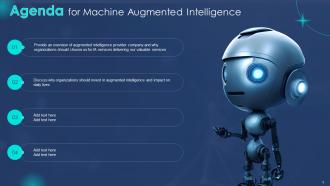
Slide 2: This slide depicts the Agenda of the presentation.
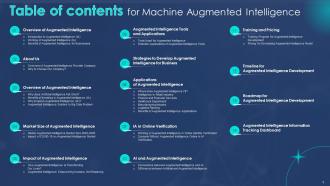
Slide 3: This slide incorporates the Table of contents.
Slide 4: This slide highlights the Title for the Topics to be covered further.
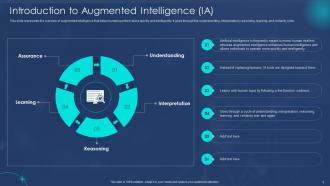
Slide 5: This slide represents the Introduction to Augmented Intelligence (IA).
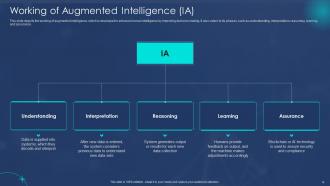
Slide 6: This slide shows the Working of Augmented Intelligence (IA).
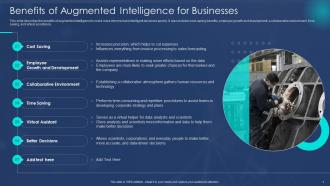
Slide 7: This slide describes the benefits of augmented intelligence to make more informed and intelligent decisions quickly.
Slide 8: This slide includes the Heading for the Components to be discussed in the upcoming template.
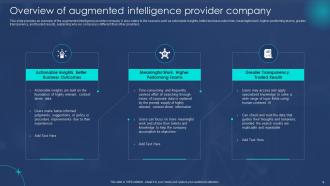
Slide 9: This slide provides an overview of the augmented intelligence provider company.
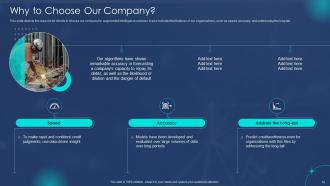
Slide 10: This slide depicts the reasons for clients to choose this company for augmented intelligence services.
Slide 11: This slide mentions the Title for the Ideas to be covered in the following template.
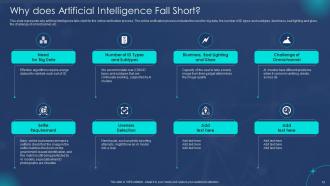
Slide 12: This slide represents why artificial intelligence falls short for the online verification process.
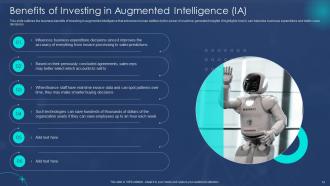
Slide 13: This slide outlines the business benefits of investing in augmented intelligence that enhances human abilities by the power of machine-generated insights.
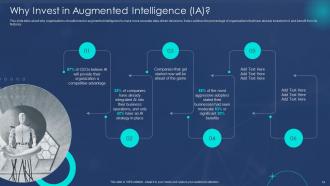
Slide 14: This slide talks about why organizations should invest in augmented intelligence to make more accurate data-driven decisions.
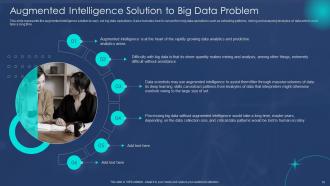
Slide 15: This slide represents the augmented intelligence solution to carry out big data operations.
Slide 16: This slide mentions the Heading for the Ideas to be covered further.
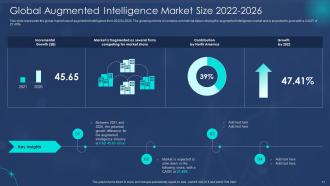
Slide 17: This slide deals with the Global Augmented Intelligence Market Size 2022-2026.
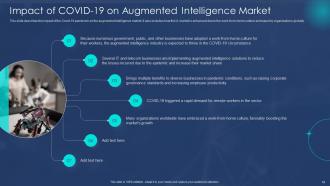
Slide 18: This slide describes the impact of the Covid-19 pandemic on the augmented intelligence market.
Slide 19: This slide incorporates the Title for the Components to be further discussed.
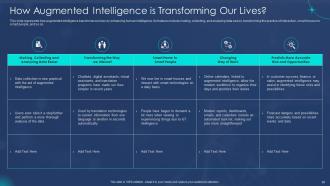
Slide 20: This slide represents how augmented intelligence transforms our lives by enhancing human intelligence.
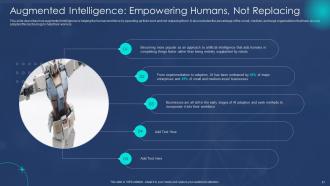
Slide 21: This slide describes how augmented intelligence is helping the human workforce by speeding up their work and not replacing them.
Slide 22: This slide exhibits the Heading for the Topics to be further discussed.
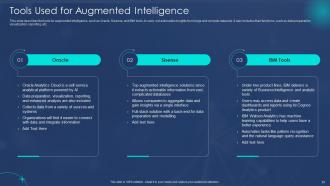
Slide 23: This slide states the Tools Used for Augmented Intelligence.
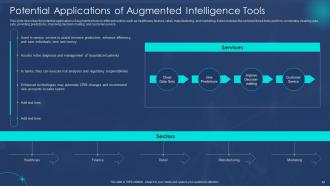
Slide 24: This slide presents the Potential Applications of Augmented Intelligence Tools.
Slide 25: This slide portrays the Title for the Topics to be discussed in the following template.
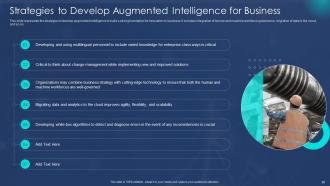
Slide 26: This slide represents the strategies to develop augmented intelligence to build a strong foundation for innovation in business.
Slide 27: This slide indicates the Heading for the Contents to be covered in the forth-coming template.
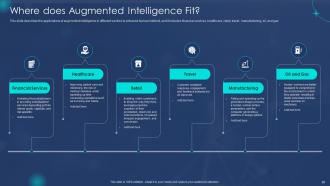
Slide 28: This slide describes the applications of augmented intelligence in different sectors to enhance human intellect.
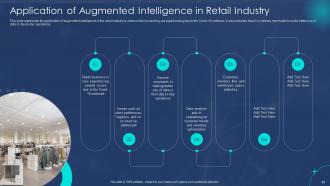
Slide 29: This slide presents the application of augmented intelligence in the retail industry to address the issues they are experiencing due to the Covid-19 outbreak.
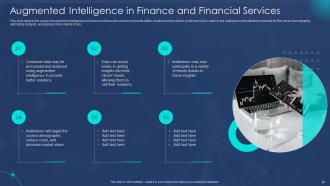
Slide 30: This slide depicts the usage of augmented intelligence in finance and financial services to provide better solutions to the client’s problems.
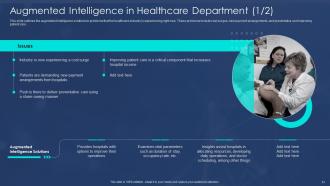
Slide 31: This slide outlines the augmented intelligence solutions to problems that the healthcare industry is experiencing right now.
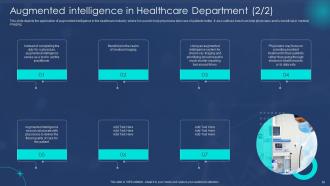
Slide 32: This slide continues the Augmented intelligence in Healthcare Department.
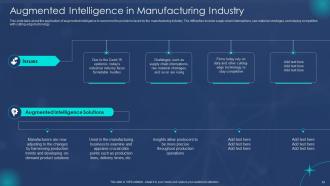
Slide 33: This slide talks about the application of augmented intelligence to overcome the problems faced by the manufacturing industry.
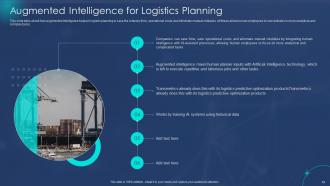
Slide 34: This slide displays the Augmented Intelligence for Logistics Planning.
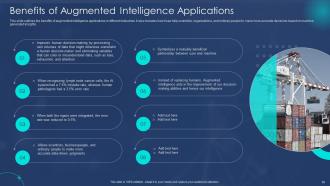
Slide 35: This slide outlines the benefits of augmented intelligence applications in different industries.
Slide 36: This slide indicates the Title for the Ideas to be further discussed.
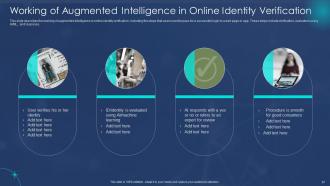
Slide 37: This slide describes the working of augmented intelligence in online identity verification.
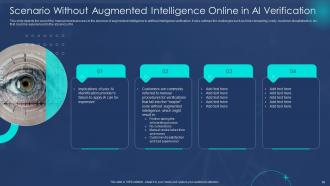
Slide 38: This slide depicts the cost of the manual review process in the absence of augmented intelligence in artificial intelligence verification.
Slide 39: This slide elucidates the Heading for the Ideas to be further discussed.
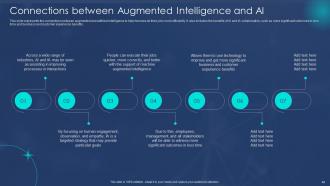
Slide 40: This slide represents the connections between augmented and artificial intelligence to help humans do their jobs more efficiently.
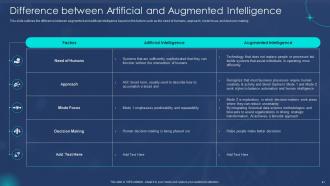
Slide 41: This slide outlines the difference between augmented and artificial intelligence.
Slide 42: This slide portrays the Title for the Components to be further discussed.
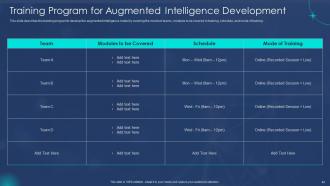
Slide 43: This slide shows the Training Program for Augmented Intelligence Development.
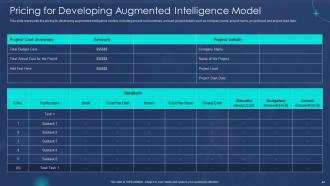
Slide 44: This slide reveals the pricing for developing augmented intelligence models.
Slide 45: This slide exhibits the Heading for the Topics to be discussed in the following template.
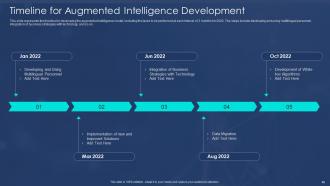
Slide 46: This slide presents the Timeline for Augmented Intelligence Development.
Slide 47: This slide showcases the Title for the Ideas to be further discussed.
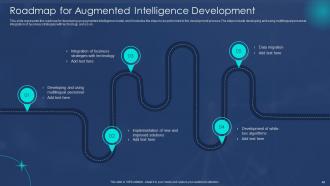
Slide 48: This slide presents the Roadmap for Augmented Intelligence Development.
Slide 49: This slide depicts the Heading for the Ideas to be covered in the forth-coming template.
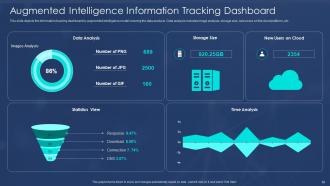
Slide 50: This slide reveals the Augmented Intelligence Information Tracking Dashboard.
Slide 51: This is the Icons slide containing all the Icons used in the plan.
Slide 52: This slide depicts Additional information.
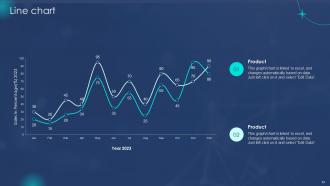
Slide 53: This slide elucidates the Line chart.
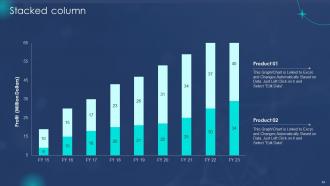
Slide 54: This slide reveals the Stacked column.
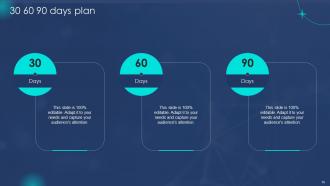
Slide 55: This is the 30 60 90 days plan slide for effective planning.
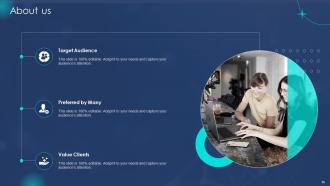
Slide 56: This is the About us slide. State your Company-related information here.
Slide 57: This is our Meet our awesome team slide for listing the team-related information.
Slide 58: This slide contains the Post it notes for reminders and deadlines.
Slide 59: This slide highlights the Organization's Timeline.
Slide 60: This slide showcases the SWOT analysis.
Slide 61: This is the Puzzle slide with related imagery.
Slide 62: This is the Thank You slide for acknowledgement.
Machine Augmented Intelligence IT powerpoint presentation slides with all 67 slides:
Use our Machine Augmented Intelligence IT powerpoint presentation slides to effectively help you save your valuable time. They are readymade to fit into any presentation structure.







FAQs for Machine Augmented Intelligence IT
Machine augmented intelligence enhances human decision-making by combining human intuition with AI capabilities, while artificial intelligence operates independently to automate tasks without human intervention. This strategic combination enables professionals in finance, healthcare, and manufacturing to leverage computational power for complex analysis while maintaining human oversight, ultimately delivering faster insights and better outcomes than either approach alone.
Organizations integrate machine augmented intelligence by identifying repetitive tasks suitable for automation, training employees on collaborative AI tools, and implementing gradual rollouts with continuous feedback loops. Through strategic integration, companies in manufacturing, healthcare, and finance streamline operations, enhance decision-making accuracy, and reduce processing times, while employees focus on higher-value strategic activities, ultimately delivering improved efficiency and competitive advantage.
Healthcare, finance, manufacturing, and retail industries benefit most from machine augmented intelligence through enhanced decision-making capabilities, automated processes, and improved customer experiences. These sectors leverage human expertise combined with AI insights to streamline operations, reduce costs, and deliver faster services, with hospitals improving diagnostics, banks accelerating loan approvals, and manufacturers optimizing production efficiency.
Machine augmented intelligence enhances business decision-making by combining human judgment with AI's data processing capabilities, predictive analytics, and pattern recognition. Through these systems, organizations streamline risk assessment, accelerate strategic planning, and minimize cognitive biases, with many financial services and healthcare institutions finding that augmented approaches deliver faster, more accurate decisions while preserving critical human oversight.
Key ethical considerations include data privacy protection, algorithmic bias mitigation, transparency in decision-making processes, human oversight maintenance, and ensuring equitable access to AI benefits. Organizations must balance automation efficiency with workforce impact, establish clear accountability frameworks, and maintain human agency in critical decisions, with many financial services and healthcare institutions finding that proactive ethical guidelines enhance customer trust while delivering competitive advantage.
Machine augmented intelligence improves customer experiences by enabling personalized recommendations, faster response times, predictive support, intelligent chatbots, and seamless omnichannel interactions. Through real-time data analysis, businesses streamline customer journeys, anticipate needs, and deliver proactive solutions, with retail and financial services finding significantly enhanced satisfaction rates and reduced resolution times.
Businesses can measure machine augmented intelligence success through key performance indicators like operational efficiency gains, decision accuracy improvements, time-to-insight reductions, and employee productivity metrics. Through comprehensive analytics dashboards, organizations track cost savings, faster processing times, and enhanced customer experiences, with many financial services and healthcare institutions finding that combining quantitative ROI measurements with qualitative user satisfaction scores delivers the most strategic insights.
Data quality serves as the foundation for machine augmented intelligence effectiveness, directly impacting accuracy, reliability, and decision-making capabilities through clean, consistent, and comprehensive datasets. Poor data quality can lead to biased algorithms and flawed insights, while high-quality data enables organizations in healthcare, finance, and retail to achieve more precise predictions, streamlined operations, and ultimately deliver superior customer experiences and competitive advantages.
Machine augmented intelligence supports remote and hybrid work environments by automating routine tasks, enhancing collaboration through intelligent scheduling and communication tools, and providing real-time insights for decision-making. These technologies streamline workflow management, enable seamless knowledge sharing across distributed teams, and deliver personalized productivity recommendations, with many organizations finding that augmented intelligence ultimately enhances team coordination and operational efficiency.
Organizations adopting machine augmented intelligence tools face challenges including data quality issues, employee resistance to change, integration complexities with existing systems, skill gaps, and initial implementation costs. However, these obstacles present opportunities for strategic workforce development and operational enhancement, with many companies finding that phased rollouts, comprehensive training programs, and clear communication about human-AI collaboration ultimately deliver improved productivity and competitive advantage.
Machine augmented intelligence enhances human problem-solving by providing rapid data processing, pattern recognition, and analytical capabilities that complement human creativity, intuition, and contextual understanding. Through strategic collaboration, organizations in healthcare, finance, and manufacturing leverage AI's computational power alongside human expertise, ultimately delivering faster decision-making, reduced errors, and innovative solutions.
Businesses should monitor conversational AI evolution, automated decision-making integration, predictive analytics advancement, human-AI collaboration platforms, and real-time data processing capabilities. These emerging trends enable organizations to streamline operations, enhance customer experiences, and accelerate strategic decisions, with many financial services and healthcare institutions finding that early adoption delivers significant competitive advantages in increasingly data-driven markets.
Startups leverage machine augmented intelligence by combining human creativity with AI-powered data analysis, automated market research, and predictive customer insights to accelerate product development and decision-making. Through these strategic combinations, entrepreneurs streamline operations, enhance customer experiences, and identify market opportunities faster than traditional methods, ultimately delivering competitive advantages in increasingly dynamic markets.
Professionals working with machine augmented intelligence need data analysis skills, programming knowledge in Python or R, statistical understanding, domain expertise in their specific field, and strong critical thinking abilities. These competencies enable workers to interpret AI outputs, validate recommendations, and make strategic decisions, with many organizations finding that combining technical training with industry knowledge delivers the most effective human-AI collaboration and competitive advantage.
Machine augmented intelligence transforms hiring and talent management by automating resume screening, predicting candidate success, and identifying skill gaps through data analysis. These AI-powered systems enable HR teams to process applications faster, reduce unconscious bias in selection, and match candidates more precisely to roles, while delivering improved hiring outcomes and strategic workforce planning capabilities.
-
Understandable and informative presentation.
-
Qualitative and comprehensive slides.