

Types Of Autonomous Robotic System Powerpoint Presentation Slides




Try Before you Buy Download Free Sample Product
 Impress Your
 Audience
 100%
100% Editable
 Save Hours
 of Time


This PowerPoint presentation provides a comprehensive overview of autonomous mobile robots AMRs, including their advantages and disadvantages. The Types of Autonomous Robotic System IT PowerPoint Presentation covers the reasons why companies should consider adopting AMRs, as well as the architecture, functional and operational software, and operating system of these robots. It also includes a breakdown of the system components of AMRs and the different types of AMRs available, such as goods-to-person, collaborative, autonomous forklifts, and automated storage and retrieval systems. Additionally, the presentation highlights the various types of AMR systems, such as programmable, non-programmable, adaptive, and intelligent systems. The Autonomous Mobile Robots Architecture template also discusses the technological advancements impacting AMRs and the safety considerations to be aware of when working with these robots. Furthermore, it includes an overview of fleet management and the different applications of AMRs across various industries. The presentation also includes a comparison between AMRs and AGVs, as well as pricing information for building AMRs. Finally, the template features slides with a timeline, a roadmap for AMR development, and a dashboard to track the performance of autonomous mobile robots. Download our editable and customizable template, which is compatible with Google Slides.
People who downloaded this PowerPoint presentation also viewed the following :
Content of this Powerpoint Presentation
Slide 1: This slide introduces Types of Autonomous Robotic System (IT). State your company name and begin.
Slide 2: This slide states Agenda of the presentation.
Slide 3: This slide shows Table of Content for the presentation.
Slide 4: This is another slide continuing Table of Content for the presentation.
Slide 5: This slide highlights title for topics that are to be covered next in the template.
Slide 6: This slide represents the introduction of autonomous mobile robots, and it also includes the market value in 2021 and the estimated CAGR rate by 2027.
Slide 7: This slide depicts why AMRs are called mobile robots by explaining their various features.
Slide 8: This slide describes why AMR is called an autonomous robot, as they do not need human assistance to navigate through the production area.
Slide 9: This slide represents the benefits for organizations working with AMRs for more profitable operations.
Slide 10: This slide represents the disadvantages of autonomous mobile robots, including sensible natural navigation, more expensive than AGVs, and lower positioning accuracy.
Slide 11: This slide highlights title for topics that are to be covered next in the template.
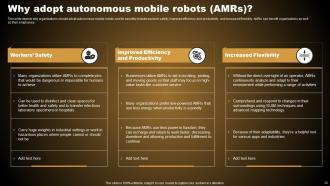
Slide 12: This slide depicts why organizations should adopt autonomous mobile robots, and its benefits.
Slide 13: This slide highlights title for topics that are to be covered next in the template.
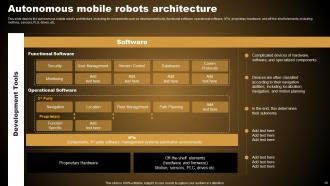
Slide 14: This slide depicts the autonomous mobile robot's architecture.
Slide 15: This slide represents the key considerations while choosing the proper AMR solution hardware.
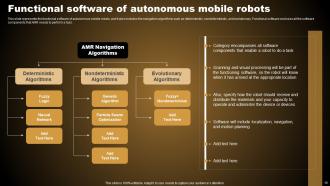
Slide 16: This slide represents the functional software of autonomous mobile robots.
Slide 17: This slide talks about the operational software of autonomous mobile robots.
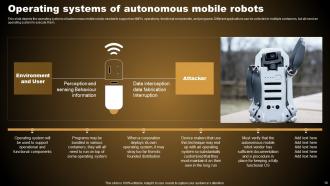
Slide 18: This slide depicts the operating systems of autonomous mobile robots needed to support an AMR's operations, functional components, and programs.
Slide 19: This slide highlights title for topics that are to be covered next in the template.
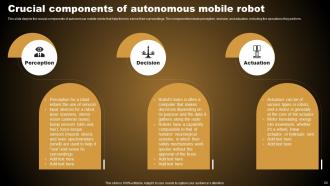
Slide 20: This slide depicts the crucial components of autonomous mobile robots that help them to sense their surroundings.
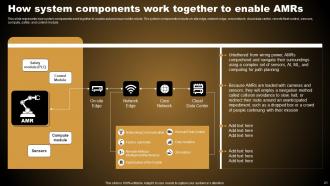
Slide 21: This slide represents how system components work together to enable autonomous mobile robots.
Slide 22: This slide highlights title for topics that are to be covered next in the template.
Slide 23: This slide represents the goods-to-person autonomous mobile robots that are further divided into two categories.
Slide 24: This slide outlines the collaborative mobile robots overview that assists the workers during each activity or operation.
Slide 25: This slide talks about the overview of autonomous forklifts and their types.
Slide 26: This slide represents the overview of enhanced sortation AMR solutions used for sorting in the warehouse.
Slide 27: This slide depicts the automated storage and retrieval system overview, a type of AMR.
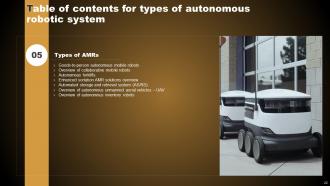
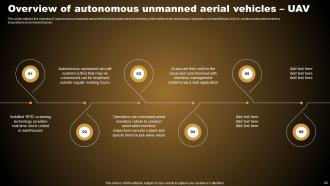
Slide 28: This slide outlines the overview of autonomous unmanned aerial vehicles to provide real-time inventory information in the warehouse.
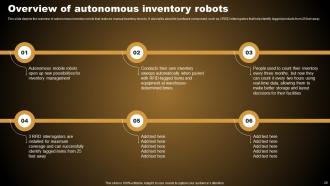
Slide 29: This slide depicts the overview of autonomous inventory robots that reduces manual inventory checks.
Slide 30: This slide highlights title for topics that are to be covered next in the template.
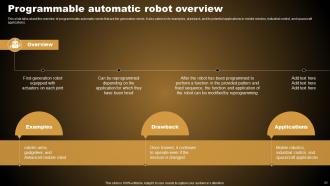
Slide 31: This slide talks about the overview of programmable automatic robots that are fist generation robots.
Slide 32: This slide represents the non-programmable automatic robot overview that is used for mass production in industries.
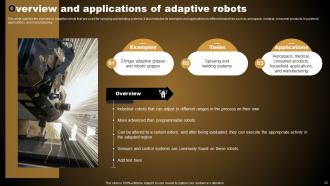
Slide 33: This slide outlines the overview of adaptive robots that are used for spraying and welding systems.
Slide 34: This slide explains the overview of intelligent robots equipped with sensors and microprocessors.
Slide 35: This slide highlights title for topics that are to be covered next in the template.
Slide 36: This slide represents the hardware technological advances impacting autonomous mobile robots.
Slide 37: This slide depicts the software technological advances impacting the autonomous mobile robots.
Slide 38: This slide highlights title for topics that are to be covered next in the template.
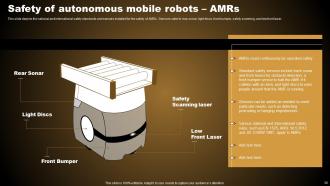
Slide 39: This slide depicts the national and international safety standards and sensors installed for the safety of AMRs.
Slide 40: This slide represents the overview of the AMR fleet manager that manages the autonomous mobile robots.
Slide 41: This slide highlights title for topics that are to be covered next in the template.
Slide 42: This slide describes the application of autonomous mobile robots in distribution centers.
Slide 43: This slide depicts the usage of autonomous mobile robots for cleaning and disinfection to eliminate the problems of the manual cleaning process.
Slide 44: This slide talks about applying autonomous robots in hospitals and the healthcare industry to fulfill tight budgets.
Slide 45: This slide outlines the application of robots to provide hospitality services in hotels and restaurants.
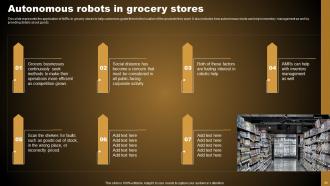
Slide 46: This slide represents the application of AMRs in grocery stores to help customers guide them to the location of the products they want.
Slide 47: This slide talks about using autonomous robots in last-mile delivery to deliver consumer products faster.
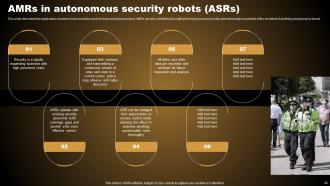
Slide 48: This slide describes the application of autonomous security robots to help security personnel.
Slide 49: This slide represents the application of AMRs in smart cities and public sectors to uplift the lifestyle.
Slide 50: This slide exhibit table of content- Difference between autonomous mobile robots and AGVs.
Slide 51: This slide represents the difference between autonomous mobile robots and automated guided vehicles.
Slide 52: This slide exhibit table of content- Pricing for AMRs building and installation.
Slide 53: This slide depicts the pricing for autonomous mobile robot development and installation.
Slide 54: This slide exhibit table of content- Timeline for autonomous mobile robots development.
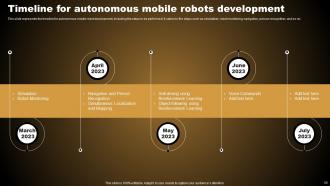
Slide 55: This slide represents the timeline for autonomous mobile robot development, including the steps to be performed.
Slide 56: This slide highlights title for topics that are to be covered next in the template.
Slide 57: This slide describes the roadmap for autonomous mobile robot development, including the steps to be performed.
Slide 58: This slide highlights title for topics that are to be covered next in the template.
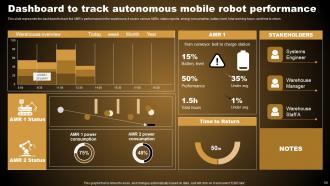
Slide 59: This slide represents the dashboard to track the AMR’s performance in the warehouse.
Slide 60: This slide is titled as Additional Slides for moving forward.
Slide 61: This slide contains all the icons used in this presentation.
Slide 62: This slide depicts Venn diagram with text boxes.
Slide 63: This slide contains Puzzle with related icons and text.
Slide 64: This slide displays Mind Map with related imagery.
Slide 65: This is an Idea Generation slide to state a new idea or highlight information, specifications etc.
Slide 66: This slide showcases Magnifying Glass to highlight information, specifications etc
Slide 67: This is a Financial slide. Show your finance related stuff here.
Slide 68: This slide provides 30 60 90 Days Plan with text boxes.
Slide 69: This slide shows Post It Notes. Post your important notes here.
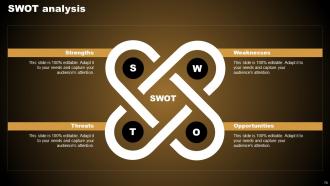
Slide 70: This slide shows SWOT describing- Strength, Weakness, Opportunity, and Threat.
Slide 71: This is a Timeline slide. Show data related to time intervals here.
Slide 72: This is About Us slide to show company specifications etc.
Slide 73: This is Our Mission slide with related imagery and text.
Slide 74: This is a Thank You slide with address, contact numbers and email address.
Types Of Autonomous Robotic System Powerpoint Presentation Slides with all 79 slides:
Use our Types Of Autonomous Robotic System Powerpoint Presentation Slides to effectively help you save your valuable time. They are readymade to fit into any presentation structure.

































FAQs for Types Of Autonomous Robotic System
So basically you've got four main pieces: sensors, processing power, actuators, and the algorithms that make decisions. Cameras and lidar collect data from around the robot. Then your processing unit figures out what to do with all that info and plans the next move. Actuators are like the robot's muscles - they actually carry out the movements. But honestly, the software is where things get interesting. You need algorithms that can see, plan ahead, and adapt on their own. It's like giving a robot eyes, a brain, and hands that actually talk to each other. Figure out which part matters most for what you're building first.
So basically they use a bunch of different sensors - cameras, lidar, radar, those ultrasonic things. All that data gets processed to spot obstacles and figure out where to go next. It's pretty wild how they combine everything together (called sensor fusion) to actually "see" what's around them. Like giving a robot spatial awareness, you know? Oh, and if you're messing around with this stuff - definitely get your sensor calibration dialed in first. That's where things usually go wrong. Trust me on that one, learned it the hard way lol.
So AI is what makes robots actually think instead of just running basic code. They can process all that sensor data and spot patterns - super useful when your delivery bot hits traffic or some random obstacle. Machine learning means they actually improve over time, which honestly blows my mind sometimes. Short sentences work. Without AI, you'd just get simple if-then responses, but now they can reason through problems autonomously. If you're building these systems, train them on tons of different scenarios so they won't freak out when something weird happens they've never seen.
Honestly, the worst part is dealing with all the stuff your robot hasn't seen before - like weird lighting or random obstacles. Sensors fail constantly, so you need backups for everything. Testing is a total pain too. Real-world tests cost a fortune and simulations miss half the problems anyway. Hardware breaks, software crashes, components stop talking to each other... it's endless. Oh and don't even get me started on trying to predict every possible failure mode. My take? Do hazard analysis early and build redundancy into literally everything from the start.
Manufacturing's where I'm seeing the craziest changes - those assembly line robots are insanely efficient now. Amazon's warehouses are basically run by bots at this point, which is kinda scary when you think about it. Healthcare's blowing up too with surgical robots and patient care systems. Oh, and farming! Autonomous tractors everywhere. My cousin works in ag tech and says it's wild how much has changed in just five years. If you're thinking investments or switching careers, I'd definitely look at those areas since they're scaling super fast right now.
Honestly, ethics is driving pretty much every big call in autonomous robotics these days. Who's liable when that delivery robot smacks into someone? That question alone keeps lawyers up at night. Privacy stuff with all the data they're hoovering up is another headache. Plus there's the whole job displacement thing - which, let's be real, is happening whether we talk about it or not. Most companies are throwing together ethics boards and baking transparency into their systems early. Way easier than trying to fix it after you've already shipped something broken.
So basically, it's about how much humans stay in the loop. Fully autonomous means the system handles everything on its own - no human needed. Semi-autonomous still requires people to jump in for certain decisions or tricky situations. Most industrial robots you'll see are semi-autonomous honestly, because companies don't trust machines with all the complex judgment calls yet. Makes sense when you think about it. Full autonomy mostly happens in super controlled spaces like Amazon warehouses. For your situation, just think about how much babysitting your team can actually handle day-to-day.
So basically your robot uses sensors to constantly scan what's around it, then machine learning kicks in to figure out weird new stuff it hasn't seen before. The cool part? It actually gets better over time by learning from mistakes. You'll want solid sensor fusion - that's where multiple sensors work together instead of just one doing all the heavy lifting. Also build in backup plans because robots are gonna encounter random crap you never thought of. The perception system has to be rock solid, paired with algorithms that can roll with uncertainty. Pretty fascinating how they adapt on the fly honestly.
Honestly, LiDAR's gotten so much cheaper lately - and way smaller too. Computer vision can handle multiple camera feeds at once now, which is pretty wild. Solid-state sensors are replacing the old mechanical ones since they don't break as easily in rough conditions. The GPS/IMU combo accuracy is insane though, like sub-centimeter precise. Makes me wonder how we even navigated before lol. But here's the thing - it's all about how these sensors talk to each other now. They're sharing data to build these crazy detailed 3D maps. If you're building something autonomous, definitely check out sensor fusion frameworks. That's where things get really interesting.
Think of communication protocols as your robots' way of staying in touch - they decide how fast and reliably bots share stuff like where they are, what they're doing, environmental data. Bad protocols? You get dropped connections, collisions, robots basically doing their own thing (trust me, it's chaos). Your choice here impacts everything. High bandwidth lets you do cool complex coordination but kills batteries way faster. Lightweight protocols save power but you're stuck with basic functionality. Honestly, I'd start by figuring out your latency needs first - makes picking the right one way easier.
Yeah, robots are gonna wipe out tons of manufacturing and warehouse jobs - no sugarcoating that. Repetitive stuff gets hit first. But honestly? New tech always kills some jobs while creating weird new ones we never thought of. Like, who knew "drone pilot" would be a real career 10 years ago? Problem is the new gigs need totally different skills than what got automated away. My advice - focus on stuff robots suck at. Creative thinking, dealing with people, solving messy problems that don't have clear answers. Those skills actually make you more valuable, not replaceable.
Okay so first things first - encrypt everything. Communications, data, the works. Physical security is honestly where most people mess up though - anyone can just walk up and plug in a USB if you're not careful. Set up proper authentication for remote access, and definitely segment your network so the robots aren't connected to anything critical. Regular pen testing is a must since hackers get craftier every day. Oh, and secure boot processes! Start by figuring out where you're most vulnerable right now and tackle those spots first.
Robots are gonna get so much smarter with AI integration - they'll actually learn instead of just running the same programs over and over. Hardware's getting cheaper too, which is huge. Edge computing means they won't need constant internet connection to function properly. The coolest part? Different robot systems will start sharing knowledge with each other. Human-robot teamwork is becoming the norm rather than robots just taking over jobs completely. Oh, and if you're thinking about investing in this stuff, definitely look for platforms that can adapt and play nice with other systems. That's where the real money will be.
Hey! So there's actually some pretty solid stuff happening with energy efficiency right now. Better batteries are obvious, but the smart power management algorithms are where it gets interesting. Dynamic voltage scaling is becoming the go-to move if you're doing autonomous systems - definitely worth checking out. Solar panels and kinetic recovery are still kinda early but cool to watch. The AI power allocation systems that learn usage patterns? Those are probably the biggest game-changers. Oh, and adaptive motion planning for route optimization saves way more power than you'd think. Sleep modes for non-essential stuff helps too obviously.
Honestly, you'll want to lean heavily into simulation first. Think of it as your crash-test dummy phase - you can break things digitally without destroying actual hardware or teaching your bot to plow through drywall (been there). Run tons of scenarios to catch weird edge cases before they bite you in real life. The physics engines these days are pretty solid, so start simple and work up to more complex stuff. I always tell people simulation saves your butt and your budget. Once you've debugged everything virtually, then move to physical testing. Way less stressful that way.
-
Templates are beautiful and easy to use. An amateur can also create a presentation using these slides. It is amazing.
-
I am glad to have come across Slideteam. I was searching for some unique presentations and templates for my business. There are a lot of alternatives available here.