

Behavioral theory of management by elton mayo leadership and management learning outcomes ppt summary




Try Before you Buy Download Free Sample Product
 Impress Your
 Audience
 100%
100% Editable
 Save Hours
 of Time


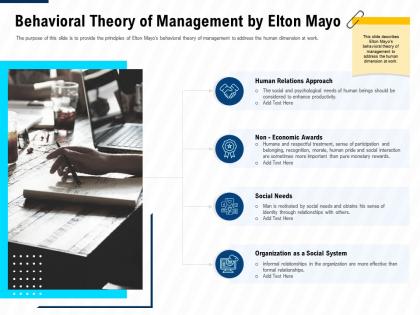
The purpose of this slide is to provide the principles of Elton Mayos behavioral theory of management to address the human dimension at work.
People who downloaded this PowerPoint presentation also viewed the following :
Behavioral theory of management by elton mayo leadership and management learning outcomes ppt summary with all 2 slides:
Use our Behavioral Theory Of Management By Elton Mayo Leadership And Management Learning Outcomes Ppt Summary to effectively help you save your valuable time. They are readymade to fit into any presentation structure.

FAQs for Behavioral theory of management by elton mayo leadership and management learning
Behavioral management theory emphasizes human relationships, motivation, and social dynamics, focusing on employee satisfaction, team collaboration, and participatory decision-making rather than rigid hierarchical control. Unlike classical theories that prioritize efficiency through standardized processes, behavioral approaches recognize that motivated employees drive productivity, with organizations in healthcare, technology, and manufacturing finding that emphasizing communication and employee engagement ultimately delivers higher performance and competitive advantage.
The behavioral approach emphasizes employee motivation and morale by recognizing that human factors, psychological needs, and workplace relationships directly impact productivity, job satisfaction, and organizational performance. Through understanding individual behaviors, team dynamics, and communication patterns, managers can enhance employee engagement, reduce turnover, and create supportive work environments, with many organizations finding that prioritizing employee well-being ultimately delivers stronger business results and competitive advantage.
Leadership serves as the central catalyst in behavioral theory, focusing on understanding employee motivations, fostering positive relationships, and adapting management styles to individual and group needs. Effective leaders apply these principles by actively listening to their teams, providing meaningful recognition, creating collaborative environments, and tailoring their approaches based on employee behaviors and preferences, ultimately delivering enhanced productivity, reduced turnover, and stronger organizational culture across diverse industries.
Understanding group dynamics improves team performance by identifying communication patterns, role clarity, and conflict resolution mechanisms that enhance collaboration and productivity. Through behavioral management principles, leaders can leverage team member strengths, establish clear expectations, and create psychological safety, with many organizations finding that structured group processes ultimately deliver higher engagement, reduced turnover, and measurable performance improvements.
Behavioral management theory contributes to conflict resolution by emphasizing understanding individual motivations, improving communication patterns, and fostering collaborative team dynamics through structured interpersonal approaches. This framework enables managers to address underlying behavioral causes of conflict, implement targeted intervention strategies, and create supportive environments that transform workplace disputes into opportunities for enhanced team cohesion and productivity.
Employee perceptions and attitudes are central to behavioral theory, as they directly influence motivation, productivity, and workplace relationships through individual interpretations of management actions, organizational culture, and job satisfaction levels. Understanding these psychological factors enables managers to create supportive environments, address concerns proactively, and tailor leadership approaches, ultimately enhancing team performance and organizational effectiveness.
Behavioral management techniques that foster positive organizational culture include regular feedback sessions, team-building activities, recognition programs, open communication channels, and collaborative goal-setting processes. These approaches enhance employee engagement, trust, and motivation by emphasizing interpersonal relationships and social dynamics, with many organizations finding that consistent application ultimately delivers improved productivity, reduced turnover, and stronger competitive advantage.
Managers can utilize feedback mechanisms by implementing regular performance reviews, real-time coaching sessions, peer evaluations, goal-setting conferences, and recognition programs that directly connect individual actions to organizational objectives. Through these structured approaches, companies like retail chains and financial services firms enhance employee alignment, accelerate performance improvement, and ultimately deliver stronger organizational outcomes while building more engaged, purpose-driven teams.
Emotional intelligence significantly enhances behavioral management implementation by improving leader-employee communication, enabling accurate emotional assessment, and facilitating empathetic responses to workplace dynamics. Through heightened emotional awareness, managers in healthcare, retail, and financial services streamline conflict resolution, enhance team collaboration, and deliver more personalized motivational approaches, ultimately creating stronger organizational cultures and improved performance outcomes.
Organizations can measure behavioral management effectiveness through employee engagement surveys, productivity metrics, retention rates, absenteeism tracking, and performance evaluations. These measurement tools enable companies to assess how behavioral interventions impact motivation, collaboration, and output, with many finding that regular feedback mechanisms, goal-setting assessments, and team dynamics evaluations ultimately deliver improved workplace satisfaction and measurable productivity gains.
Managers face resistance to change, difficulty measuring behavioral outcomes, and the need for extensive training in interpersonal skills and employee psychology. This transition requires patience and resource investment, as behavioral approaches demand more time for relationship-building and individualized management styles, with many organizations finding that initial productivity dips before long-term engagement improvements emerge.
Behavioral theory informs training program development by emphasizing observation, modeling, and reinforcement to shape interpersonal behaviors through role-playing exercises, peer feedback systems, and structured practice scenarios. Organizations leverage these principles to create comprehensive programs that enhance communication skills, conflict resolution abilities, and team collaboration, with many companies finding that behavior-based training delivers measurable improvements in employee engagement and workplace productivity.
The Hawthorne Effect demonstrates that worker productivity increases when employees know they're being observed, revealing the critical importance of attention and recognition in workplace performance. This foundational behavioral management principle enables organizations to enhance employee engagement through strategic observation, feedback systems, and recognition programs, with many companies finding that simple acknowledgment of worker contributions delivers significant productivity gains and improved workplace morale.
Behavioral theory emphasizes understanding employee needs, motivation, and interpersonal dynamics, which directly addresses remote work challenges like isolation, communication barriers, and maintaining team cohesion. Organizations applying these principles focus on creating psychological safety in virtual environments, fostering digital collaboration through empathetic leadership, and designing remote policies that prioritize employee well-being, ultimately delivering higher engagement and productivity.
Managers can foster employee engagement through positive reinforcement, participative decision-making, flexible leadership styles, regular feedback systems, and recognition programs that align with individual motivational drivers. By understanding diverse behavioral patterns, organizations in sectors like healthcare, retail, and financial services enhance team collaboration, reduce turnover, and ultimately deliver improved productivity while creating supportive workplace cultures that drive competitive advantage.
-
Innovative and attractive designs.
-
Informative presentations that are easily editable.
-
Best way of representation of the topic.