

Bureaucratic theory of management by max weber leadership and management learning outcomes ppt portfolio




Try Before you Buy Download Free Sample Product
 Impress Your
Audience
 100%
Editable
 Save Hours
of Time


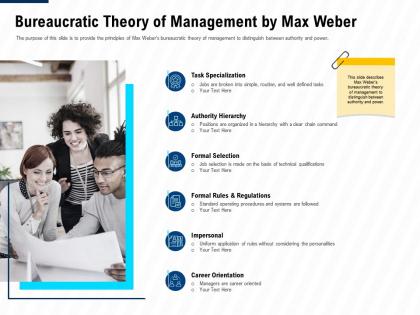
The purpose of this slide is to provide the principles of Max Webers bureaucratic theory of management to distinguish between authority and power.
People who downloaded this PowerPoint presentation also viewed the following :
Bureaucratic theory of management by max weber leadership and management learning outcomes ppt portfolio with all 2 slides:
Use our Bureaucratic Theory Of Management By Max Weber Leadership And Management Learning Outcomes Ppt Portfolio to effectively help you save your valuable time. They are readymade to fit into any presentation structure.


FAQs for Bureaucratic theory of management by max weber leadership and management learning
So Weber had these six main ideas about bureaucracy. You've got your classic hierarchy with clear chain of command, formal rules everyone has to follow, and specialized roles based on actual skills. No playing favorites either - everything stays impersonal and professional. People get hired and promoted based on merit, not who they know (wild concept, right?). Oh, and documentation for literally everything. The whole point was making organizations super efficient and cutting out corruption. Honestly, walk into any big company today and you'll see his fingerprints all over their structure and endless policy handbooks.
Oh man, bureaucratic management is such a double-edged sword. You get really clear hierarchies and everyone knows their role, which honestly does help things run smoother. But here's the thing - it makes companies slow as molasses when they need to change direction fast. I've watched teams get completely stuck in paperwork hell when a quick decision could've solved everything. You definitely need some structure so things don't fall apart, but too much and you'll kill any chance of innovation. Maybe start with your core processes standardized, then leave wiggle room for the weird situations that always pop up.
So basically, bureaucratic setups give you solid hierarchies and everyone knows exactly what they're doing. Super consistent processes, less office politics, better accountability - all that good stuff. But here's the thing: it can turn your workplace into the DMV pretty fast. Everything slows down because changes have to go through like five different people first. Your creative employees might get frustrated since they can't just... do things, you know? I'd probably test it out in one department first instead of overhauling everything. Really depends if you value stability over being able to pivot quickly when shit hits the fan.
Honestly, bureaucratic management is pretty good for accountability because everyone gets super specific roles and knows exactly who they report to. No confusion about whose fault it is when stuff hits the fan (though that can be stressful too). You'll have documented procedures for literally everything, so people can't pull the "nobody told me how to do this" card. The formal structure makes it way easier to track who's doing what and hold them responsible. My advice? Write clear job descriptions and do regular check-ins - it really works.
So Weber's bureaucratic theory actually *loves* hierarchy - thinks it's the solution to everything. Clear chains of command mean everyone knows who's boss and who reports where. No more confusion or playing favorites since authority comes from your job title, not who you're buddies with. Well, that's the theory anyway lol. The whole point is formal rules make things fairer and more efficient. Your team sounds like it needs better job descriptions and clearer reporting lines. Sometimes the boring stuff actually works.
Think of standardization as the thing that keeps massive organizations from completely falling apart. Bureaucracies create these uniform procedures and rules that everyone has to follow - same forms, same decision-making process, same way of handling tasks across every department. Honestly, it's kind of brilliant in a boring way. You can actually predict what'll happen when you submit that loan application or file a complaint because there's a set process for everything. Next time you're dealing with any bureaucratic mess, just find their standardized procedures first. That's your roadmap right there.
Keep the solid structural bits but ditch whatever's slowing you down. Clear roles and accountability? That stuff's actually valuable. But you'll want flexibility for when markets go crazy. Some teams I know do this "structured agility" thing - they've got decent processes but people can skip approval chains during emergencies. Honestly, half the time those approval steps exist just because nobody questioned them. Document your standards and keep what works, then create express lanes for urgent stuff. Start by figuring out which processes actually help versus the ones that are just... there because they've always been there.
McDonald's is probably the most obvious example - your Big Mac tastes identical everywhere because of their rigid systems. The IRS processes millions of tax returns the same way every year. Hospitals use strict protocols and clear chains of command, which honestly makes sense when lives are on the line. Amazon's warehouses also run on these principles to handle crazy order volumes. Oh, and government agencies in general love this stuff. Bottom line: if you're dealing with repetitive work at a huge scale, these structured approaches can really help streamline things.
So bureaucratic theory is all about strict rules and hierarchy - basically every government office you've ever been to with their endless forms. Human relations theory flips that completely, focusing on keeping employees happy instead of following rigid procedures. Systems theory kind of splits the difference, treating organizations like interconnected puzzle pieces. Weber's bureaucratic stuff works great for consistency, but it can totally crush creativity and make people miserable. Perfect for industries that need serious compliance though. I'd probably mix in some human relations approaches too - nobody wants to work somewhere that feels like a prison, you know?
Honestly? Bureaucracy just moves too damn slow for today's world. Your team will hate waiting weeks for approvals on simple stuff. Innovation dies when there's that much red tape. Most people want some freedom at work now - they don't want to be treated like robots following scripts. But here's the thing - you can't just throw out all structure either. Keep the clear job roles and consistent processes that actually work. Just don't make everything so rigid that nobody can think for themselves or adapt when things change.
Honestly, tech has made bureaucracy weird - like, better and worse simultaneously. Sure, you can automate all that paperwork and approval stuff Weber was obsessed with. Workflow software, digital signatures, whatever. But employees want instant responses now, not some drawn-out chain of command nonsense. The bureaucratic hierarchy thing? Totally clashes with how fast everything moves today. I think the trick is keeping the good parts - structure, accountability - while using technology to cut through the BS. Speed up the slow processes. Make communication less painful. It's doable, just tricky to balance.
Honestly, bureaucratic management is perfect for places like hospitals, banks, and government offices - anywhere regulations are super strict. You can't mess around when it comes to patient safety or financial compliance, you know? Manufacturing companies love it too because everything needs to be standardized. Big corporations use it when they need different departments to actually work together smoothly. The clear hierarchy and step-by-step procedures just make sense in those environments. But if you're at some startup or creative agency? Yeah, your team's gonna hate all that red tape and rigid structure.
Tell them about the stuff that'll actually make their lives easier - like knowing exactly what they need to do to get promoted, or having clear job expectations instead of guessing what the boss wants. Most people secretly love knowing how decisions get made, even if they complain about "processes." Call it "removing guesswork" instead of adding bureaucracy. Share examples where other teams avoided drama because everyone knew the rules ahead of time. Honestly, once people see it prevents favoritism and those awkward "why did Sarah get promoted instead of me?" moments, they usually come around. It's really about fairness, not just more forms to fill out.
Honestly, the trick is creating "flex zones" where people can bend rules without breaking everything. Give your middle managers some wiggle room to make calls within set boundaries. Set up clear paths for when someone needs to escalate weird situations - trust me, they will happen. Cross-train people so they're not stuck in one role forever. Regular review cycles help too, so you're not stuck with processes from 2019 that don't make sense anymore. Oh, and rapid response teams for when things go sideways fast. Start small - pick your three most annoying rigid processes and figure out where you could add some flexibility without losing accountability.
Honestly, you gotta carve out some "rule-free zones" where teams can move fast without all the usual bureaucratic BS. Maybe do innovation sprints or give people 20% time where they don't need endless approvals. Keep your main processes intact - those exist for good reasons - but designate specific projects where the hierarchy gets flattened. I've seen this work really well when everyone's crystal clear about which mode they're in. Sometimes you follow protocol, sometimes you don't. The worst thing is when people aren't sure which rules apply because then nobody takes risks.
-
Easily Editable.
-
Excellent work done on template design and graphics.
-
Awesome use of colors and designs in product templates.