


Best practices in contractor safety management





Try Before you Buy Download Free Sample Product
 Impress Your
 Audience
 100%
100% Editable
 Save Hours
 of Time


Our Best Practices In Contractor Safety Management are topically designed to provide an attractive backdrop to any subject. Use them to look like a presentation pro.
People who downloaded this PowerPoint presentation also viewed the following :
Content of this Powerpoint Presentation
Description:
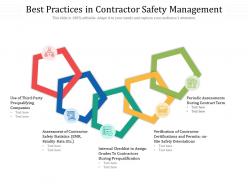
The image shows a PowerPoint slide titled "Best Practices in Contractor Safety Management," a framework for managing the safety aspects of working with contractors. The slide is visually organized into a hexagon-shaped flow with different colored sections, each representing a key safety management practice, and is accompanied by text boxes for further elaboration:
1. Use of Third-Party Prequalifying Companies:
This suggests employing external organizations to vet contractors on safety measures before engagement.
2. Assessment of Contractor Safety Statistics (EMR, Fatality Rate, Etc.):
Indicates the evaluation of potential contractors based on their safety records.
3. Internal Checklist to Assign Grades to Contractors During Prequalification:
Refers to an internal grading system to categorize contractors based on their safety protocols.
4. Periodic Assessments During Contract Term:
Recommends ongoing safety evaluations throughout the term of the contract.
5. Verification of Contractor Certifications and Permits;
On-site Safety Orientations: Suggests ensuring that contractors have the necessary certifications and conducting safety orientations on-site.
This layout is indicative of a continuous process in contractor safety management, emphasizing the importance of safety from prequalification to the end of the contract term. The slide notes that it is fully editable, allowing users to adapt it to specific industry needs.
Use Cases:
Here are seven industries where such slides can be used:
1. Construction:
Use: Implementing safety protocols for contract workers.
Presenter: Safety Manager
Audience: Project managers, contractors
2. Oil & Gas:
Use: Ensuring compliance with safety regulations for external teams.
Presenter: Compliance Officer
Audience: Field workers, subcontractors
3. Mining:
Use: Maintaining high safety standards with mining contractors.
Presenter: Health and Safety Executive
Audience: Mining operators, service contractors
4. Chemical Manufacturing:
Use: Managing hazardous material handling by contractors.
Presenter: Plant Manager
Audience: Chemical engineers, operational staff
5. Power Generation:
Use: Overseeing safety measures for contracted power plant workers.
Presenter: Operations Director
Audience: Maintenance teams, engineering consultants
6. Transportation:
Use: Enforcing safety compliance for contracted drivers and staff.
Presenter: Fleet Manager
Audience: Drivers, logistics coordinators
7. Aerospace:
Use: Applying rigorous safety checks for aerospace contractors.
Presenter: Quality Assurance Manager
Audience: Technicians, engineers
Best practices in contractor safety management with all 2 slides:
Use our Best Practices In Contractor Safety Management to effectively help you save your valuable time. They are readymade to fit into any presentation structure.

FAQs for Best practices in
You need five things for contractor safety: upfront screening to weed out sketchy companies, safety orientation before they start, clear ways to report incidents, ongoing monitoring (this is where everyone screws up), and emergency procedures. Most places do the initial paperwork then basically forget about it - don't be that company. Actually check that contractors are following your rules throughout the whole project, not just the first week. Oh, and audit your current contractor relationships first to see what you're missing. The monitoring piece is honestly make-or-break for the whole thing.
Track your incident rates and near-miss reports - those are your bread and butter metrics. Training completion matters too, but honestly? Nothing beats actually going out and watching people work. Site visits tell you way more than any spreadsheet will. Monthly safety meetings work great if you make them collaborative instead of just lecturing everyone. Contractors need to feel safe sharing concerns without getting in trouble. I'd do monthly scorecards that pull all this stuff together. Oh, and don't forget safety training completion rates - boring but necessary.
Honestly, communication makes or breaks contractor safety. Day one, you've got to nail down site rules, hazards, emergency stuff - all of it. I can't tell you how many accidents I've witnessed just because someone missed an update about new dangers or procedure changes. Those safety briefings and toolbox talks? They're gold, but only if you actually listen to what contractors tell you back. Don't just dump info on them. Set up different ways to communicate too - verbal, written, maybe some digital system. Oh, and check in regularly. People forget things or new hazards pop up.
Honestly, the tech side has gotten crazy good for contractor safety stuff. Mobile apps let people report incidents right away instead of waiting around. Those digital platforms automatically check if certifications are current - saves so much headache. IoT sensors will ping you if air quality tanks or someone wanders into a restricted zone. Wearable devices track environmental hazards too, which is pretty cool. The documentation part used to be such a nightmare, but now cloud systems keep all your training records and compliance data in one spot. My advice? Pick whatever safety process eats up most of your time and digitize that first. You'll notice the difference immediately.
Dude, managing multiple contractors is a total nightmare - everyone does their own thing and communication goes to hell. You gotta set hard safety rules from day one and actually stick to them. Regular safety meetings help, plus get everyone using the same incident reporting system. Oh and definitely screen contractors before hiring them, saves you headaches later. The tricky part? Don't let anyone slide on the rules. Once word spreads that you're flexible, your whole program falls apart. It's basically like dealing with teenagers who think they know better.
Build compliance right into how you pick and manage contractors. I always check their safety records, certs, and insurance during the bidding process - saves headaches later. Once they're working, hit them with safety orientations and regular toolbox talks so they know your rules. Random audits are honestly your best friend here. People stay way more compliant when they think you might pop up any minute. Don't just assume they'll follow protocols on their own - that's wishful thinking. Set up regular check-ins and document everything. You'll catch problems before they blow up.
Definitely start with proper safety orientation - cover site hazards, emergency procedures, PPE requirements, all that. Skip the boring PowerPoint though, do hands-on demos instead. People actually remember that stuff. Make sure they know your reporting systems and who to call if something goes wrong. Oh, and get proof of their company's safety certs upfront. Long-term contractors especially need regular refresher training because they start taking shortcuts once they get comfortable (happens every time). Document everything. Basically treat them exactly like your own employees safety-wise - no exceptions.
Honestly, I'd go with monthly audits - quarterly is the bare minimum but you're just asking for trouble. New contractors? Watch them like a hawk for at least six months before backing off. High-risk stuff needs even more attention. I learned this the hard way when we had a close call with a contractor who seemed solid but was cutting corners. Their safety record matters too - sketchy history means more frequent check-ins. Once they've proven themselves and you're confident in their work, then maybe stretch it to quarterly. But really, catching problems early saves you so much headache later.
Honestly, you've gotta walk the walk from day one. Don't just throw a safety manual at them and hope for the best - that's useless. Do proper onboarding that actually covers your protocols, then keep hammering it home with regular check-ins and toolbox talks. Your own crew needs to set the tone because contractors will mirror whatever they see. I'm a big fan of recognition programs too - call out the guys who really prioritize safety. Oh, and this is huge: make sure people feel comfortable speaking up about hazards without getting their heads bitten off. That culture piece makes all the difference.
Track your TRIR, DART rates, and near-miss frequency - those are your bread and butter. Don't sleep on contractor safety orientation compliance though, that one tells you way more than most people realize. For leading indicators, safety observations and how fast you close corrective actions are solid picks. Honestly, training completion rates matter but they're kinda boring to track. Stick with 3-4 metrics you actually check monthly, then do a deeper dive quarterly. The whole point is picking stuff that changes how people act, not just makes pretty charts for management.
Set up a solid reporting chain so contractors know who to call first - usually your site safety manager, then escalate depending on how bad it is. Definitely get them 24/7 contact numbers because accidents happen at the worst times, trust me. When something does go wrong, secure the scene right away, handle any medical stuff, then investigate with their safety person there too. Oh and document everything together - covers both your asses legally and actually helps you figure out how to stop it next time. Basic stuff but you'd be surprised how many places mess this up.
Toolbox talks are huge for this stuff. Get them involved in your safety committees too, plus those daily pre-work huddles - honestly those work better than anything else I've tried. Walk around with their supervisors regularly and make sure they feel comfortable reporting problems without getting thrown under the bus. Weekly check-ins are a good starting point, then you can figure out what actually clicks with your crew. The biggest thing? Don't treat them like outsiders. Include them in incident reviews and build real feedback loops. It's all about making them feel like they're part of your team, not just some external vendor you're babysitting.
Honestly, the biggest thing is looking at what contractors actually bring to your site that's different. Their equipment, processes, materials - it's usually way different from your normal stuff. Then figure out how they'll interact with your current operations and people. Here's the tricky bit though - they probably don't know your site's weird dangers like you do. So you've got to assess their work AND how it meshes with everything else you've got running. Walk through their whole work sequence step by step. That's where you'll spot the contractor-specific problems before they bite you.
Start with a solid safety orientation covering site hazards, emergency procedures, and required certifications before they begin. Have them complete all mandatory training and sign off on your safety policies - trust me, this paperwork actually matters. I've witnessed way too many accidents because contractors didn't know our specific risks. Check their insurance and safety records upfront too. Oh, and set up regular check-ins during their first few weeks to catch any questions. Document everything properly. The last thing you want is someone getting hurt because they weren't properly briefed.
Turn those old incident reports into actual training material instead of letting them collect dust. Create case studies from what went wrong before - your stuff plus industry incidents. Build these into contractor orientation as required modules. Most companies are terrible at this, honestly. Update your safety checklists so they actually address the hazards that bit you last time. Toolbox talks should reference real examples too. The whole point is making it systematic rather than crossing your fingers and hoping contractors remember past mistakes.
-
Much better than the original! Thanks for the quick turnaround.
-
Use of different colors is good. It's simple and attractive.
-
Best Representation of topics, really appreciable.
-
Very unique and reliable designs.
-
Great designs, really helpful.