


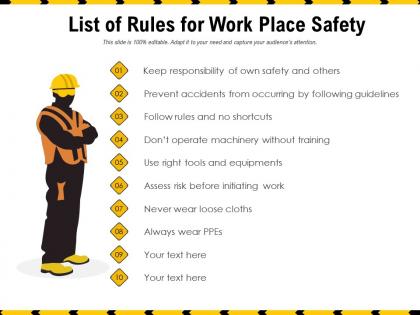
List of rules for work place safety




Try Before you Buy Download Free Sample Product
 Impress Your
 Audience
 100%
100% Editable
 Save Hours
 of Time


Our List Of Rules For Work Place Safety are topically designed to provide an attractive backdrop to any subject. Use them to look like a presentation pro.
People who downloaded this PowerPoint presentation also viewed the following :
List of rules for work place safety with all 2 slides:
Use our List Of Rules For Work Place Safety to effectively help you save your valuable time. They are readymade to fit into any presentation structure.

FAQs for List of rules for
Look, you'll need solid hazard identification first - that's your foundation. Training everyone is non-negotiable, plus set up incident reporting that people actually want to use. Regular audits keep things honest. Honestly, the consequences part sucks but you gotta have teeth in your policy or people ignore it. Emergency protocols are obvious but still worth mentioning. Get someone who knows their stuff as your safety officer - not just whoever drew the short straw. Here's the real deal though: if your leadership doesn't care, you're screwed from the start. Check your recent incidents to see where you're bleeding first.
Start with a job hazard analysis - break down each task and spot what could go wrong. Walk the actual workspace and talk to workers (honestly, they know the real dangers better than anyone). Document everything, then rank risks by how likely and how bad they could be. For fixing things, eliminate hazards first if you can, then substitute safer options, engineering controls, admin controls, and PPE last. Oh, and don't forget to review these regularly since stuff changes all the time.
Start with basic safety orientation for everyone new, then add job-specific hazard training for different roles. Emergency stuff is critical too - fire drills, first aid, evacuation procedures. Most places totally slack on refresher training but honestly that's what keeps people sharp. Make it interactive instead of boring slides (nobody retains anything from those anyway). Document everything for compliance reasons. Oh and definitely audit what you've got now versus what's actually required in your industry - might save you some headaches later.
Look, safety's gotta be everyone's thing, not just some annual HR presentation nobody pays attention to. Your managers need to actually walk the walk - if they're cutting corners, your team will too. Hold regular meetings, but honestly? The real game-changer is letting people speak up without worrying they'll get fired. Set up simple ways for reporting hazards and near-misses, then actually do something about them. Don't just file it away somewhere. Give props to whoever catches problems early. Oh, and make it crystal clear that everyone going home in one piece matters way more than hitting some arbitrary deadline. That's the mindset shift you need.
Oh man, leadership makes or breaks workplace safety honestly. If your managers are actually following protocols and calling people out for sketchy behavior, everyone else will too. But I've worked places where bosses just talk the talk - those accident rates don't lie. Good leaders invest in training, get you decent equipment, and won't throw you under the bus for reporting problems. That last part's huge because people clam up real fast if they think they'll get blamed. Hold your leadership's feet to the fire and don't stay quiet when things get sloppy.
Honestly, there's some pretty cool tech out there that actually works for workplace safety. Wearable sensors can track air quality and if someone's getting too tired - which is huge for preventing accidents. IoT stuff automatically shuts down machines when something's wrong, and AI cameras catch people doing dumb things before they get hurt. The apps are clutch though - workers can report problems instantly instead of filling out paperwork later. Digital training beats those ancient safety videos hands down. My advice? Pick one thing that fixes your worst safety problem and start there. Don't try to do everything at once.
Your workplace should definitely have evacuation plans and procedures for fires, medical stuff, and bad weather. Look for posted escape routes and know where the meeting spots are outside. Each floor needs trained first aid people too. Communication during emergencies is tricky - they can't just rely on emails nobody checks. Find out where fire extinguishers and AED units are located. Honestly, the practice drills matter most since muscle memory kicks in when you're panicking. Does your place do quarterly drills? Don't just go through the motions - actually pay attention and take them seriously.
Definitely report it right away through whatever system your company uses - could be online or just forms from HR. Document everything first though: what went down, when it happened, location, witnesses if there were any. Photos help too if you can safely take them. Your boss should know immediately, but honestly if they blow you off or they're part of the mess, skip straight to safety officers or HR. Most places let you report anonymously if you're scared about backlash. Don't sit on this thinking someone else will deal with it. Keep copies of whatever you submit.
Dude, don't mess around with safety regs - OSHA will absolutely destroy you with fines and can literally shut your whole operation down. If someone gets hurt, you're looking at workers' comp claims, medical bills, plus lawsuits from injured employees. Executives can even face criminal charges depending on how bad it gets. I actually know a company that went belly-up after one major incident - it was brutal to watch. Wrongful death suits are no joke either. Document everything though. All your safety training, compliance stuff, whatever. That paperwork might save your ass if things go sideways.
Oh man, you definitely should! These assessments catch all the little things that mess you up later - like how your monitor's too low so you're always craning your neck, or your mouse is positioned weird. Honestly, I didn't realize how much my setup sucked until I got one done. They'll spot stuff before it becomes actual pain that sidelines you for weeks. Simple tweaks like chair height or keyboard angle make a huge difference. My company's HR department does them - might be worth asking yours? Your future back will thank you lol.
Do quarterly audits for sure, then throw in monthly spot checks. Honestly, bringing someone from another department is a game changer - they'll spot stuff you've walked past a million times. Make a checklist hitting the basics: equipment, exits, signage, whatever hazards you deal with. Document with photos and tackle issues within 48 hours. Your employees are goldmines for this stuff since they actually work in the space daily. Oh, and track patterns over time instead of just fixing one-off problems. Way more useful that way.
Honestly, mental health is such a big deal for workplace safety and people don't talk about it enough. Your brain's basically your main safety tool, right? So when you're stressed or anxious, you can't focus properly and end up missing hazards or making dumb mistakes. I've totally seen this happen - one person having a rough time throws off the whole team's communication. The ripple effect is real. Best thing companies can do is make it normal to discuss mental health stuff openly. Having managers who actually check in helps, plus those employee assistance programs if your work has them.
Start with regular safety training for everyone - and document it all. Do workplace inspections yourself before OSHA shows up (way less stressful, trust me). Keep detailed records of incidents and near-misses since they love their paperwork. Give specific people safety responsibilities so stuff doesn't slip through. Create clear reporting procedures for concerns and actually follow through. Oh, and treat this as ongoing work, not some box you check once. Honestly, staying ahead of it beats scrambling later.
Dude, skip those boring safety videos - nobody pays attention anyway. Your team needs stuff they can actually understand and use. Get materials translated into their languages, put up visual signs with clear symbols, and do hands-on training where people practice instead of just sitting there. Mix it up since everyone learns differently. Your supervisors need to actually walk the walk too, not just talk about safety rules. Oh, and definitely ask your team first what's confusing them right now. That'll save you time figuring out where to start.
Dude, safety training is honestly a no-brainer. Your injury rates will drop when people actually know what they're doing. Insurance companies love giving discounts to companies with good programs too - I mean, they'd rather not pay out claims, right? But here's the thing that really matters: employees feel way more valued when you invest in keeping them safe. That translates to better morale and people actually sticking around. Oh, and productivity goes up too. Start with whatever's most dangerous in your workplace first, then build from there.
-
Much better than the original! Thanks for the quick turnaround.
-
Good research work and creative work done on every template.