


Workplace Ethics Powerpoint Presentation Slides




Try Before you Buy Download Free Sample Product
 Impress Your
 Audience
 100%
100% Editable
 Save Hours
 of Time


Showcase business core values with our content ready Workplace Ethics PowerPoint Presentation Slides. Talk about the role of an individual in organizational effectiveness using the visually appealing work ethics in an organization's presentation deck. Make use of the business ethics PowerPoint templates to demonstrate business ethics needs and drivers. The visually appealing business ethics PowerPoint complete deck contains forty-two self-explanatory templates such as ethical awareness framework, key statistics, education, action, pillars, leadership principles, areas of responsibility, and many more. The content given in this core value of the business presentation deck is extensively researched by our team of experts. Incorporate the high-quality corporate values PPT slides to shape ethical conduct in the organization. Besides this, users can also utilize the ready-to-use guiding principles of business presentation graphics to maintain an ongoing commitment to ethical behavior. Therefore, download this professionally designed business values PPT deck to discuss the business approach to ethics & social responsibility. Get the grins back on their faces with our Workplace Ethics Powerpoint Presentation Slides. Erase any frowns that emerge.
People who downloaded this PowerPoint presentation also viewed the following :
Content of this Powerpoint Presentation
Workplace ethics are fundamental principles and guidelines that affect behavior, decisions and interactions within an organization. These principles are essential for a company to have to make employees feel respected, motivated, and valued. Workplace ethics are not only crucial for a company’s values but also essential for a company’s growth and sustainability. There are many benefits of workplace ethics, in addition to the creation of a positive environment. These benefits inculcate trust and integrity and increase employee productivity and morale within an organization.
Download our ready to use template for corporate workplace ethics!!!
Workplace ethics play a critical role in shaping the reputation of a company. These guidelines offer the employees a safe environment and help in employee retention for a company. Workplace ethics also help in creating a safer world and ethical society, with the virtue of being fair an ingrained trait. To demonstrate workplace ethics, you can use SlideTeam’s 100% editable nd customizable PPT Templates if you want to highlight the workplace ethics of your organization
Explore our professional ethics PowerPoint presentation slides!!!
Template 1: Introduction to Business Ethics Template
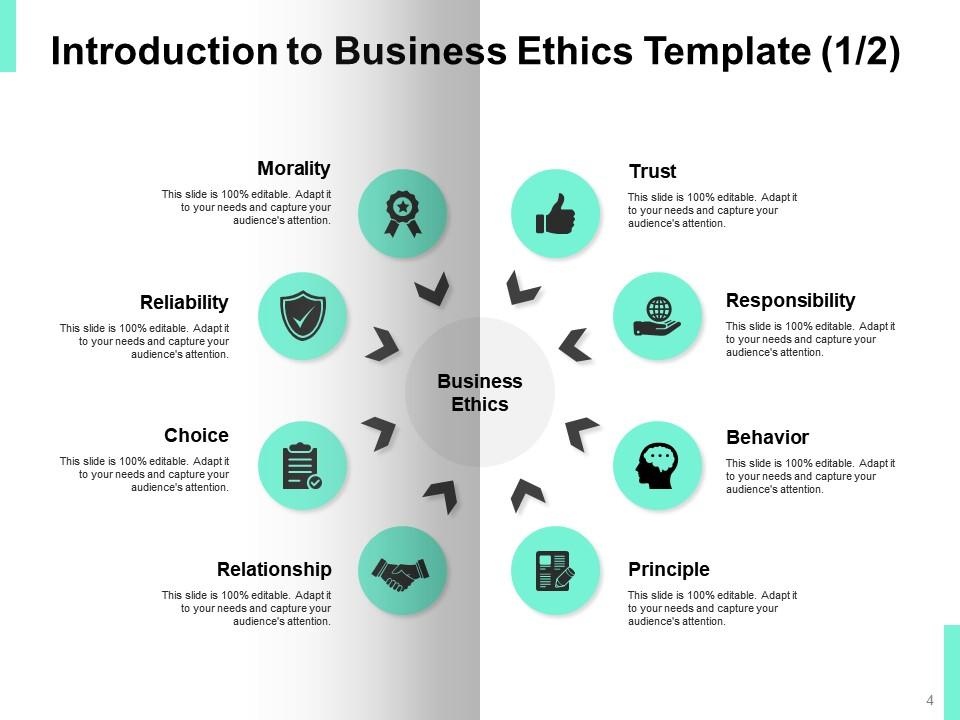
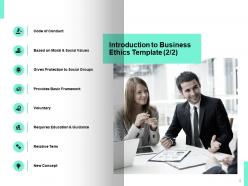
Components of business ethics play a crucial role in any business. This template demonstrates these components as behavior, principle, relationship, choice, reliability, morality, responsibility, and trust. The impressive and captivating icons will help make business ethics interesting and captivating. These are some of the ethics that an employee has to abide by in a company.
Template 2: Ethical Principles for Business Executives

This template highlights core principles that business executives must follow to pave the way to success. Honesty, leadership, promise-keeping, law-abiding, integrity, fairness, accountability, and commitment to excellence are critical components of a successful business.
Template 3: Role of Individual in Organizational Effectiveness Template

Highlighting individual roles and responsibilities is another major component because of transparency. This PPT Template will help you employ roles like inspired thinking, purposeful communication, work talents, and fulfilled self. There are key competencies that employees must have in a professional setting. There is additional space if you want to add some qualities an employee must have in a company.
Template 4: Business Ethics Need

Business ethics provide a business with the framework to operate responsibly, ethically and sustainably. Maintaining trust and credibility are two crucial things which are established by work ethics. This PPT template helps to define the need for work ethics in a work setting. You can highlight the need for these guidelines for the survival of business, stopping business malpractices, protecting consumer rights, creating a good image of business, consumer satisfaction, and protecting employees and shareholders.
Template 5: Business Approach to Ethics & Social Responsibility

This PPT Template plays a crucial role in demonstrating a business approach to responsibility and ethics. You can highlight the value, purpose, impact, and benefits of corporate social responsibilities. Through a well-designed table, you can highlight the purpose, impact and benefit of corporate philanthropy, risk management and value creation.
Template 6: Ethical Functioning
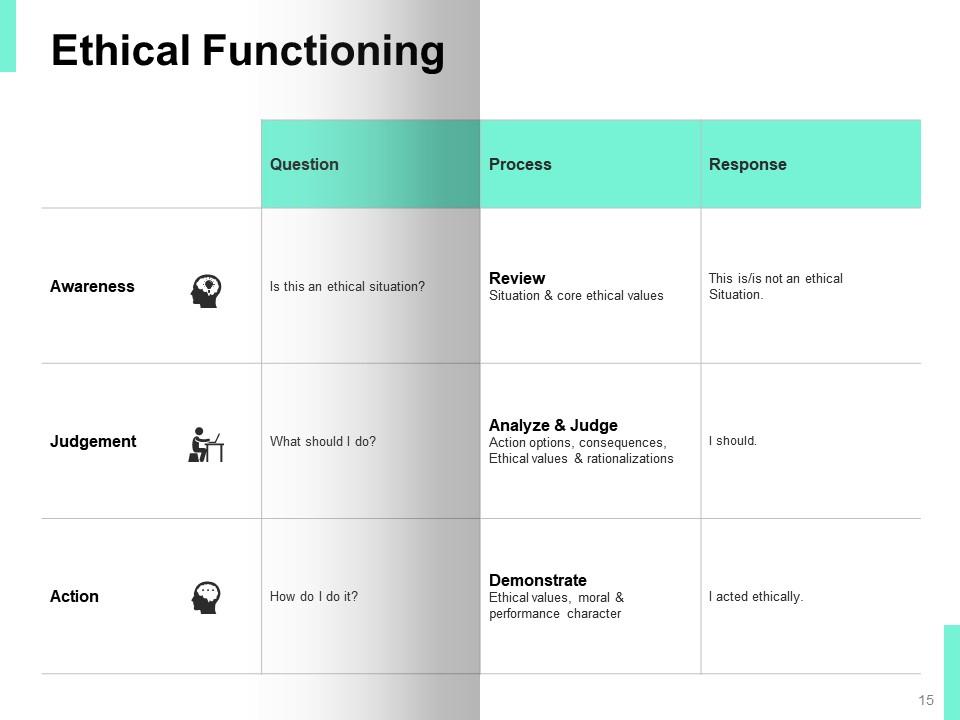
This template will help you tackle workplace behaviors by introducing you to how to be aware, judge, and act. Questions, processes, and responses help you reach a particular conclusion. For instance, this template will help you know how to take a particular action, what ethical values and morals are, and what is an ethical situation and what is not.
Template 7: Ethical Awareness Framework
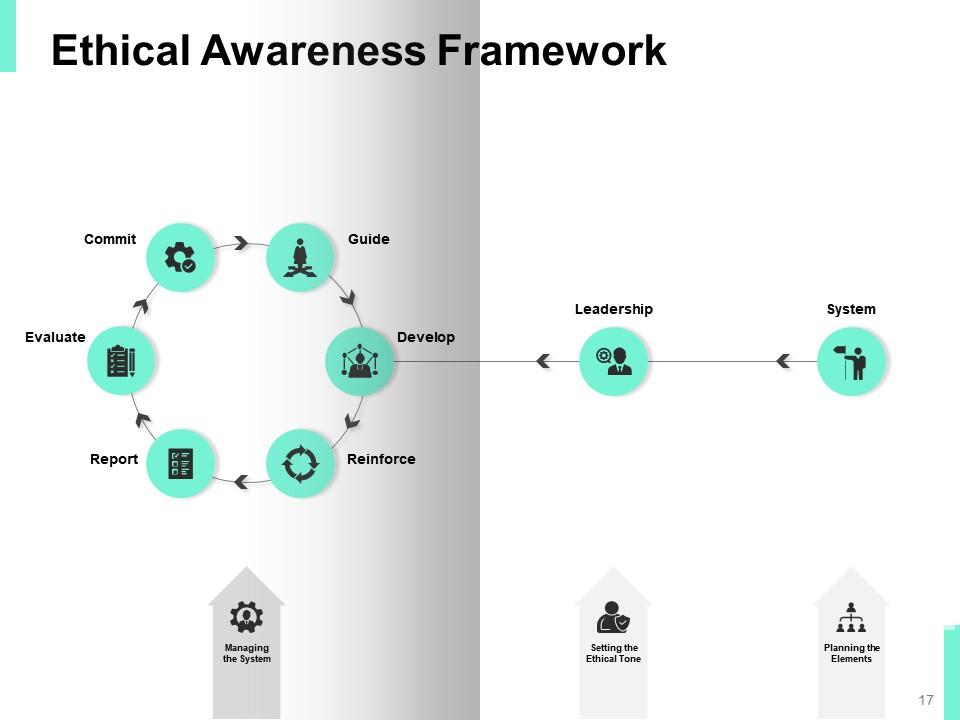
This PPT Template on ethical awareness framework helps promote an organization's decision-making and ethical behavior. This structure provides employees with guidelines and tools to make informed decisions. The icons help one evaluate, guide, commit, develop, reinforce, repeat, and manage the system.
Template 8: Ethical Awareness Key Statistics

The ethical awareness statistics help track unethical behavior. Through innovative visuals, you can demonstrate the total number of people in the workforce who are over 18. You can also add how many have observed misconduct, reported misconduct, and experienced retaliation. This template will easily help you capture every little detail of ethical awareness.
Template 9: Ethical Action 5 Pillars

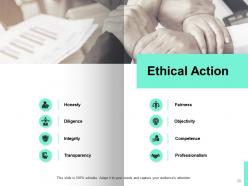
There are five pillars of ethical action: care, equity, respect, excellence, and dignity. These pillars are also known as the education, reflective, knowledge, wellness, and restorative pillars. This template helps define the ethical awareness action plan through innovative and captivating icons and visuals. This PPT slide easily demonstrates the five pillars of ethical awareness.
Template 10: Ethical Leadership 4V Model

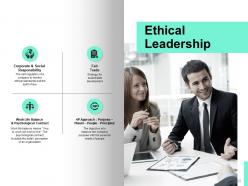
There are four Vs of an ethical model: vision, voice, virtues, and values. This template provides you with the opportunity to demonstrate the four Vs of ethical leadership, which are the key principles for leaders to follow.
ETHICS MATTER
In conclusion, business ethics maintain trust and credibility among stakeholders, especially customers and vendors. These PPT templates help demonstrate the values and behaviors employees must abide by in a work setting. As we know, business ethics are important for reputation, trust, legal compliance, long-term success, and great success.
P.S. Demonstrate workplace ethics with our PPT slides, download them now!!!
Workplace Ethics Powerpoint Presentation Slides with all 42 slides:
Use our Workplace Ethics Powerpoint Presentation Slides to effectively help you save your valuable time. They are readymade to fit into any presentation structure.












FAQs for Workplace Ethics
So your values are like your gut check for work decisions, you know? When something feels off or right, that's usually them talking. Mine definitely clash with corporate BS sometimes - super awkward. But honestly, the best workdays happen when what I believe lines up with what I'm doing. You feel way more like yourself. Short answer: figure out your top few values first. Then notice how they pop up when you're dealing with coworkers or making calls on projects. Makes everything clearer.
Honestly, it starts with leadership - they can't just preach ethics, they need to actually live it. Clear policies help, but skip those awful compliance videos nobody pays attention to. People need safe ways to report problems without getting thrown under the bus. Here's what really works though: reward the employees who make tough ethical choices. Build it into performance reviews too. The whole point is making good behavior feel normal and appreciated, not like some annoying extra task. Oh, and make the training actually interesting if you want people to remember it.
Look, unethical stuff at work can totally wreck your career. You might get fired, face legal trouble, or just have everyone treat you weird afterward - which honestly sucks more than you'd think. Future job hunting becomes harder too since references matter so much. Plus your company takes a hit with lawsuits and reputation damage. My old manager always said to ask yourself if you'd be cool with your actions ending up on the front page of a newspaper. Sounds cheesy but it actually works as a gut check.
Oh totally, where you're from hugely affects what seems "right" at work. Like giving gifts to clients - some cultures see it as building relationships, others call it bribery. Hierarchy's another big one. I've noticed Americans tend to be way more direct with feedback than say, Japanese colleagues. Even basic stuff like being on time or how close you stand to someone varies a ton. Honestly? Just stay curious instead of getting judgy. Ask questions when something feels off. Most people appreciate it when you're genuinely trying to understand their perspective.
Ugh, ethical stuff as a leader is tricky! First thing - figure out your decision-making process before you're in the mess. Your team needs to feel safe calling out problems without getting thrown under the bus. Most leaders totally bomb this part, honestly. Get different viewpoints, think about who gets hurt long-term. Write down why you decided what you decided (sounds boring but trust me). Oh, and actually stick to your standards - can't be flexible with ethics one day and rigid the next. Make your values super obvious to everyone from day one.
Dude, transparency is huge for workplace ethics. Like, when bosses are actually open about decisions and screw-ups, people trust each other way more. Nobody wants to deal with sketchy, secretive management - been there, it sucks. Being transparent stops those little ethical shortcuts from becoming massive problems because everything's out in the open. You want better ethics on your team? Start sharing how you make decisions. Even the messy parts. Others will follow your lead, and honestly, it makes such a difference in how people communicate when things go sideways.
Most places do ethics training - conflict of interest stuff, whistleblowing, decision frameworks. The good programs use actual workplace scenarios instead of those dumb "don't steal office supplies" examples that help nobody. Interactive workshops beat just reading compliance docs any day. Some companies bring in outside consultants too, which can be pretty solid. I'd hit up HR to see what they've got. Push for the scenario-based training if they don't already do it - way more useful when you're actually facing real dilemmas at work.
Honestly, you need multiple ways for people to report stuff anonymously - not just one useless hotline nobody trusts. Real legal protection is huge too, and managers who retaliate should face actual consequences. Train everyone on what's worth reporting and how to stay safe doing it. The whole culture has to shift so speaking up feels like you're helping, not stabbing people in the back. I've seen too many places where "ethics" is just a poster on the wall. Build trust first by proving it won't wreck someone's career, then maybe people will actually use it.
Honestly, tech is making work ethics way more complicated than it used to be. Data privacy is a huge mess now - like, what are we even allowed to do with customer info anymore? AI keeps screwing up hiring decisions with built-in bias, which is frustrating. Remote work sounds great until you realize you're answering emails at 9pm because boundaries don't exist. Social media makes it stupidly easy to overshare company stuff by accident. Oh, and don't get me started on employee monitoring software - feels like Big Brother sometimes. But hey, it's not all bad since tech can make workplaces more inclusive. Just stay alert when your company rolls out new tools and trust your gut if something feels sketchy.
Okay so basically when companies actually do the right thing, people feel way more secure at work. Nobody wants to stress about whether their boss is gonna screw them over, you know? It's like - why would you stay somewhere that makes you feel icky about your job? Fair treatment means less office drama too. Clear expectations, consistent policies, all that stuff just makes people less anxious. Honestly, I think transparent communication is huge. People will stick around if they respect where they work and don't lose sleep over it.
Dude, the legal stuff can get really messy - lawsuits, fines, sometimes even criminal charges if things go sideways. Harassment, discrimination, fraud, safety issues... all that can lead to civil suits or investigations. Your company won't hesitate to cut you loose if they think you're trouble (learned that one the hard way). If you're in management, personal liability becomes way more real. Honestly though, just stick to company policies and don't be afraid to call out sketchy stuff. Oh, and document everything - you'll thank yourself later if things blow up.
So basically you want to track incident reports and how people actually respond to your ethics training. Employee surveys work great for this stuff. Exit interviews are honestly your best bet though - people will tell you what really happened once they're out the door. Set up anonymous reporting and see if anyone actually uses it. That tells you everything about trust levels. Quarterly surveys focused on ethics help too, but compare those feelings to real numbers like violations or complaints. The whole point is figuring out if people believe in the system enough to speak up when something's wrong.
CSR is basically your company's moral compass - it shows employees what you actually stand for beyond just making money. When you commit to stuff like sustainability or community work, people see that and it guides their daily decisions. Honestly, it's way more effective than just posting ethics rules on a wall somewhere. Your team feels more motivated when they know their work contributes to something meaningful. I've seen it firsthand - employees at companies with genuine CSR initiatives just seem more engaged. So if you want better workplace ethics, push for CSR programs your people can actually believe in.
Healthcare deals with life-or-death stuff and patient privacy - pretty intense stakes there. Finance is obsessed with conflicts of interest since it's people's money. Tech companies? They're basically winging it with data privacy and algorithmic bias as they figure things out. Worker safety and environmental impact matter more in manufacturing. Here's the thing though - whatever could screw people over the worst in your field is usually where the ethics get strictest. So look at your industry's biggest potential disasters and you'll find where the rules are tightest.
Honestly, the trick is getting your team to actually help write the thing instead of just dumping some corporate template on them. Run workshops, send out surveys - find out what messy situations they've actually dealt with. Those generic "be honest and work hard" codes are useless. You want yours to sound like your people and tackle real problems they face, not hypothetical BS. Oh, and don't just roll it out once and call it done. You'll need to bring it up in meetings, reference it when making decisions. Otherwise it just sits in some digital folder collecting dust while everyone forgets it exists.
-
Good Job .... thanks a lot
-
It saves your time and decrease your efforts in half.
-
Editable templates with innovative design and color combination.
-
Design layout is very impressive.
-
Excellent work done on template design and graphics.
-
Unique research projects to present in meeting.