

Business Ethics Powerpoint Presentation Slides




Try Before you Buy Download Free Sample Product
 Impress Your
 Audience
 100%
100% Editable
 Save Hours
 of Time


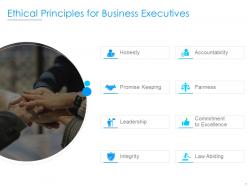
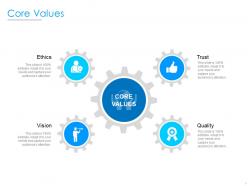
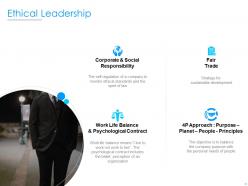
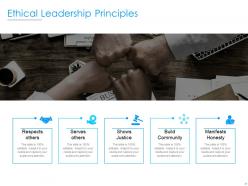
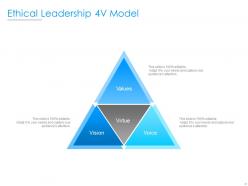
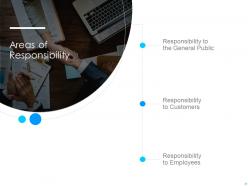
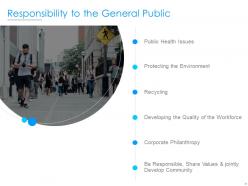
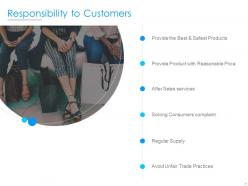
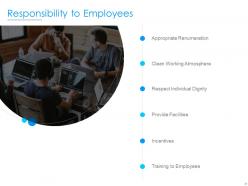
Showcase the ethical problems that might arise in a professional environment with these Business Ethics PowerPoint Presentation Slides. Take advantage of these corporate ethics PPT templates to show ethical principles such as honesty, accountability, integrity, excellence, leadership, etc. Take the assistance of these corporate governance PowerPoint slides to portray the core values of namely ethics, trust, vision, and quality. Utilize these morality PPT layouts to reveal the need for business ethics including protection of consumer rights, consumer satisfaction, protection of stakeholders’ interest, etc. Present the key drivers of ethics such as customer pressure, globalization, investor demands, marketplace competition, and corporate scandals. Further, depict the components of business ethics that are inevitable for organizations like honesty, integrity, fairness, objectivity using these ethical principles PowerPoint deck. Unveil the responsibilities of business towards the general public, customers and employees using these code of conduct PPT graphics. Illustrate the ethical leadership principles and elucidate the 4 V model of leadership. Download this corporate ethics PowerPoint slideshow to ensure the integrity of your organization,
People who downloaded this PowerPoint presentation also viewed the following :
Content of this Powerpoint Presentation
Innovation is an essential input to business success and growth. However, these also bring with them a tendency to take shortcuts or indulge in ethical missteps. With the rapidly changing business environment and the adoption of technological advancements, from facial recognition to artificial intelligence, companies encounter more ethical dilemmas than before. This is the reason why ethics has become an essential business function, as in marketing and finance.
To manage a successful business, a business owner needs to follow specific rules and principles. Here comes the role of business ethics. In simplest terms, business ethics are the standards or principles used to guide decision-making. Generally, business houses establish it to promote integrity among the employees and build trust with the consumers and investors.
Are you worried about your business reputation? No worries. A company is sure to work correctly, protecting its employees as well as clients. Ethical operations of a business ensure both short-term and long-term profitability.
Business ethics play a crucial role in a business's long-term success. Therefore, you need to adhere to business ethics methods, tools, and frameworks to make correct technological decisions. To check out the best tech playbook to leverage business ethics, Click here.
Business Ethics Templates
SlideTeam has introduced 100% customizable and editable business ethics PPT templates for your convenience. The slide deck, containing forty-two slides, is well-designed with relevant visuals and subject-driven content.
Explore the value and ethics PPT templates. Click here to enable your company to make decisions.
Let’s go through some best-in-class business ethics PPT templates that you should incorporate into your presentation!
Template 1: Introduction to Business Ethics Template
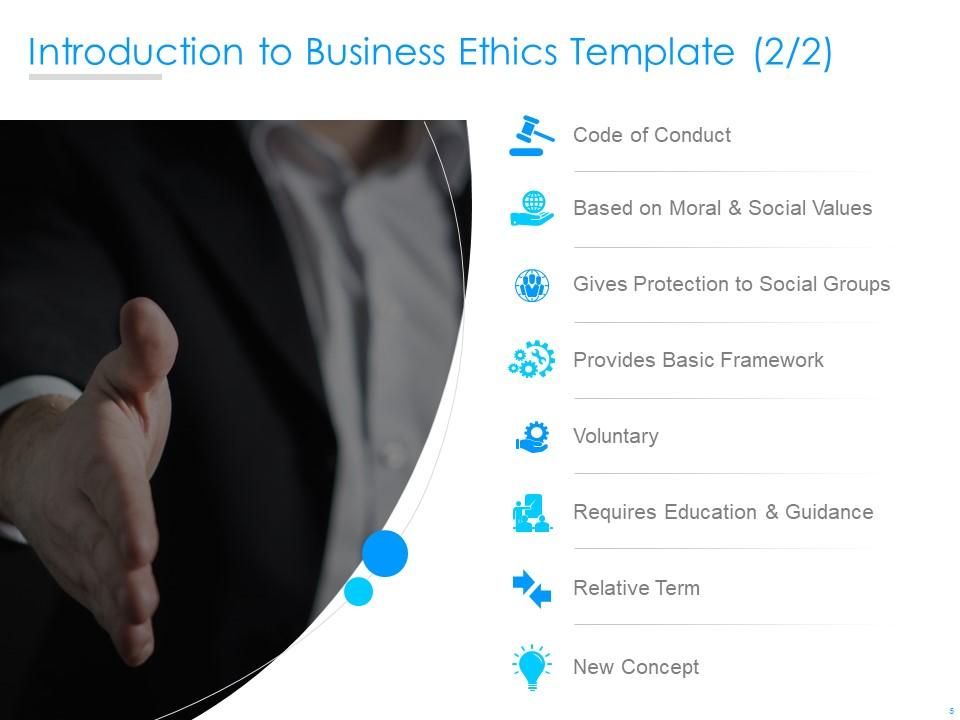
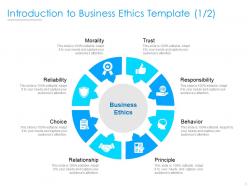
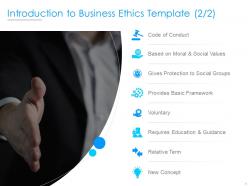
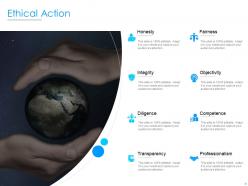
Ethics is an essential segment of philosophy that defines things morally, such as "right" and "wrong" or "good" or "bad." While doing business, it is essential to keep in mind that every business operation should be ethical. Showcase the ethical problems that can arise in a professional environment with our Business Ethics PPT slide deck. This is a professional and visually inviting template showing an introduction to business ethics. It contains vital elements along with appropriate icons like a code of conduct, voluntary protection for social groups, relative teams, new concepts, and more.
Template 2: Role of Individual in Organizational Effectiveness Template (1/2)
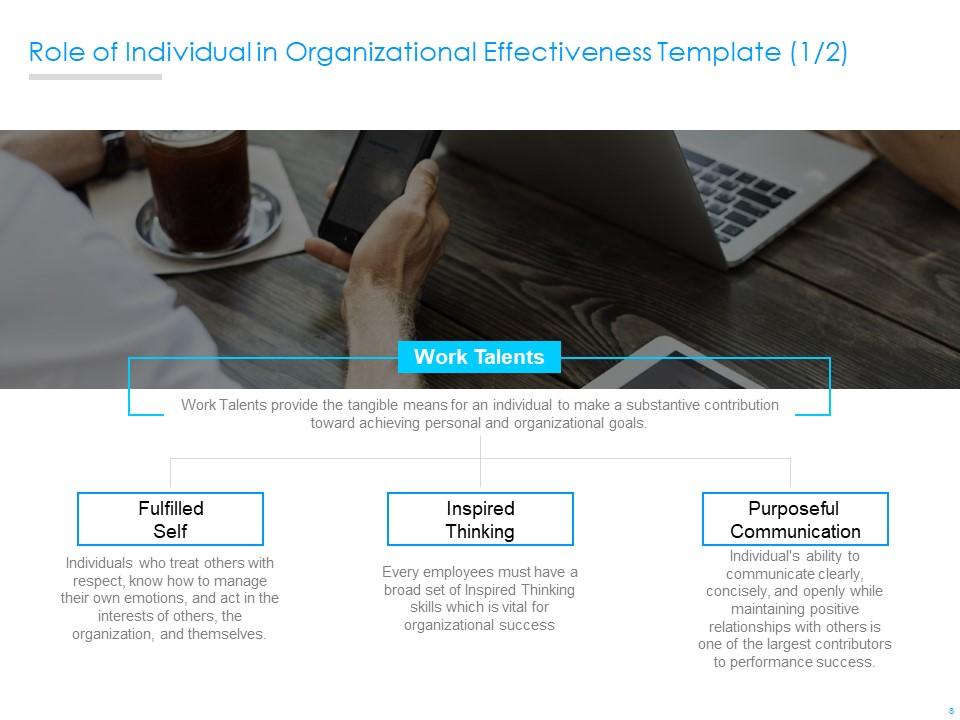
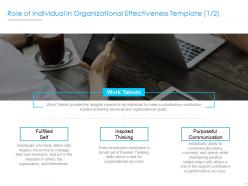
Uncover the bedrock of successful business activities with the help of our engaging PPT deck on the "Business Ethics Template." Work talents in a company provide a means for an individual to make a substantive contribution toward achieving both organizational and personal goals. It contributes to the successful performance of a business. This PPT layout from the slide deck represents the role of individuals in administrative effectiveness. It explains three critical skills of individuals that are fulfilled: safe, inspired thinking, and purposeful communication, and each skill is significant in a company's progress.
Template 3: Role of Individual in Organizational Effectiveness Template (2/2)
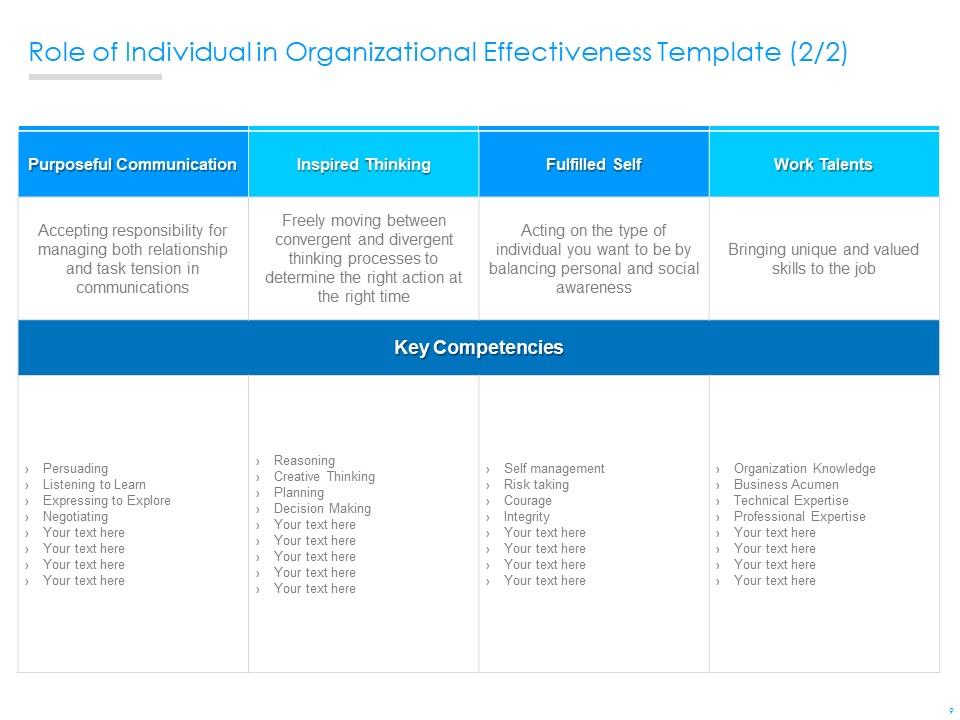
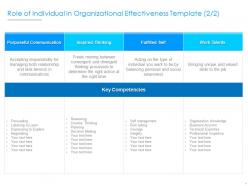
This is another slide showcasing individual role and their respective critical competencies in a proper tabular format for a better understanding of the subject. It nicely showcases the role separately: purposeful communication, inspired thinking, fulfilled self, and work talents. Purposeful communication includes key competencies like persuading and negotiating and inspired thinking includes reasoning, planning, creative thinking, and more. One of the other two fulfilled self includes self-management, courage, risk-taking, etc., whereas work talents include organization knowledge, technical and professional expertise, etc.
Template 4: Business Ethics Need
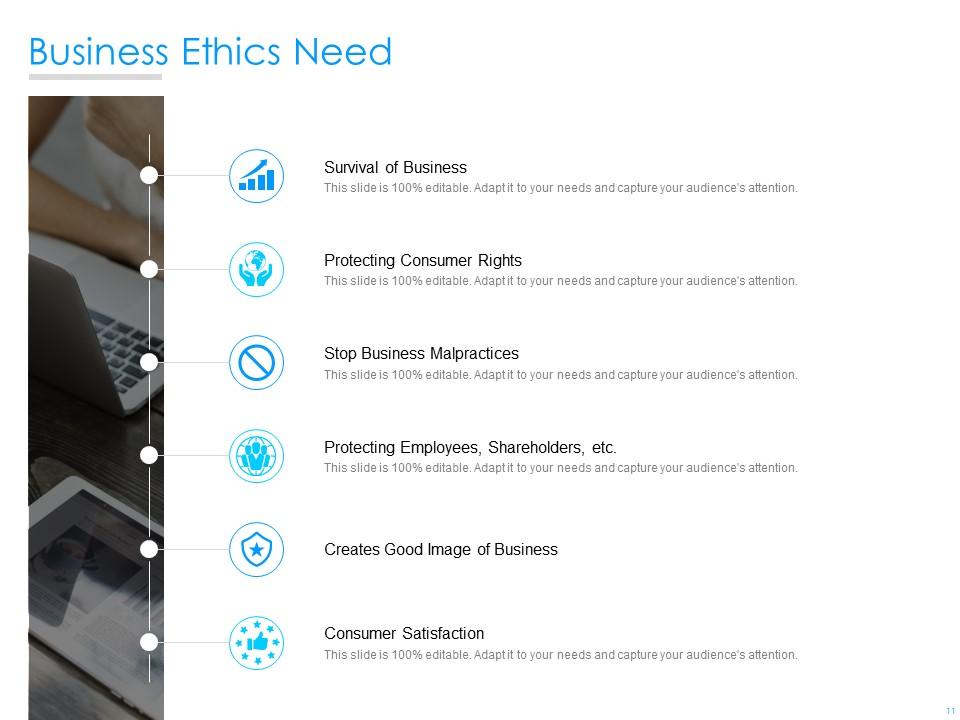
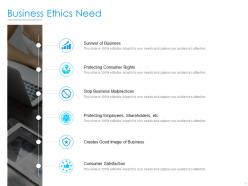
In this digitized world, ethics is the need of the hour. It acts as a guiding compass directing businesses towards positive impact and sustainable growth. Good ethics is essential for a company to promote brand loyalty and establish a positive reputation. Take advantage of this corporate ethics PowerPoint template to showcase the inevitable facts of ethics and their significance in a company. This PPT preset is crafted by experts who display the needs of ethics, including the survival of the business, protecting customer rights, stopping business malpractices, improving consumer satisfaction, and more. Win trust and flare out by understanding the ethical frameworks and corporate responsibility.
Template 5: Business Ethics Key Drivers
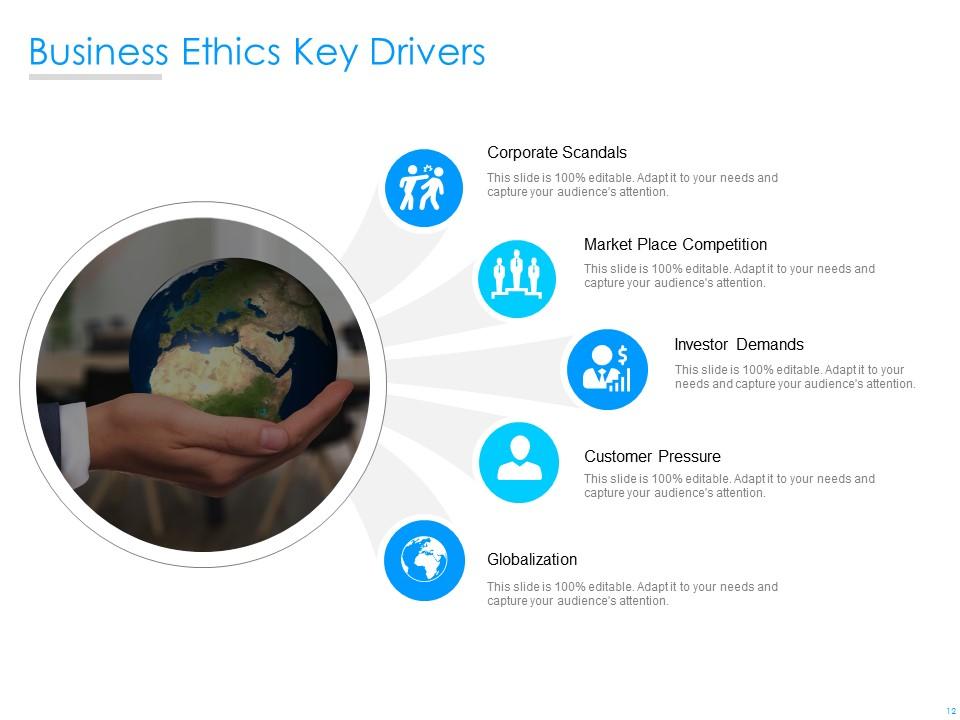
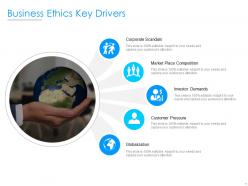
With the growing scrutiny of various business activities, it is essential to carry out the operations properly or ethically. Since digital communication and technology have made it easier to recognize ethical misconduct, almost every business opts for a business ethics program. Take advantage of this corporate ethics PowerPoint template to elucidate the critical drivers of business ethics. This visually engaging PPT layout wonderfully presents key drivers like corporate scandals, marketplace competition, investor demands, customer pressure, and globalization, along with suitable graphical icons. Get it now and uncover the importance of responsible and transparent conduct in developing an environment of integrity that goes beyond industries.
Template 6: Business Approach to Ethics and Social Responsibility
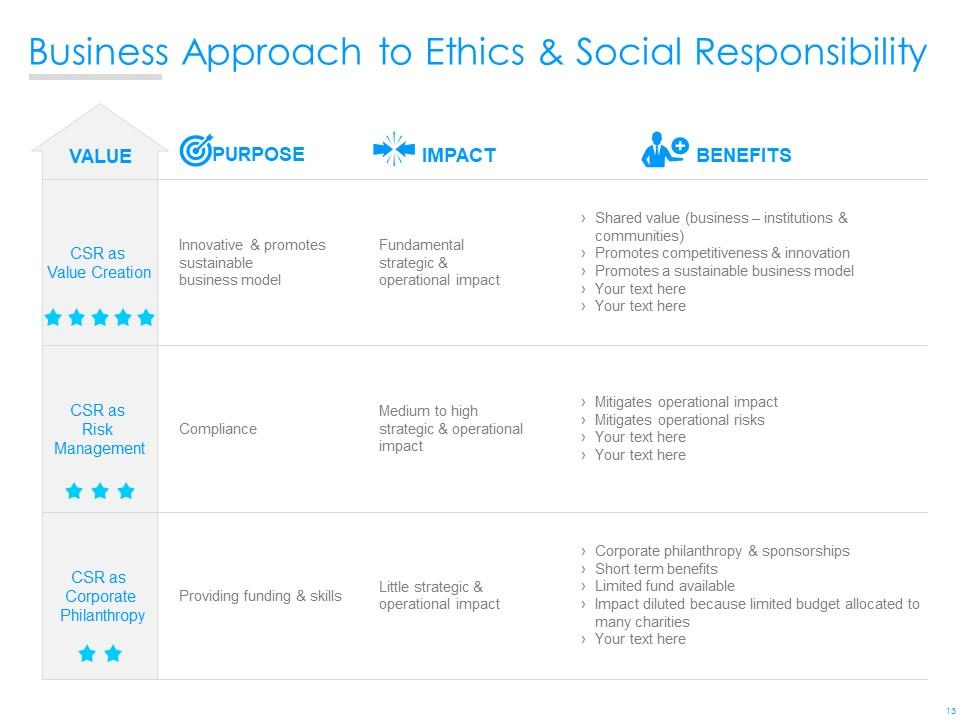
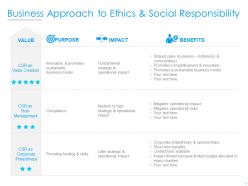
CSR, or Corporate Social Responsibility, is another crucial segment of business operations. It emphasizes that businesses should uphold ethical values and give to the welfare of the environment and society beyond financial objectives. Our presentation opens a gateway to get a better understanding of the approach of a business towards ethics and social responsibility. Ethics and social responsibility help guide companies to make informed decisions that align with social well-being. This PPT slide depicts CSR as value creation, risk management, and corporate philanthropy, along with a brief explanation of its purpose, impact, and benefits.
Template 7: Ethical Functioning
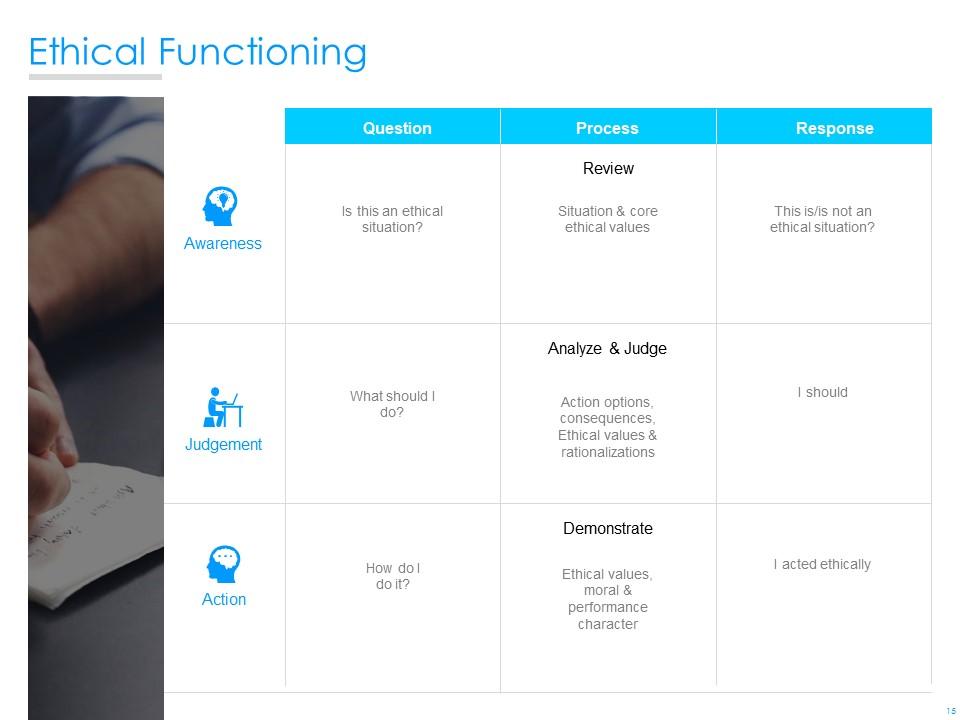
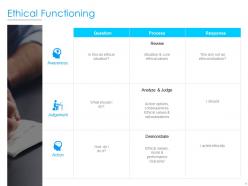
Business ethics have no one-size-fits-all approach, and that's why ethical functioning varies from one business to another. Each organization’s operations have an ethics function according to its operation sector and internal structure. Introducing our impactful PPT presentation on ethical functioning to equip the users with more excellent knowledge of the ethical cornerstone of a successful business. It elucidates the inevitable factors, including awareness, judgment, and action, with its process and review. Download this slide today and empower yourself as a strong presenter to your audience.
Template 8: Forces that Shape Business Ethics
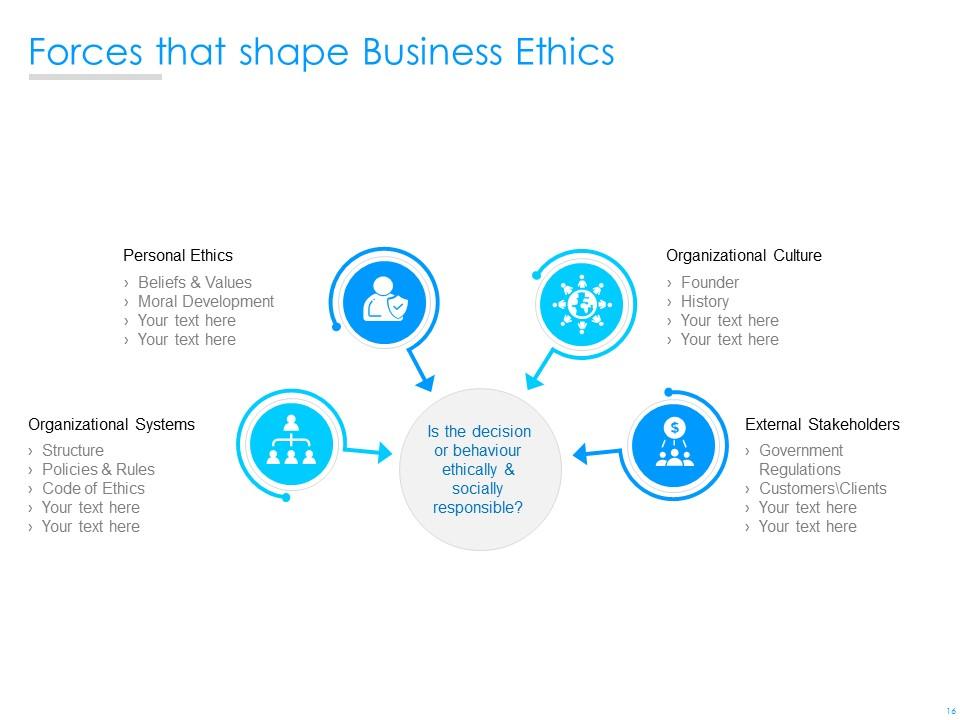
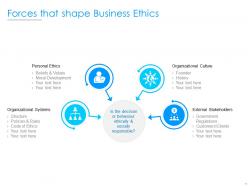
Business ethics is governed by an array of factors that help in shaping the responsible and moral conduct of an organization. Are you worried about your corporate decision or behavior being socially or ethically responsible? Gain insights into how the external forces shape various segments of business ethics and their profound influence with our wide range of meticulously designed PPT templates. It highlights the five significant factors influencing business ethics with a simple diagram and skillfully crafted visuals. The five forces explained here are personal ethics, organizational culture, and external stakeholders. Download this slide and ensure the integrity of your organization to your client.
Template 9: Ethical Awareness Framework
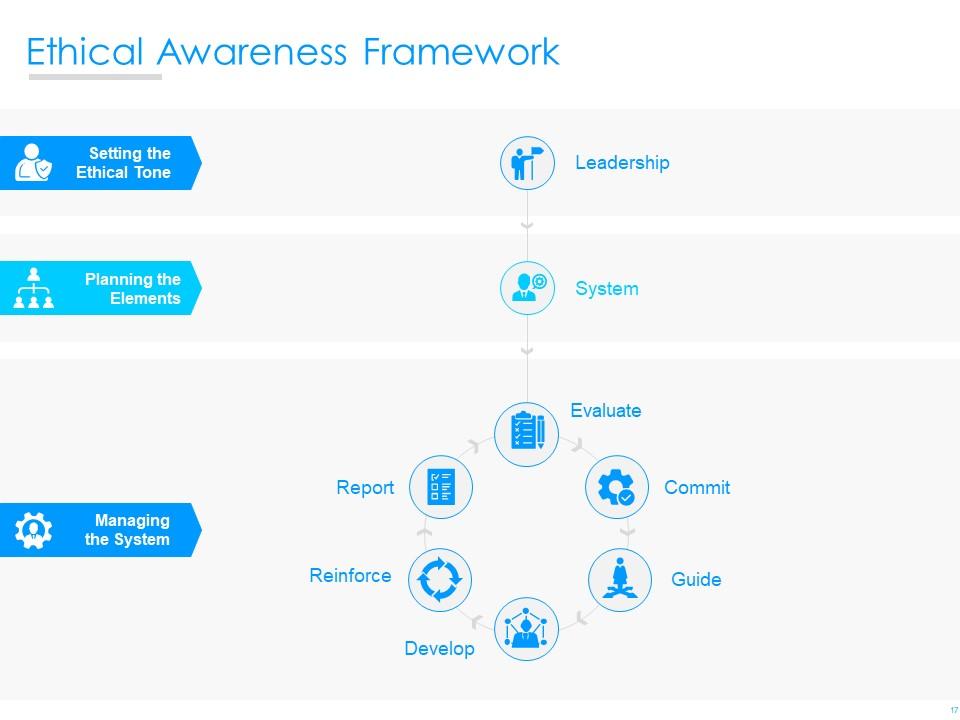
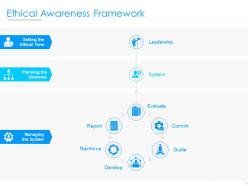
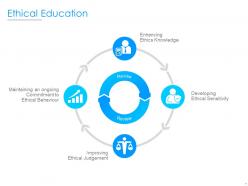
Ethical frameworks refer to perspectives used to reason what action can provide the most ethical outcome. Dive into the realm of ethical awareness framework and its functioning with our professionally crafted PowerPoint template. It displays the framework with an arrow framework containing elements such as leadership and system evaluation. The last element (evaluate) is shown with an illustration containing graphically represented components like report, evaluate, commit, guide, and more. This template not only helps in message delivery but also encourages your clients to foster a culture of ethical awareness.
Template 10: Ethical Awareness Key Statistics
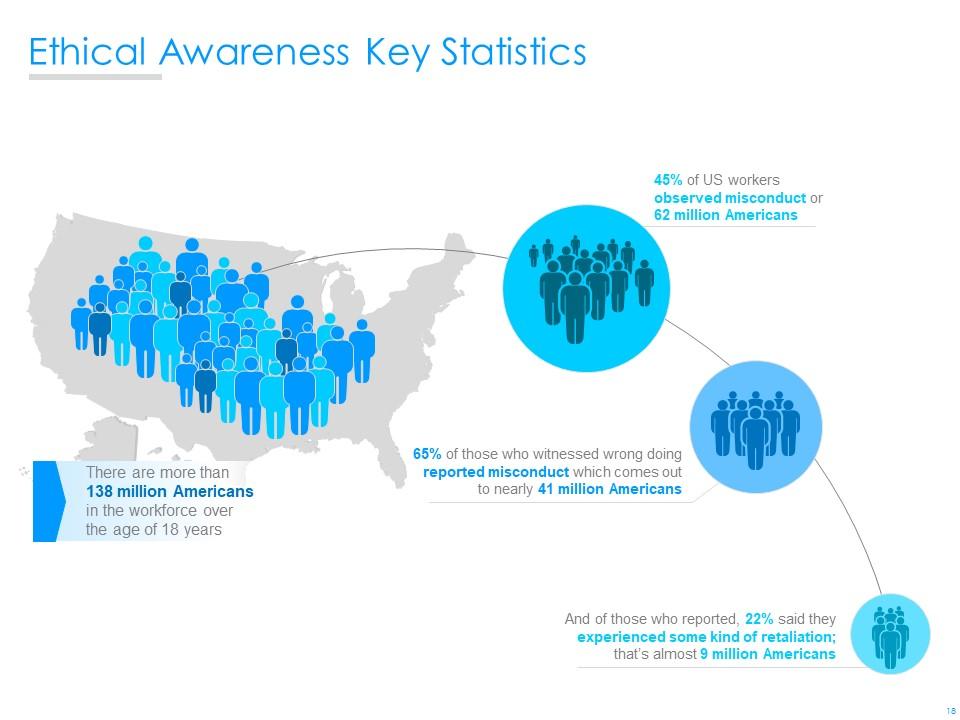
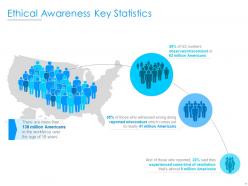
If you are trying to recognize and understand ethical considerations and implications in a specific context, you need to know about ethical awareness. Our PPT, "Ethical Awareness Key Statistics," is highly beneficial in showcasing appropriate ethical awareness statistics. The design of this layout makes it the best tool to communicate essential statistics of ethical awareness. It highlights the relevant information with the help of a diagram to enable you to understand complex concepts in a simplified manner. Get this creative PPT template now and impress your audience.
Business Ethics Too Important to Be Left to Chance
Business ethics templates help showcase the ethical problems that can arise in a professional environment. They interactively enhance your organization's ethics. Using these professionally crafted, user-friendly PowerPoint slides ensures the encouragement of moral behavior among your workforce and wins over your essential stakeholders. Incorporating these visually appealing charts, graphics, and diagrams will help enhance users' understanding and engagement.
Also, help businesses develop clear and effective business communication plans by incorporating the role of ethics in business communication plan templates. Find out the best templates regarding ethics in business communication plans.
Business Ethics Powerpoint Presentation Slides with all 42 slides:
Use our Business Ethics Powerpoint Presentation Slides to effectively help you save your valuable time. They are readymade to fit into any presentation structure.

FAQs for Business Ethics
Honestly, corporate values are like your company's moral compass - they should guide how everyone acts and makes choices. But here's the thing: they're completely useless if leadership doesn't actually follow them. You can't just slap inspirational words on the wall and call it a day. What really matters is whether you're rewarding behavior that matches those values. Like, are you promoting people who embody them? If there's a disconnect between what you preach and what you actually do, employees will notice fast. Want better ethics? Start by checking if your daily operations actually reflect what you claim to stand for.
Don't just stick ethics in some manual people will never open. During onboarding, walk them through real situations they'll actually encounter—show what good choices look like. Honestly, those yearly training sessions are pretty useless. Instead, bring it up in regular team meetings. Your managers have to actually walk the walk and praise people when they make solid ethical calls. The whole point is making it feel normal, not like this separate "ethics thing." Oh, and try weaving it into your usual project check-ins too.
Dude, cutting corners on ethics is such a bad idea. Legal troubles and fines are just the beginning - your reputation gets trashed and customers bail fast. Social media makes everything worse now too. Employees start checking out or straight up quit, regulators come sniffing around... it's a nightmare. The money you lose is brutal, but honestly the brand damage lasts forever. Oh and rebuilding trust? Takes years. Way better to just do things right from day one than deal with that mess later. Trust me on this one.
Yeah totally! Build ethics right into your business from day one instead of slapping it on later. Sustainable profits actually come from doing the right thing - customers stay loyal, employees don't quit every five minutes, and you won't get hammered by some scandal. My old boss learned that the hard way. Think of ethics as your secret weapon, not something that costs money. Find spots where your values match profitable moves, like being transparent about your supply chain or actually investing in your people. Shareholders love returns that last.
Dude, it really comes down to setting the example. When you're upfront about screwing up and treat everyone fairly, people notice. They start doing the same thing - it's weird how that works. Your team watches what you actually do way more than what you say in meetings. Honestly, I think most people want to do the right thing anyway, they just need to see it's okay. Be consistent with your values and don't be fake about it. The whole thing spreads naturally once you get momentum going.
Dude, social media completely changed the game for companies. One bad decision goes viral and you're screwed - I've seen businesses get destroyed overnight by a single TikTok. Can't hide anything anymore, which honestly is great for holding corporations accountable. Companies are actually investing in proper ethics training now because they know customers will roast them online if they mess up. Bad working conditions? Environmental damage? That stuff spreads instantly. Most businesses would rather do the right thing upfront than deal with the shitstorm later. My take? Just assume everything you do will be public eventually.
Dude, start with solid supplier audits and get ethics clauses written into every contract. You've gotta do actual site visits too - can't just trust their paperwork, you know? I learned this the hard way at my last job. Find suppliers who actually care about this stuff, not just whoever's cheapest. Set up anonymous reporting so workers can speak up without getting fired. Short sentences work. Have backup plans ready because something will definitely go wrong eventually. Make ethics a dealbreaker from the start - it'll save you massive headaches later.
Look, ethics is basically your moral compass - the framework guiding how you make decisions. CSR is what you actually *do* with those decisions out in the world. So if ethics tells you exploiting workers is wrong, CSR means you go implement fair wages or support local causes. They're connected though - you can't pull off genuine CSR without solid ethics backing it up, otherwise it's just performative BS (which people see right through anyway). My advice? Start by checking if your company's actions actually match what it claims to stand for. That's where most places trip up.
Ugh, global business ethics is such a headache because every culture has totally different ideas about what's right and wrong. Like, giving gifts builds relationships in Japan but looks like straight-up bribery here in the US. Wild, right? Different places also have their own takes on hierarchy, being transparent with info, and whether you're responsible as an individual or as a group. I'd say do your homework on local customs before jumping into new markets - honestly saved me so much trouble when I was dealing with overseas clients. Set clear ethical rules for your company but don't be tone-deaf about local culture. Train your people too.
Honestly, just pick one solid framework and actually stick with it - don't try to boil the ocean here. Get a code of conduct that isn't from the Obama era, then set up some regular training (yeah, I know, boring). Anonymous reporting is clutch though. Your leadership team needs to actually practice what they preach because people notice that stuff immediately. Regular audits sound like a pain but they'll save your ass when things go sideways. Oh, and definitely get an ethics committee that meets more than once a year. Start small, nail the basics first.
Dude, data privacy is such a mess right now. Companies are sitting on tons of personal info, and honestly? Most handle it terribly. You've got to ask yourself - are we being upfront about tracking, or just sneaking cookies everywhere like everyone else does. Just because the law lets you collect something doesn't make it right. People actually trust you with their stuff, which is kind of wild when you think about it. That trust should matter more than whatever's technically legal or profitable. Short version: don't be sketchy with people's data.
Ugh, there's so many sketchy tactics out there. False claims are probably the worst - like when companies straight-up lie about what their product does. Going after kids and elderly people is gross too. Then you've got the sneaky stuff like hiding fees in microscopic text or those "limited time" deals that somehow last forever lol. Don't even get me started on ads that prey on people's fears just to sell garbage they don't need. Oh, and data privacy violations with targeted ads? That's getting crazy invasive. My rule is simple: would I be cool with someone marketing to my mom this way? If not, it's probably unethical.
Honestly, the best training programs just make ethics feel real instead of preachy. Use actual scenarios your team deals with - like, what happens when a client asks for something sketchy? Role-playing these situations beats abstract lectures every time. Make it ongoing too, not some boring annual thing everyone forgets. When people regularly talk through gray areas together, they're way more likely to speak up when weird stuff happens. Oh, and tailor examples to specific roles - what matters to sales is different from what IT faces. Keep those conversations flowing.
Honestly? Pick ethics when there's real danger - safety issues, environmental mess, fraud, that kind of thing. Companies like Enron thought they were so smart prioritizing profits until everything collapsed. Your shareholders don't want returns if it means their investment crashes from scandal later. Laws exist for a reason too. Short sentences here - if you're already questioning whether something's sketchy, it probably is. Wells Fargo learned this the hard way with their fake accounts disaster. Trust yourself and say something.
So basically, talking to your stakeholders is like having built-in reality-checkers. You know how sometimes you get tunnel vision? Well, employees, customers, suppliers - they'll spot ethical issues you totally missed. I learned this the hard way at my last job actually. The trick is mapping out who matters most to your business, then checking in with them regularly. Not just when crisis hits, but like... ongoing conversations. They feel heard, you avoid major screw-ups, and honestly it just builds way more trust. Plus you'll make better decisions because you're thinking about real impacts on actual people instead of just numbers on a spreadsheet.
-
Easily Editable.
-
Unique research projects to present in meeting.