


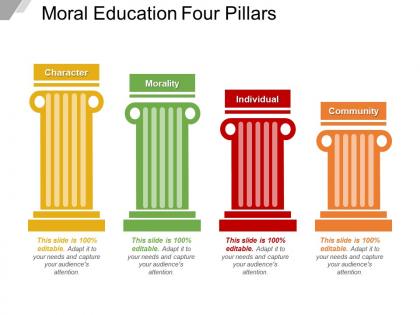
Moral education four pillars




Try Before you Buy Download Free Sample Product
 Impress Your
 Audience
 100%
100% Editable
 Save Hours
 of Time


Portray the various components of morality with this Moral Education Four Pillars template. This ethics PowerPoint presentation comprises four parts namely character, morality, individual and community. Take advantage of this values infographic and show your audience the right way of leading life. Showcase various principles of moral education such as honesty, generosity, sensitivity, consideration, etc. in this layout. Encourage good behavior or a proper code of conduct among employees with the help of this layout. This ethics graphic is best suitable for schools, colleges, educators, and corporations. Distinguish between right and wrong activities with the help of this slide. Owing to the adaptability of this slideshow, it can be modified according to the need or requirement of the situation. Take the assistance of this ethics PPT and induce your employees to behave with propriety. Download this morality diagram to create a remarkable impact on your stakeholders through stunning visuals.
People who downloaded this PowerPoint presentation also viewed the following :
Moral education four pillars with all 5 slides:
Encourage a cost effective approach with our Moral Education Four Pillars. Get folks to have a close grip on expenditure.


FAQs for Moral
Look, teaching kids right from wrong is huge for how they'll make decisions later. You can't just hope they figure it out on their own - trust me on that one. Show them what empathy and honesty look like in real life. Have those awkward conversations about why stuff matters, not just what the rules are. Kids need to understand how their choices affect other people. Start early with the tough topics. Honestly, half of it's just being consistent about modeling the behavior you want them to copy. It's way more effective than lecturing.
Pick scenarios without obvious right/wrong answers first - like is it okay to lie so you don't hurt someone's feelings? Let them think alone for a bit, then do small groups before opening it to everyone. The key is getting them to actually wrestle with it instead of just saying what sounds good. I always ask "what would you do and why?" rather than pushing them toward some answer I already decided on. Kids get way more into it when they can relate to the situation somehow. Oh, and don't judge their responses - just facilitate. Maybe try one dilemma weekly?
So basically, when kids get solid moral education, it creates this crazy domino effect across generations. Crime drops. People actually give a damn about their communities and vote. You get leaders who aren't total scumbags - though that's probably setting the bar pretty low these days, lol. But seriously, it works because people start thinking beyond just "what's in it for me." Trust between different groups improves, there's way less corruption, and society just... holds together better. The key is starting early and being consistent about it. The effects really compound over time.
Honestly, where you are in the world makes a massive difference in how schools teach morals. Japanese schools are all about group harmony and helping society - way different from Western schools that push individual rights and making your own choices. Religion obviously changes everything too. Some places weave faith right into lessons, others keep it completely separate. Teaching methods? Totally depends. Some cultures just tell kids what's right and wrong straight up. Others do the whole discussion thing where students debate it out (which I actually think works better). But yeah, if you're making curriculum, definitely check what your community actually values first or you'll miss the mark completely.
Honestly, kids absorb way more from watching you than listening to lectures. When my siblings fight over toys, I'll jump in with "hey, how can we make this fair for everyone?" Instead of big moral speeches, just weave it into random moments - like praising honesty when they admit to breaking something. Books are clutch for this stuff too. Maybe pick one value to focus on each month? Like if it's kindness, point out kind acts you see at the store or whatever. The trick is making it feel natural, not like you're delivering some after-school special. Trust me, the preachy approach backfires every time.
Honestly, tech makes ethics way more interesting than those boring textbook cases. Your students can actually *experience* moral dilemmas through interactive simulations - like should I snitch on my friend for cheating? VR is amazing for this stuff but yeah, expensive. Discussion platforms are solid too since kids can debate with peers worldwide and see different viewpoints. There are apps with ethics games that work well for solo practice. I'd start with free discussion forums or simulation sites first - way better engagement than traditional methods. Oh, and the workplace conflict scenarios are surprisingly popular with students.
Honestly, you gotta mix it up because moral stuff is tricky to assess. Portfolio reflections are awesome - students write about real dilemmas they've faced and how they'd handle them. Case studies work great too since you hear how they actually think through problems. Role-playing scenarios? Even better - you see their values in action rather than just what they write down. I also love peer feedback sessions, though those can get a bit chaotic sometimes. The real trick is focusing on their reasoning process, not whether they give you the "correct" answer you're looking for.
Mix up how kids engage with the same moral concepts - some love stories, others need hands-on problem-solving. Survey them first about learning styles and cultural backgrounds, then work that into your lessons. Case studies from different cultures help tons. Switch between small groups, debates, and writing reflections. Honestly, letting students connect lessons to their own lives makes everything click better. The variety keeps you from getting bored too (trust me on this one). Your core principles don't change, but how you teach them absolutely should.
Oh totally - they go hand in hand! You can't really teach kids ethics without helping them understand emotions first. Like, empathy and self-control are basically the foundation of making good moral choices. When students can actually feel how their actions impact others (and manage their own reactions), ethical dilemmas become way less abstract. Most solid programs weave emotional skills right into the ethics lessons now. Honestly, I've seen the biggest breakthroughs happen when you throw in some emotion-focused activities - suddenly the whole "do the right thing" message actually clicks with them.
Getting the community involved makes a huge difference - kids see that ethics actually matter beyond school walls. Parents will back you up way more when they're included from day one, which honestly saves you so much headache later. Local leaders and organizations bring real stories that textbooks just can't match. Service projects give students chances to practice what they've learned too. I'd start super small though - maybe invite one community member to speak or partner with a nearby nonprofit for something simple. You don't want to overwhelm yourself right off the bat.
Honestly, the hardest part is just getting people to agree on what values you should even be teaching. Parents have one idea, admins have another - it's wild how different everyone's opinions are. You don't want to come across as preachy either, which is trickier than it sounds. Plus most teacher training programs barely touch this stuff, so you're kinda winging it. Oh, and good luck finding time in your already packed schedule! I'd say start with the obvious universal stuff like kindness and respect. Get input from parents early so they don't freak out later. Maybe look into some workshops to build your confidence too.
Honestly, moral education is like giving kids the tools to actually handle conflict instead of just yelling at each other. They learn empathy and how to see things from someone else's perspective - which is huge. Active listening becomes second nature. So does finding middle ground rather than trying to "win" every argument. The emotional regulation piece is probably the biggest game-changer though. Most adults I know still lose it during arguments, so starting kids early makes sense. Role-playing different scenarios works really well, plus you can use actual classroom drama when it pops up as teachable moments.
Honestly, stories are amazing for teaching ethics because kids get emotionally invested in the characters. They'll debate what Harry Potter should've done for hours, but zone out during a lecture about moral philosophy. Classic fables work, but don't sleep on modern stuff either. When students read about characters facing tough choices, they naturally start thinking about consequences and different viewpoints. The whole thing feels safe since it's not their real life. I usually grab short stories or excerpts - way easier than full novels. Gets them talking about values without it feeling preachy, you know?
Totally doable! Just weave moral stuff into what you're already teaching instead of adding more to your plate. Literature discussions are perfect for ethical dilemmas, and science debates get kids thinking about real consequences. Honestly, the random teachable moments work better than planned lessons half the time. Make values part of how your classroom runs - like talking up integrity during tests or pushing teamwork in group projects. Kids pick up on this naturally while you're still covering everything you need to. I'd start with whatever subject feels easiest and go from there.
So Singapore's Character and Citizenship Education is probably your best starting point - they actually build values into regular classes using real situations and community work. Finland does something cool where they just mix ethical stuff into everything instead of separate morality lessons. Japan has these "moral time" sessions that use stories and group talks to teach empathy. Colombia's got this program about citizenship skills and conflict resolution. Oh, and Finland's approach is honestly pretty genius since it doesn't feel forced. But yeah, definitely look at Singapore's model first - it's systematic and you can actually measure if it's working.
-
Content of slide is easy to understand and edit.
-
Amazing product with appealing content and design.