


Education learning journey powerpoint slide show
You must be logged in to download this presentation.




Try Before you Buy Download Free Sample Product
 Impress Your
 Audience
 100%
100% Editable
 Save Hours
 of Time


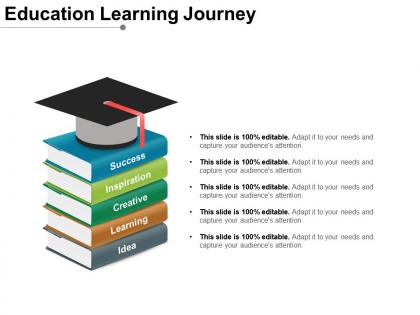
Provide the right motivation to your audience with the help of Education Learning Journey PowerPoint Slide Show. This creative PowerPoint template for education lets you explain the significance of education journey to the onlookers. The PPT slide enables you to explain your audience step by step approach that can be followed in order to achieve success in life. This slideshow can be used by teachers, business operators or any other organisation to provide an insight to their audience to reach the greatest heights in life. Using this PPT, you can create suitable plans to bring out the best results.The image in the template consists of a five stage process depicting different steps in the learning journey. These steps are ideas, learning, creativity, inspiration and success. The presenter can alter the steps according to the requirement. Download this attractive PPT slide and enhance the learning process.
People who downloaded this PowerPoint presentation also viewed the following :
Education learning journey powerpoint slide show with all 5 slides:
Now you know your reputation is at stake. Use our Education Learning Journey Powerpoint Slide Show and make a great and lasting impression.


FAQs for Education learning journey
Honestly, tech has completely transformed classrooms. Interactive whiteboards, tablets, online platforms - kids can literally take courses from their couch now. The coolest part? Adaptive software that adjusts to each student's pace automatically. No more one-size-fits-all teaching. Virtual field trips are pretty amazing too, plus students can collaborate with classrooms worldwide in real-time. My advice? Don't overwhelm yourself trying to use everything at once. Pick one new digital tool each semester and actually master it first. Trust me, your sanity will thank you later!
Honestly, just switch things up more often. Add visual stuff, hands-on activities, group work - even quick individual thinking time. I mean, prep can be a pain, but you don't need to start from zero. Maybe throw in a sketching activity for visual kids or do some think-pair-share moments. The whole point is giving them different ways to get the same info, you know? I'd try rotating approaches each week and see what actually works with your specific bunch. Some groups are just weird and respond to totally different things.
Honestly, PBL is a game-changer because kids are actually building stuff instead of cramming for tests. Critical thinking goes through the roof when they're tackling real problems they care about. Plus retention is way better - hard to forget something when you designed it yourself, you know? I've seen kids who normally zone out get completely obsessed with their projects. The collaboration skills they develop are insane too. Maybe try a simple one-week project first? Like, don't go crazy with some massive thing right away. See how they react to actually applying what they're learning instead of just regurgitating it back.
Honestly, critical thinking totally changes how kids engage with material. Instead of just memorizing stuff, they start questioning things and making real connections. I've seen students go from zoning out to actually getting excited about lessons - it's wild how much more they participate. The cool thing is once they learn to analyze and reason in one subject, those skills carry over everywhere else. Oh, and it doesn't have to be complicated to start! Just throw in some "why do you think that happened?" questions during class. You'll notice the difference right away.
Ugh, honestly it's brutal how much your family's income affects school stuff. Rich kids get private tutors, fancy test prep, better schools - the whole package. Meanwhile, lower-income students are working part-time jobs and dealing with spotty wifi at home. Their parents want to help but they're working like three jobs just to pay rent, you know? The gap starts super early too and just gets worse. I swear your zip code shouldn't determine if you get into college, but here we are. If you're helping students, definitely point them toward free stuff like Khan Academy or local tutoring programs. Every bit helps.
Check your LMS stats first - login times, how many kids are actually finishing assignments, that sort of thing. Quick surveys work great too, just ask them straight up how they're doing. I love using breakout rooms during Zoom calls because you can really feel the energy (or lack of it). Watch who's got their camera on and who's chatting. Numbers are helpful but they're not everything - sometimes a kid who looks disengaged on paper is just having a rough week. One-on-ones with the quiet students make a huge difference. Most of them just want to know you actually see them.
Honestly, start with looking at your materials - whose voices are you including? Probably the same ones everyone uses, right? Try mixing in different perspectives and experiences. Your classroom setup matters too. Some kids need visual stuff, others learn better in groups or with hands-on activities. Don't let the loud kids dominate everything either - find ways to pull in the quieter ones. Maybe start by picking apart just one lesson this week? See what's missing, then slowly build from there. Three areas to think about: what you're teaching, how your room feels, and switching up your methods.
Ugh, standardized tests basically run the whole show now. Schools get judged by those scores, so everything - curriculum, teaching methods, even budgets - revolves around them. Teachers end up "teaching to the test" because their own evaluations depend on how kids perform. It's honestly pretty frustrating. Sure, you get consistent benchmarks across districts, which I guess is useful. But it also means subjects get narrower focus, and there's this constant pressure that doesn't always help actual learning. My sister's a teacher and she's always stressed about this stuff. Don't let the scores become the only thing that matters though - student growth is way more complex than one test.
Honestly, emotional intelligence matters way more than most people realize. Kids who can handle their feelings just do better - they don't freak out during tests, actually ask teachers for help, and work well with classmates. It's wild but EI predicts grades better than being "smart" sometimes. When students recognize they're stressed or frustrated, they can actually deal with it instead of shutting down completely. Simple stuff like daily mood check-ins can help tons. I've seen struggling kids turn things around once they start understanding their emotions better. Worth trying if you're dealing with this!
Oh this is actually easier than you'd think! So instead of just saying "you're so smart," praise the process - like "I love how you kept trying different approaches." When kids mess up, frame it as data collection, not failure. Honestly, some of my favorite teachers would actually get excited about wrong answers because they're teaching moments. Give assignments where struggling is totally normal and expected. Also - tell kids about neuroplasticity! They eat that stuff up when they realize their brains physically change. Model it yourself too. Say "I don't know, let's find out together."
Honestly, the consent thing is huge - like, can a 12-year-old really agree to having their data collected? Schools grab way more info than they actually need too. Then there's the whole mess where these algorithms decide stuff about kids but nobody knows how they work. Bias is obviously a major problem. Plus what happens to all that sensitive data years later? (My old school probably still has my grades from forever ago somewhere.) Do privacy audits regularly and just ask yourself "do we actually need this data?" before adding new tech tools.
Honestly, just start with one thing - maybe asking "what was the coolest thing you learned today?" at dinner. Reading together for like 15 minutes actually works wonders (I was skeptical too but it's legit). Don't worry if you can't help with their math homework - focus more on helping them figure stuff out themselves. Set up a decent spot for homework, and here's the thing: celebrate when they try hard, not just when they ace everything. Being genuinely curious about their day matters way more than knowing all the answers.
Dude, colleges are finally getting their act together with this whole skills thing. They're doing micro-credentials now and actually partnering with real companies instead of just living in their ivory towers. COVID basically forced everyone online overnight - which honestly wasn't all bad. Now you'll see actual internships and projects built right into programs instead of being afterthoughts. Digital literacy is huge obviously, but they're also pushing critical thinking hard. My advice? Look for programs that get you real experience and industry contacts, not just a fancy piece of paper.
Honestly, interdisciplinary stuff is where it's at because real problems don't fit into neat little boxes. Students miss so many connections when subjects stay separate. Climate change is the perfect example - you need science, economics, politics, all of it. When you mix disciplines, kids get way more engaged since they're working on actual complex challenges instead of random worksheets. Makes them better problem-solvers too. I'd start small though - maybe throw some current events into history class or do math through art projects. Works way better than you'd think, and students actually remember the content longer.
Honestly, you'll need to hit this from multiple angles. Train your staff to spot warning signs first - that's crucial. Having counselors right on campus is absolute gold because kids won't wait weeks for outside help. Create classrooms where students actually feel safe talking about stuff. Oh, and weaving social-emotional learning into regular classes makes a huge difference too. Build clear connections to local mental health resources. The whole point is making support feel totally normal, not like there's something wrong with needing help. I'd start by figuring out what you already have versus what's missing.
-
Wonderful resource for professional
-
Great designs, Easily Editable.
-
Understandable and informative presentation.