


Blockchain Technology Impact On Pharmaceutical Industry Training Ppt




Try Before you Buy Download Free Sample Product
 Impress Your
 Audience
 100%
100% Editable
 Save Hours
 of Time


These slides showcase how blockchain technology has resolved the challenges of the pharma domain in the healthcare industry with improved compliance with rules and regulations,tasks automation with smart contracts,and better transparency by making database operations accessible to the public. It also highlights how it ensured proper inventory management to improve supply chain system efficiency and overall better clinical trials.
People who downloaded this PowerPoint presentation also viewed the following :
Content of this Powerpoint Presentation
Slide 1
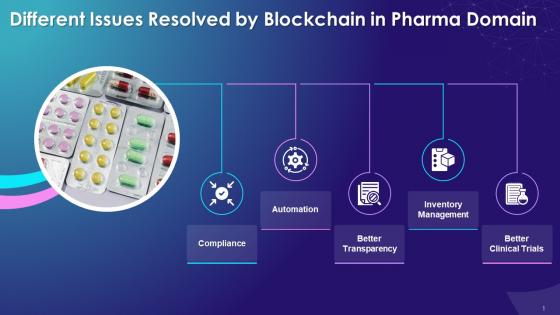
This slide illustrates challenges that the blockchain resolves in pharma domain such as compliance, automation, traceability, inventory management and better clinical trials.
Instructor’s Notes:
The multiple issues solved by blockchain in pharma domain are as follows:
Compliance:
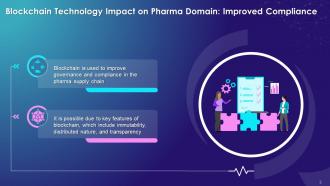
- Blockchain is used to add governance and compliance to the pharma supply chain
- It is possible due to key features of blockchain, which include immutability, distributed nature, and transparency
Automation:
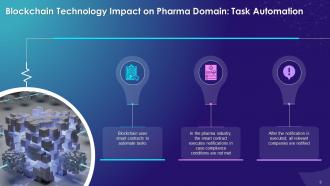
- Blockchain uses smart contracts to automate tasks on the blockchain
- In the pharma industry, the smart contract executes notifications in case compliance conditions are not met
- After the notification is executed, all the drug-relevant companies are notified
Better Transparency:
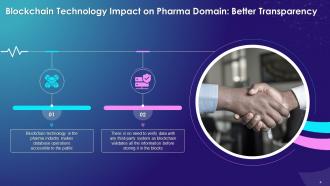
- Blockchain technology in the pharma industry makes database operations accessible to the public
- There is no need to verify data with any third party system as blockchain validates all information before storing it in the blocks
Inventory Management:
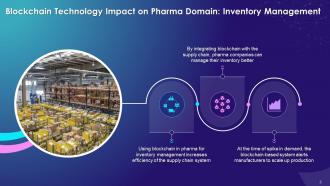
- Using blockchain in pharma for inventory management helps the supply chain system
- By integrating blockchain with the supply chain, pharma companies can manage their inventory better
- At the time of spike in demand, the blockchain-based system alerts manufacturing units to stay ready to produce more
Better Clinical Trials:
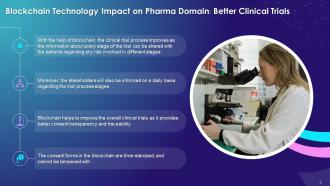
- With the help of blockchain, the clinical trial process improves as the information about every stage of the trial can be shared with patients
- Stakeholders will also be informed on a daily basis regarding the trial process stages
- Blockchain helps improves overall clinical trials as it provides better consent transparency and traceability
- Consent forms in the blockchain are time-stamped, and no one can tamper with the information once stored
Slide 2
This slide highlights the impact of blockchain on pharma domain with compliance. It explains that blockchain is used to add governance and compliance to the pharma supply chain. It also includes key features of blockchain such as immutability, distributed nature, and transparency.
Slide 3
This slide highlights the impact of blockchain on pharma domain with automation. It explains that blockchain uses smart contracts to automate tasks. In pharma industry, the smart contract executes notifications in case the compliance conditions are not met and all the drug related companies are notified.
Slide 4
This slide illustrates the impact of blockchain on pharma domain with better transparency. It explains that blockchain helps in making pharma industry database operations accessible to the public.
Slide 5
This slide illustrates the impact of blockchain on pharma domain with inventory management. It explains that using blockchain in pharma for inventory management helps the supply chain system. Integrating blockchain with supply chain can help pharma companies to better inventory management.
Slide 6
This slide illustrates the impact of blockchain on pharma domain with better clinical trials. It highlights that with the help of blockchain, the clinical trial process improves as the information about each stage of trial can be shared with risks involved also explained. Stakeholders will be informed on daily basis regarding the trial process stages. Getting the time consent process is also streamlined, as it is time-stamped and stored as information in a blockchain, which is impossible to tamper with
Blockchain Technology Impact On Pharmaceutical Industry Training Ppt with all 22 slides:
Use our Blockchain Technology Impact On Pharmaceutical Industry Training Ppt to effectively help you save your valuable time. They are readymade to fit into any presentation structure.










FAQs for Blockchain Technology Impact On Pharmaceutical
So blockchain basically lets you track every single pill from the factory all the way to the patient - total transparency. Each step gets logged permanently, so there's no way to fake where drugs came from. This is actually massive because counterfeit meds literally kill thousands of people every year. Wild, right? Plus you get automatic documentation for regulatory stuff, which makes compliance way easier. When recalls happen, they're lightning fast since everything's already mapped out. Honestly, if you're working with expensive or risky medications, it's a game-changer for keeping your supply chain legit.
So basically blockchain makes this unbreakable record of where each drug goes - from the factory all the way to your local CVS. Nobody can mess with the data once it's in there. Every company that touches the medication (manufacturers, distributors, whatever) adds their info at each step. This means you can track down exactly where some sketchy pill came from in minutes instead of waiting weeks. Pretty cool for stopping fake drugs, honestly. Oh and if you're looking into this stuff, find platforms that work with current pharma systems - you don't want to rebuild everything from scratch.
So basically blockchain keeps a permanent record of where each drug goes - from the factory all the way to you picking it up at CVS. Every single step gets logged on this distributed ledger thing, so counterfeiters can't really sneak fakes into the system anymore. Think of it like each pill bottle having its own digital ID that you can check instantly. Pretty neat stuff, honestly. You trace production, shipping, everything. The whole supply chain becomes transparent, which makes it super easy to verify if your medication is legit or not. Way harder for sketchy people to mess with.
Basically, smart contracts run your pharma deals automatically when conditions get met - no middleman hassles. Set them up so payments release once drug shipments are verified, or manufacturing kicks off when inventory drops too low. The blockchain keeps everything transparent and tamper-proof, which honestly saves so much time vs chasing signatures around. Way faster and cheaper since you're ditching manual processes. I'd start small though - maybe pilot automatic payment releases for your regular supplier deals first, see how it goes.
Honestly? Legacy systems are your biggest nightmare. Your current ERP setup wasn't designed for blockchain, so you're stuck with pricey middleware or complete overhauls. Getting every supplier to use the same standards is like... well, imagine convincing your entire family to agree on dinner plans. FDA compliance makes everything worse since you need bulletproof documentation. Oh, and don't forget training costs - that stuff adds up fast. My advice? Run a tiny pilot first. Test how everything connects before you blow your whole budget on something that might not even work.
So basically blockchain spreads patient data across tons of computers after encrypting it, which makes it super hard for hackers to mess with. Patients can actually control who sees their stuff through smart contracts - way better than the database nightmare we deal with now. Every single access gets logged too, so you've got a perfect trail of who touched what and when. Regulators eat that up, obviously. My advice? Try running a small blockchain pilot on your next Phase II trial. Test how it handles data integrity and consent stuff - might surprise you how well it works.
Honestly, blockchain is a game-changer for compliance stuff. The FDA and EMA are obsessed with tracking every step from manufacturing to patient delivery - and blockchain gives you that permanent record they want. When auditors show up, all your documentation is already there automatically. No more digging through old files like a maniac. Smart contracts can actually enforce your compliance rules for you, which cuts down on those accidental violations that always seem to happen. I'd say start with a small pilot program first - shows regulators you're not just talking about transparency, you're actually doing it. Pretty solid approach tbh.
So blockchain basically gives everyone - manufacturers, distributors, hospitals, regulators - access to the same real-time ledger. Think of it like a shared Google Doc but way more secure. You can instantly see drug authenticity and supply chain status instead of playing phone tag with five different companies. The cool thing is nobody owns the data, so even competitors can work together without worrying someone's gonna mess with it. Honestly, I'd start by figuring out what info you're always bugging your partners for - that's probably where you'll see the biggest wins with this stuff.
Look, pharma companies are sitting on massive savings with blockchain - like 10-30% just on supply chain costs. Counterfeiting alone bleeds billions from the industry yearly, and blockchain kills that problem. You're also cutting middlemen and making compliance way smoother. Honestly, I was skeptical at first too, but the math works out. Less audit time, fewer recalls, faster drug approvals - it adds up fast. The administrative stuff becomes so much cleaner. Don't go crazy though. Pick one supply chain piece to test it on first, see the results, then expand from there.
So basically blockchain tracks every single pill from factory to your medicine cabinet - like a permanent record that can't be faked. When there's a recall, companies don't have to do those scary "toss everything just in case" announcements that freak everyone out. They can pinpoint exactly which batches are bad and where they ended up. You'll get way more precise alerts about whether YOUR specific bottle is affected or not. Honestly, it's pretty cool - you could scan your medication and see its whole journey. Makes recalls super targeted instead of those broad panic-inducing ones we're used to.
So blockchain basically makes drug pricing way less shady by tracking everything from factory to pharmacy. No more mystery markups - you can see exactly what things actually cost. Smart contracts handle approvals automatically instead of waiting forever for some bureaucrat to stamp paperwork. Your finance people won't hate their lives as much, and patients get meds faster. Honestly, the current system is such a mess that anything's an improvement. I'd start with expensive specialty drugs first since that's where the biggest pricing games happen. The transparency alone would probably save you tons of headaches.
So basically DAOs let token holders vote on which pharma research projects get funding instead of leaving it all up to big companies. They're pooling money from investors worldwide to tackle diseases that aren't profitable enough for traditional pharma to bother with. The blockchain voting thing means you can actually see where your money goes and how decisions happen - pretty cool transparency wise. VitaDAO is one to watch if you're looking into research partnerships. Honestly, this could totally change how medical research gets funded, especially for rare diseases that usually get ignored.
So basically blockchain makes these unhackable digital records for all healthcare credentials - degrees, licenses, the works. No more calling around to verify someone's qualifications or waiting forever for paperwork to show up. Universities and licensing boards can all access the same trusted ledger, and each credential gets this unique signature that can't be messed with. Your hiring process becomes way faster. Plus when auditors show up (ugh), you've got rock-solid proof of everything. Honestly surprised the healthcare industry took this long to figure it out, but better late than never I guess!
Honestly, consent is your biggest nightmare here. Patients need to actually get what they're signing up for, not just breeze through some legal garbage. Here's the thing though - once data hits blockchain, it's basically permanent. So if someone wants out later? Good luck with that. You're also dealing with this weird tension where blockchain wants everything transparent but patients obviously need privacy. And let's be real, half the time these systems just make life easier for pharma companies while patients see zero benefit. Make your consent process dead simple about the whole "forever" aspect. Give people actual control over their stuff.
So blockchain is basically fixing the pharma industry's trust problems - counterfeit drugs, sketchy supply chains, all that mess. Companies are using it to track meds from factory to pharmacy with records nobody can mess with. Each transaction gets locked in permanently, which is actually pretty neat. Clinical trials and patient data are getting the blockchain treatment too. Pfizer's already testing it for drug authentication (makes sense, right?). Worth looking into if you're curious about where this space is headed.
-
I downloaded some of the presentations for work. They were simple to modify and saved me a lot of time and effort.
-
What a stunning collection of customizable templates! Really a time-saver..