

 0 Comment
 Customer Reviews

In 2016, a large-scale urban redevelopment project in Boston faced severe delays and cost overruns, ballooning its budget by over $100 million. The reason? Poor project management. Misaligned timelines, resource misallocation, and lack of communication among stakeholders turned what could have been a landmark success into a cautionary tale.
Real estate projects—whether residential, commercial, or mixed-use—are intricate puzzles that require precise planning, seamless coordination, and clear communication. From securing permits and managing budgets to tracking milestones and ensuring on-time delivery, every phase demands a structured approach to avoid chaos and setbacks.
That’s where effective project management comes into play. With the right tools and processes, you can ensure that your real estate projects stay on track, within budget, and aligned with your goals.
Looking to streamline your project management process? SlideTeam’s Real Estate Project Management Templates are here to help. These templates provide you with the tools to plan timelines, allocate resources, track progress, and collaborate with teams—all in an organized and efficient manner.
Let’s explore these templates and see how they can make your next real estate project a resounding success.
BONUS: All templates are 100% customizable to meet the unique demands of your projects.
Template 1: Real Estate Project Management PPT Template
This PowerPoint presentation provides an in-depth guide to effective property management and real estate project planning. It covers essential best practices for property selling, such as analyzing market trends, leveraging online sales channels, and understanding location-specific demands. Technological advancements in real estate, including augmented reality, drones, and virtual staging, are highlighted as key tools to optimize property selling and enhance the buyer experience. The presentation also includes a comparative analysis of popular real estate websites, a 90-day marketing plan for agents, and steps for developing a social media strategy. Additionally, it outlines the phases of real estate project management, from initial development and planning through construction and handover, and includes detailed implementation practices and activity tracking for each stage. This deck serves as a comprehensive resource for real estate professionals seeking to improve efficiency, streamline processes, and drive successful property transactions.
[product_image id=398898]
Template 2: Multiple Phases of Real Estate Project Management Process
This slide outlines the multiple phases involved in the real estate project management process, providing a structured approach from initial planning to final exploitation. Each phase is clearly defined, with designated participants and key actions required for successful project completion. The phases include Development and Planning, where design conditions and fundraising are managed, followed by Designing, Economic Assessment, and Tender and Negotiation. The construction phase involves extensive project management training and infrastructure building. Subsequent stages cover Handover for Operation, Payment for Accomplished Works, and finally, Exploitation, which focuses on ongoing building maintenance. The process is organized into Designer and Construction blocks, ensuring a seamless flow and collaboration between stakeholders such as customers, contractors, architects, and banks. This detailed roadmap provides a comprehensive framework for real estate professionals to navigate complex projects effectively.

Template 3: Real Estate Construction Risk Assessment for Project Management
This slide provides a comprehensive risk assessment framework for real estate construction project management, focusing on identifying and managing potential risks. Each row highlights a specific risk, such as a lack of design approvals, permit delays, undefined regulations, and budget misestimations. For each risk, the slide details the owner responsible, the underlying cause, the impact on the project, and the level of risk (ranging from low to high). Additionally, it includes tailored risk response strategies, like developing design solutions, holding project meetings, enforcing time management, and defining scopes to minimize errors. This structured approach enables stakeholders to proactively address potential issues, improving project performance and efficiency.

Template 4: Real Estate Project Management Estimation Plan
This slide provides an estimation plan for a real estate project management process, specifically for the "Five Star Construction" project managed by Smith Jones with sponsorship from Jaden Peterson. The plan includes parametric estimates to gauge project duration across various tasks. For each task, such as site cleaning, plumbing, and parking tile installation, the slide displays crucial metrics: effort hours, resource quantity, availability percentage, performance factor, and calculated duration estimate in hours. This structured approach allows project managers to effectively allocate resources, evaluate performance factors, and estimate completion timelines, ensuring efficient project execution. The estimation plan serves as a reliable guide for tracking progress and adjusting resource allocation as needed to meet project deadlines.

Template 5: Participants Involved in Real Estate Construction Project Management
This slide illustrates the key participants involved in real estate construction project management, highlighting the collaborative roles of each party in the operational and management processes. Central participants include the customer, landowner, finance, and tenant, each contributing distinct functions, such as land ownership, building development, and logistics. Supporting roles involve management consultants, architects, coordinators, and construction supervisors who streamline project operations from planning to execution. The slide also categorizes tasks by area, such as new facility construction and tenant-related work, assigning specific responsibilities to contractors, IT construction companies, and interior design firms. This framework underscores the importance of coordinated efforts across various stakeholders to achieve successful project outcomes in commercial real estate.

Template 6: Real Estate Project Management Scorecard Matrix
This slide presents a scorecard matrix for managing real estate projects, focusing on key performance areas like financials, learning & growth, customer expectations, and internal processes. Each category includes a specific measure, target, priority level, and data source to ensure a balanced and actionable approach to project management. The financial metric emphasizes budget conformity, aiming for a 10% improvement upon project completion, marked as a high priority and tracked through weekly budget reports. Learning & growth targets a certification rate of over 80% for teammates, while customer expectations aim for minimal variance in satisfaction. Lastly, internal processes focus on resolving issues within a week, underscored as a high priority with real-time monitoring through a web application. This matrix serves as a structured framework for assessing and maintaining project quality and efficiency across essential dimensions.

Template 7: Real Estate Construction Project Schedule Management
This slide provides an overview of the construction project schedule management for a real estate project, detailing key tasks, assigned personnel, start and end dates, and additional comments. Managed by Project Manager Lily Jones, the schedule spans from May 5, 2022, to March 31, 2023. Key phases include planning, raw material accumulation, basement creation, floors creation, light fittings, sewage pipelines, accessory installations, AC fittings, and fire extinguisher placements. Each task is assigned to specific team members, ensuring accountability and streamlined workflow. The structured timeline aids in monitoring progress and maintaining project alignment with expected completion dates. This schedule enables project stakeholders to track milestones, manage resources effectively, and address any arising delays or issues in real-time, fostering a well-coordinated construction process.

Template 8: Real Estate Project Monitoring And Management Plan
This slide provides a detailed overview of the "PQR" real estate project monitoring and management plan. Under the management of Cassandra H., the project runs from January 15, 2022, to August 12, 2022, with a primary deliverable labeled "ABC." The plan is divided into phases, each with specific tasks, assigned managers, start and end dates, task status, and task type. For example, Phase A includes tasks managed by Rocky R. and Andy B., both marked as completed. Phase B, however, has overdue tasks managed by Sally T. and Dan A. Phase C's Task 5, assigned to Sebastian G., is yet to start. The slide uses a timeline with a Gantt chart representation, providing a clear visual on each task's progress and status over the project duration. This structured layout allows for effective tracking of task completion and identification of delays for corrective actions.

Template 9: Real Estate Development Project Prioritization
This slide provides a prioritization framework for risks in real estate development projects. It categorizes risks such as "Vulnerability to Accidents," "Lawsuits from Unsatisfied Clients," "Failing to Deliver Service," and "Increasing Online Competition from Various Web Portals" with a "Moderate" priority level, given a risk ranking score of 7-12. Each risk type includes a space to define the specific management response to mitigate potential impacts. Additionally, "Travel Mishaps" are assessed with a "Low" priority due to a negligible ranking score of 0. The slide includes a rating scale guide, categorizing risks from "Negligible" to "Extreme," allowing project managers to prioritize actions based on the potential impact and probability of each risk. This structured prioritization helps to ensure that higher-priority risks receive timely attention and appropriate resources for mitigation.

Template 10: Risk Categories in Real Estate Construction Projects for Successful Management
This slide outlines the critical risk categories in real estate construction projects, emphasizing strategies for effective management. Key risks include "Slow Design Proposal Approvals," which can delay processes due to approval interruptions and is assigned a low-risk level with a solution to develop project design solutions. "Interruptions in Permits" due to outdated building designs carry a medium risk, with the strategy to conduct follow-up meetings post-design. "Poorly Defined Rules and Regulations" are classified as high risk due to potential budget and time management errors, addressed through robust time management practices. Lastly, "Poor Budget Estimation" poses a low risk, impacting design quality, with mitigation involving clear scope definition to minimize human errors. This structured approach helps to identify, assess, and manage potential disruptions, enhancing project control and successful outcomes in construction project management.

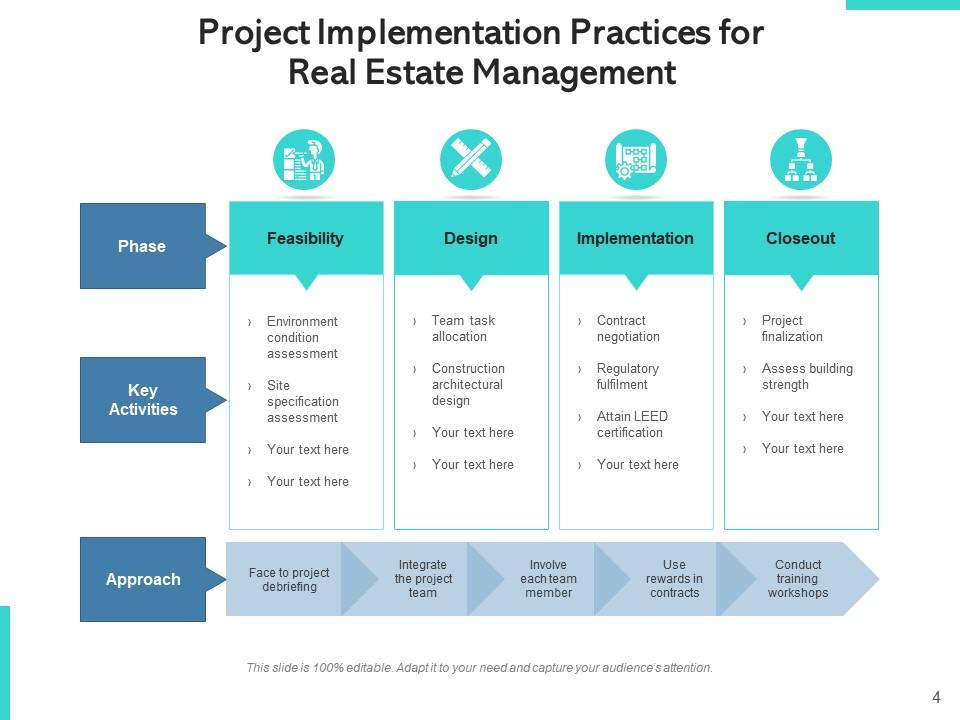
Template 11: Project Implementation Practices for Real Estate Management
This slide outlines the phased approach to project implementation in real estate management, breaking down the key activities and strategic approaches for each phase. The Feasibility phase focuses on environmental condition assessment and site specification, ensuring project viability through detailed debriefing. In the Design phase, tasks are allocated, and architectural designs are developed with an integrated project team for efficient collaboration. Implementation involves contract negotiation and regulatory compliance, with the addition of LEED certification to align with sustainable building standards, while emphasizing team involvement. Finally, the Closeout phase ensures project finalization, with a focus on building assessment and completion through training workshops, cementing the project’s structural and regulatory integrity. This structured method optimizes team coordination, minimizes risks, and aligns the project with sustainability goals for comprehensive real estate management.
Template 12: Real Estate Construction Project Management Planning Model
This slide presents a comprehensive Real Estate Construction Project Management Planning Model, detailing each stage from initial design to project turnover. The Basic Project Plan begins with the Basic Design phase, covering project scheduling, specification documentation, and architectural layout. This progresses to a Detailed Plan that includes equipment selection, material delivery, and fabrication drawings. The subsequent Equipment and Materials Procurement phase involves selecting manufacturers, contractors, and conducting material inspections. The final stage, Construction Work, comprises site inspections, team selection, and establishing a construction timeline.
The model integrates a robust Project Management System (PMS) with distinct support systems for Design, Procurement, and Construction. Each support system is underpinned by essential components like progress tracking, project scheduling, document management, and material control. This structured framework ensures a streamlined workflow, effective resource management, and alignment with project milestones, facilitating efficient project execution and seamless handover.

Final Word
In real estate, success isn’t just built on bricks and mortar—it’s built on precise planning and execution. The Boston redevelopment project serves as a powerful reminder that even the most promising ventures can falter without effective project management. Real estate projects demand more than vision—they require structured processes to align resources, timelines, and goals to ensure a smooth path from blueprint to completion.
SlideTeam’s Real Estate Project Management Templates provide the clarity and tools to navigate this complexity. Imagine having a framework to plan every phase, track progress effortlessly, and foster collaboration among teams—all while staying on time and within budget. These templates are more than just documents; they’re your roadmap to delivering projects that inspire confidence and meet expectations.
Every delay avoided, every resource optimized, and every milestone achieved brings you closer to success. With these templates, you can transform challenges into opportunities and execute your projects with confidence and precision. Because in real estate, great projects aren’t just completed—they’re managed to perfection.