Multiple phases of real estate project management process

Rating:
80%
Multiple phases of real estate project management process
Slide 1 of 2
Favourites Favourites

Try Before you Buy Download Free Sample Product

Audience Impress Your
Audience
Editable 100%
Editable
Time Save Hours
of Time
The Biggest Sale is ending soon in
0
0
:
0
0
:
0
0
Rating:
80%
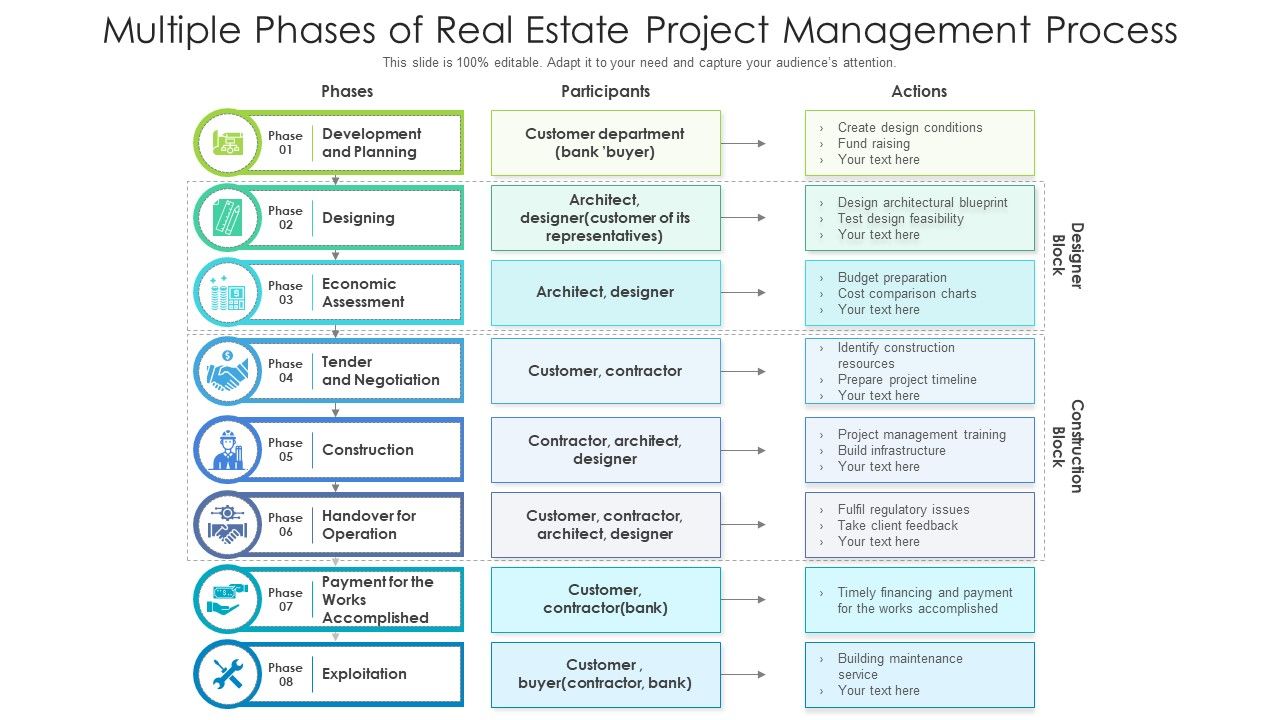
Introducing our Multiple Phases Of Real Estate Project Management Process. set of slides. The topics discussed in these slides are development and planning, designing, economic assessment, tender and negotiation. This is an immediately available PowerPoint presentation that can be conveniently customized. Download it and convince your audience.

People who downloaded this PowerPoint presentation also viewed the following :

FAQs for Multiple phases of real estate

Real estate project management involves five key phases: initiation and feasibility analysis, planning and design development, financing and permitting, construction and development, and marketing and sales completion. These phases streamline project delivery by establishing clear timelines, managing resource allocation, and coordinating stakeholder communication, with many developers finding that structured phase management reduces costs and accelerates market entry.

The planning phase determines project success by establishing realistic budgets, securing financing, conducting market analysis, and defining clear timelines and objectives. Through comprehensive feasibility studies and stakeholder alignment, developers minimize risks, anticipate challenges, and create strategic roadmaps, with many real estate firms finding that thorough upfront planning reduces costs and accelerates delivery timelines.

Essential execution phase tools include project management platforms like Procore and Autodesk Construction Cloud, financial tracking software, scheduling applications, communication systems, and quality control databases. These technologies streamline operations by automating progress reporting, coordinating contractor communications, and managing budget allocations in real-time, with many developers finding that integrated platforms ultimately deliver faster project completion and enhanced stakeholder transparency.

Risk management integrates into real estate phases through comprehensive planning during feasibility studies, continuous market monitoring throughout development, and proactive contingency protocols during construction and sales phases. Through systematic risk assessment frameworks, developers can identify financial vulnerabilities, regulatory changes, and market fluctuations early, ultimately delivering more predictable outcomes and protecting investment returns.

Best practices for stakeholder communication include establishing regular reporting schedules, creating centralized communication platforms, maintaining transparent progress updates, conducting phase-specific meetings, and providing tailored information for different stakeholder groups. These approaches streamline coordination by ensuring consistent messaging, reducing miscommunication, and enhancing project transparency, with many real estate developers finding that structured communication protocols ultimately deliver faster approvals, stronger investor confidence, and more successful project outcomes.

Budgeting shifts from broad estimates in feasibility and planning phases to detailed line-item tracking during construction, then focuses on operational costs and revenue optimization post-completion. Early phases prioritize land acquisition and development costs, while construction demands precise vendor management and contingency planning, with many developers finding that phased budget controls ultimately deliver better project margins and timeline adherence.

Market analysis in pre-construction serves as the foundation for strategic decision-making, determining project feasibility, target demographics, pricing strategies, competitive positioning, and optimal property features. Through comprehensive market research, developers can identify demand patterns, assess risk factors, and align project specifications with buyer preferences, ultimately minimizing investment risks while maximizing market appeal and profitability potential.

Project managers ensure compliance by conducting thorough regulatory research, establishing relationships with local authorities, implementing regular inspection schedules, and maintaining detailed documentation throughout development. Through strategic coordination with legal teams, zoning specialists, and municipal offices, developers streamline permit processes, minimize costly delays, and avoid potential violations, ultimately delivering projects on time while building stronger community relationships for future developments.

Real estate project performance metrics include budget variance, timeline adherence, cost per square foot, return on investment, quality scores, and stakeholder satisfaction rates. These indicators enable project managers to track financial efficiency, schedule compliance, and delivery standards, while construction firms and development companies find that comprehensive metric tracking ultimately delivers better resource allocation, risk mitigation, and competitive market positioning.

Technology enhances collaboration through cloud-based project management platforms, real-time communication tools, shared document repositories, mobile applications, and integrated workflow systems. These solutions streamline coordination by enabling instant updates, centralized data access, and seamless information sharing across development, construction, and sales teams, ultimately delivering faster project timelines and improved operational efficiency.

Effective delay management strategies include proactive scheduling with buffer time, real-time progress monitoring, alternative supplier networks, weather contingency planning, and cross-trained workforce deployment. These approaches enable construction teams to pivot quickly when obstacles arise, with many real estate developers finding that robust communication protocols and flexible resource allocation ultimately minimize project delays while maintaining quality standards and budget control.

Sustainability considerations are increasingly critical in real estate planning and execution, driving regulatory compliance, cost reduction, and market competitiveness. Modern developments integrate energy-efficient systems, sustainable materials, and green certifications throughout project lifecycles, with many developers finding that environmentally conscious projects deliver higher property values, lower operational costs, and enhanced tenant attraction in today's market.

Primary challenges during real estate handover include incomplete construction work, documentation discrepancies, quality defects, regulatory compliance gaps, and coordination issues between contractors, buyers, and legal teams. These complications often result in delayed possession, additional costs, and customer dissatisfaction, with many developers finding that systematic quality audits and comprehensive documentation reviews significantly streamline the process while enhancing buyer confidence.

Lessons learned from previous projects enhance future real estate development through improved risk assessment, refined timeline planning, and optimized resource allocation strategies. By analyzing past successes and challenges, developers can streamline procurement processes, enhance stakeholder communication protocols, and implement proven cost control measures, ultimately delivering projects more efficiently while minimizing common pitfalls across residential, commercial, and mixed-use developments.

Project documentation serves as the foundation for accountability, compliance, and decision-making across all real estate management phases, including feasibility studies, permits, construction records, financial tracking, and performance metrics. These comprehensive records enable developers to streamline regulatory approvals, minimize legal risks, and maintain operational transparency, with many real estate firms finding that systematic documentation ultimately delivers faster project timelines and enhanced investor confidence.

Ratings and Reviews

80% of 100
Write a review
Most Relevant Reviews
  1. 80%

    by Deandre Munoz

    Top Quality presentations that are easily editable.

1 Item

per page: