

Phases Of E Commerce Project Management Plan




Try Before you Buy Download Free Sample Product
 Impress Your
 Audience
 100%
100% Editable
 Save Hours
 of Time


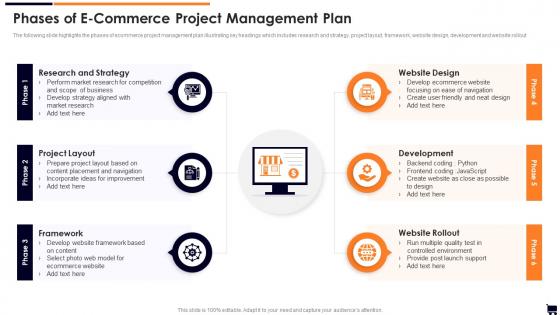
The following slide highlights the phases of ecommerce project management plan illustrating key headings which includes research and strategy, project layout, framework, website design, development and website rollout
People who downloaded this PowerPoint presentation also viewed the following :
Phases Of E Commerce Project Management Plan with all 6 slides:
Use our Phases Of E Commerce Project Management Plan to effectively help you save your valuable time. They are readymade to fit into any presentation structure.





FAQs for Phases Of E Commerce
So there's usually 5 main phases: discovery/planning, design, development, testing, then launch. Discovery is honestly make-or-break - you figure out requirements, budget, timeline. Super tempting to rush this part but don't. Design comes next (wireframes, mockups, all that UX stuff). Then developers do their thing. Testing is way more complex than people realize - you're checking payment flows, security, mobile stuff, basically everything. Launch happens last with post-launch support. Oh and stakeholders will definitely pressure you to skip proper planning. Just ignore them lol.
Start by mapping out exactly what you're building - which product categories, payment methods, features, all that stuff. But here's the key part: be super clear about what you're NOT doing. I've watched so many projects blow up because someone assumed mobile optimization was included when it wasn't even discussed. Document everything. Are you handling inventory? Customer service flows? Marketing stuff? Define your MVP first, then make a separate list for nice-to-haves. Trust me on this - stakeholders will try to sneak extras into scope later if you don't.
Ugh, scope creep is the absolute worst - clients always want "just one more tiny thing" that breaks everything. Payment gateways are a nightmare too, way harder than they look. Your timeline will get crushed by unrealistic deadlines that skip testing time. Third-party integrations? They literally never work like the docs say they will. Plus you're constantly juggling UX vs what's actually possible to build, inventory syncing issues, and teams who can't agree on priorities. Honestly, just pad your estimates like crazy and write down every single scope change or you'll go insane.
Dude, agile is clutch for e-commerce. Your requirements are gonna change non-stop - new features, user complaints, market stuff. Short sprints let you pivot fast instead of mapping out some massive plan that'll probably flop anyway. You catch problems early and ship what customers actually want. I swear, I've watched teams burn months perfecting checkout flows that users absolutely hated. With agile you're iterating on real data, not guesswork. Try 2-week sprints first. Focus on one feature at a time and get it live. Way less painful than the waterfall nightmare.
Track conversion rate, average order value, and customer acquisition cost - those are your bread and butter. Cart abandonment rate tells you where people are bailing out. Page load times matter more than most people think, honestly. Nobody's got patience for slow sites these days. Revenue growth is obvious but doesn't tell the whole story about what's actually working. Oh, and customer lifetime value if you care about long-term stuff beyond launch. Get your baseline numbers first, then check weekly so you'll catch problems before they snowball.
Focus on user impact and revenue first - that's your compass. Hit the critical stuff like payments right away, then rank everything else by customer feedback and business value. I swear by effort vs impact scoring matrices (makes me feel professional lol). Get your stakeholders to help rank features though - way better than doing it solo. Don't ignore technical debt either, that stuff sneaks up on you. Map out quarterly milestones so everyone's aligned on what's happening and when. Oh, and always have a reason ready for why certain features didn't make it.
Honestly, UX should be driving pretty much every major decision you make on this project. Get your research done upfront and loop UX designers into sprint planning from the start. I've watched so many teams completely rebuild their checkout flows because they treated UX like an afterthought - such a waste of time and budget. Test prototypes with actual users before dev goes too deep. Your technical choices can't create friction for customers, period. Build conversion tracking and user feedback right into your timeline from day one instead of scrambling to add it later.
Honestly, cross-functional teams are a game changer for e-commerce stuff. You get dev, design, marketing, and ops all talking from day one instead of those awful surprises where someone's like "oh wait, we literally can't build that." Everyone actually gets the whole customer experience too, not just their little corner of it. I've seen too many projects crash because people worked in silos. Get everyone involved in your planning meetings and do regular check-ins. For your next launch, just figure out who needs to be there and bring them in early. Trust me on this one.
Honestly, start with just the basics - maybe Asana for tracking everything and Slack so you're not drowning in emails. Notion is clutch for keeping all your docs in one place (I literally can't function without it anymore). Once you actually launch, you'll need Google Analytics and some heat mapping tool to see what's working. Oh, and definitely set up a staging environment for testing stuff before it goes live - learned that one the hard way. But seriously, don't go crazy with tools right away. Pick like 2-3 solid ones first, then add more when your team gets bigger and things get messier.
First thing - figure out what HAS to happen in order vs what can happen at the same time. Put your best devs on the critical stuff like payments and login features. Those break everything if they're wonky. Don't do what I did and scatter everyone across a million features right away. Focus is key. Budget like 20% extra time for testing and random stuff breaking (because it will). Oh, and get some kind of project tracker so you can see where things are getting stuck before you're scrambling at the deadline. Way less stressful that way.
Dude, three main things to watch out for: technical stuff, business side, and security. Always build in extra time for testing because something WILL break right before launch - Murphy's law is real. Get real user feedback early to validate your ideas, and watch your burn rate like a hawk. Security can't be an afterthought - get your penetration testing set up and nail down PCI compliance from the start. Keep a risk list and check it weekly with your team. Oh, and have backup plans ready for the big scary scenarios that keep you up at night.
Honestly, just tackle one region at a time or you'll go crazy. Map out what each market needs - GDPR for Europe, data laws for China/Russia, tax stuff, whatever. Build those compliance checks right into your project timeline from day one. Don't wait until the end, trust me on this. Get local lawyers involved early since this stuff changes constantly and how they interpret things matters way more than you'd think. Oh and document literally everything - make checklists your team can actually use. Regular audits are annoying but way cheaper than fixing disasters later.
Start with scalability - can it grow with you without costing a fortune? Integration with your current tools (CRM, inventory stuff) is critical too. Payment fees really add up, so compare those carefully. User experience matters for both customers and your team. Security's obviously non-negotiable. Mobile responsiveness and customization options are key. Support quality is way more important than people realize - trust me, you don't want to be stuck at midnight with broken checkout and no help. I'd honestly make a scorecard of must-haves vs nice-to-haves before you start doing demos. Saves time.
Okay so first thing - start those weekly check-ins from day one and actually send recap emails after every meeting. Trust me on this one, I had a client who thought "mobile-friendly" meant something completely different than what we delivered... awkward. Define your success metrics upfront and don't be shy about referencing them when scope creep hits (it always does). Your project dashboard should be visible to everyone - no one likes surprises when it comes to timelines and budgets. Oh, and document everything. Seriously, everything.
Honestly, I'd start by stalking your competitors a bit - check their pricing, what they're selling, read their reviews to see what people complain about. Google Analytics shows you how people actually behave on sites, which is way more useful than guessing. If you've got customers already, just ask them stuff directly. Focus groups work too but they're kinda awkward sometimes. Oh, and keyword research is clutch because it shows what people really search for vs what we assume they want. Test everything with A/B tests on your pages. Mix the hard data with actual conversations - that's where the gold is.
-
“Thanks to SlideTeam. Now I can make smart presentations in a fraction of time without any hassle.”
-
I had them make a presentation for an office retirement party. They were very helpful in understanding what we wanted and delivered the perfect presentation. Highly recommended!