


Electronic Commerce Powerpoint Presentation Slides





Try Before you Buy Download Free Sample Product
 Impress Your
 Audience
 100%
100% Editable
 Save Hours
 of Time


Introducing Electronic Commerce PowerPoint Presentation Slides. This presentation gives an overview of Ecommerce, organizational structure, E-business infrastructure, trends, and key drivers, E-environment. Take the assistance of the readily available eCommerce PPT slide design and showcase worldwide trends in the eCommerce industry. Discuss the key growth drivers and E-environment with our ready-to-use PPT infographics. It also depicts business strategies. Discuss E-marketing and its components by taking advantage of our electronic money PPT slideshow. The presentation also provides information on customer relationship management with its strategies. After that, it shows business models such as E-shops, E-malls, E-procurement. The slides further cover the revenue model, payment methodologies, change management, implementation, and maintenance. Download our visually appealing E-business PowerPoint slide deck and create an amazing presentation.
People who downloaded this PowerPoint presentation also viewed the following :
Content of this Powerpoint Presentation
Slide 1: This title slide introduces Electronic Commerce. Add the name of your company here.
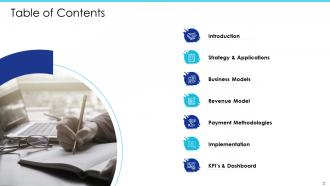
Slide 2: This slide contains the Table of Contents. It includes – Introduction, Strategy & Applications, Business Models, etc.
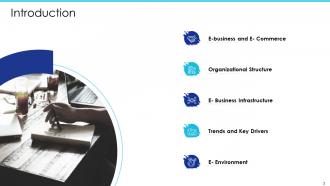
Slide 3: This is a table of content slide showing the Introduction. It includes - E-business and E-Commerce, Organizational Structure, etc.
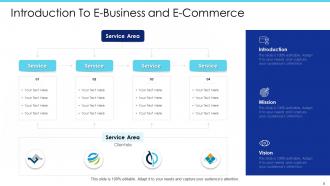
Slide 4: This slide presents the Introduction To E-Business and E-Commerce.
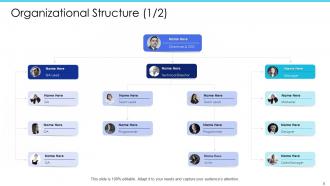
Slide 5: This slide presents the Organizational Structure (1/2).
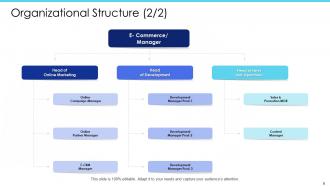
Slide 6: This slide presents the Organizational Structure (2/2).
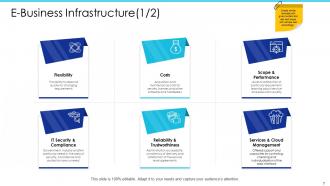
Slide 7: This slide presents the E-Business Infrastructure (1/2). Create a similar template with the given content and add text boxes with sample text accordingly.
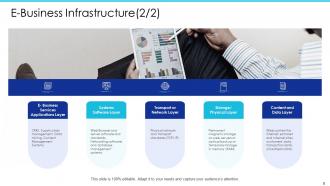
Slide 8: This slide presents the E-Business Infrastructure (2/2). Web Browser and server software and standards, Networking software, and database management systems.
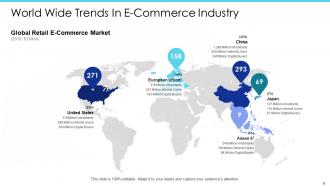
Slide 9: This slide presents the World-Wide Trends in E-Commerce Industry.
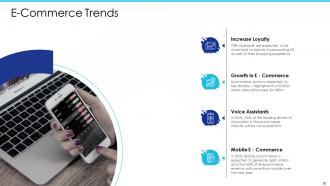
Slide 10: This slide presents the E-Commerce Trends.
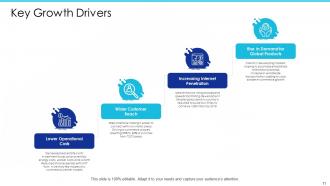
Slide 11: This slide presents the Key Growth Drivers.
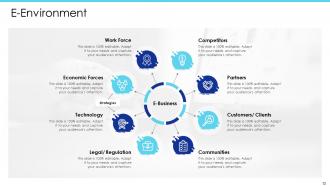
Slide 12: This slide presents the E-Environment.
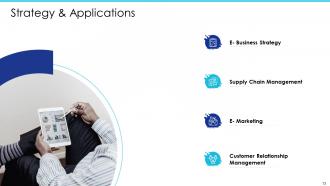
Slide 13: This is a table of content slide showing the Strategy & Applications. It includes - E-Business Strategy, Supply Chain Management, Customer Relationship Management, and E-Marketing.
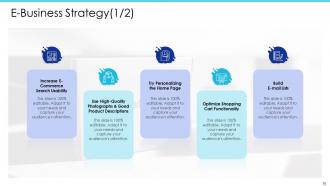
Slide 14: This slide presents the E-Business Strategy (1/2).
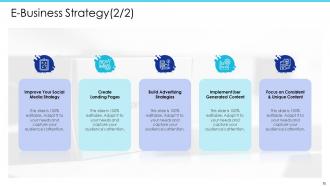
Slide 15: This slide presents the E-Business Strategy (2/2).
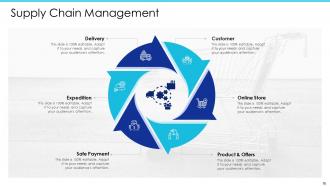
Slide 16: This slide presents the Supply Chain Management.
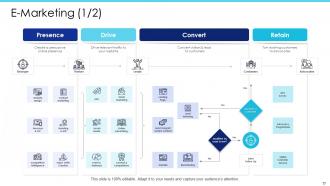
Slide 17: This slide presents the E-Marketing (1/2). It includes – Presence, Drive, Convert and Retain.
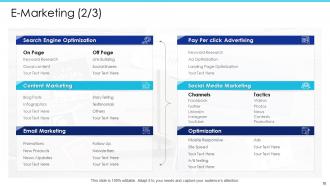
Slide 18: This slide presents the E-Marketing (2/3).
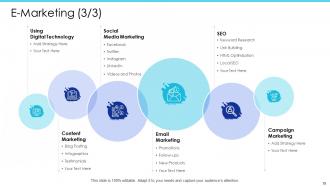
Slide 19: This slide presents the E-Marketing (3/3).
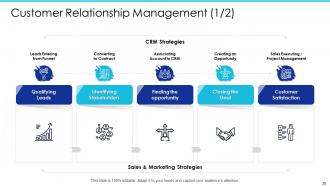
Slide 20: This slide presents the Customer Relationship Management (1/2). \
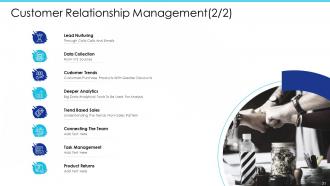
Slide 21: This slide presents the Customer Relationship Management (2/2).
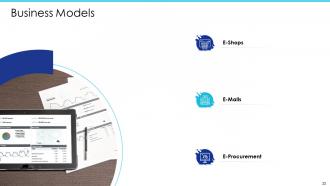
Slide 22: This is a table of content slide showing the Business Models. It includes - E-Malls, E-Shops, and E-Procurement.
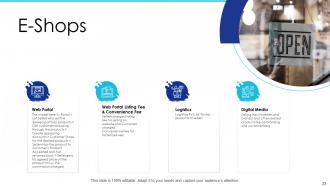
Slide 23: This slide presents the E-Shops. It includes - Logistics, Digital Media, Web Portal Listing Fee & Convenience Fee, and Web Portal.
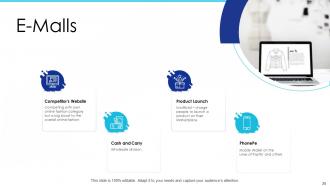
Slide 24: This slide presents the E-Malls.
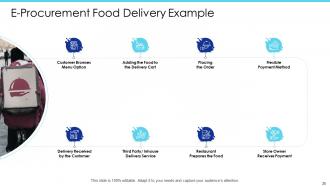
Slide 25: This slide presents the E-Procurement Food Delivery Example.
Slide 26: This is a table of content slide showing the Revenue Model.
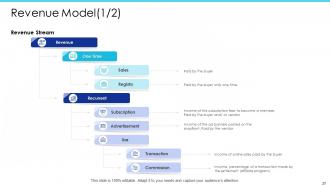
Slide 27: This slide presents the Revenue Model (1/2).
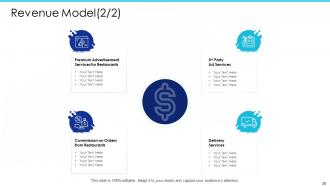
Slide 28: This slide presents the Revenue Model (2/2).
Slide 29: This is a table of content slide showing the Payment Methodologies.
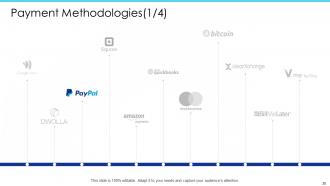
Slide 30: This slide presents the Payment Methodologies (1/4).
Slide 31: This slide presents the Payment Methodologies (2/4).
Slide 32: This slide presents the Payment Methodologies (3/4).
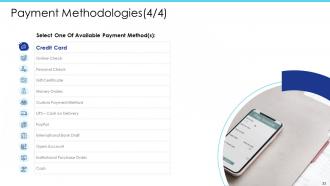
Slide 33: This slide presents the Payment Methodologies (4/4).
Slide 34: This is a table of content slide showing the Implementation. It includes - Implementation and Maintenance, Change Management, and Analysis and Design.
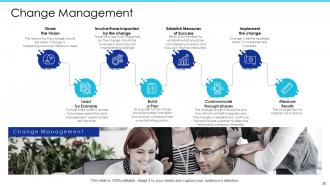
Slide 35: This slide presents the Change Management.
Slide 36: This slide presents the Analysis Tools (1/2).
Slide 37: This slide presents the Analysis Tools (2/2).
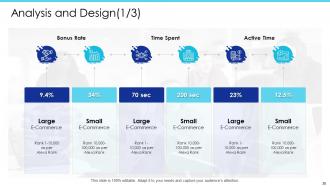
Slide 38: This slide presents the Analysis and Design (1/3).
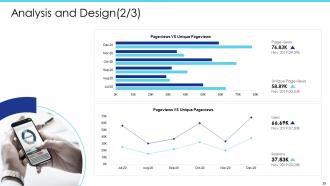
Slide 39: This slide presents the Analysis and Design (2/3).
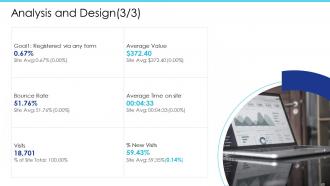
Slide 40: This slide presents the Analysis and Design (3/3).
Slide 41: This is a table of content slide showing the Ecommerce Management KPIs & Dashboard. It includes - KPI Metrics and KPI Dashboards.
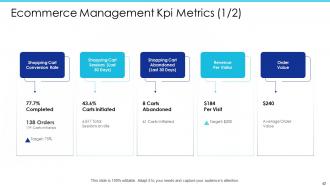
Slide 42: This slide presents the Ecommerce Management KPI Metrics (1/2).
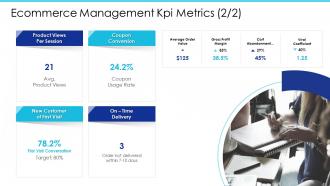
Slide 43: This slide presents the Ecommerce Management KPI Metrics (2/2).
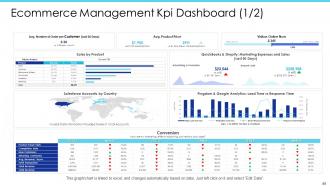
Slide 44: This slide presents the Ecommerce Management KPI Dashboard (1/2).
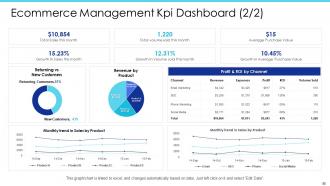
Slide 45: This slide presents the Ecommerce Management KPI Dashboard (2/2).
Slide 46: This is the Electronic Commerce Icons Slide.
Slide 47: This slide introduces the Additional Slides.
Slide 48: This slide presents Our Vision, Mission, and Goal.
Slide 49: This slide presents Our Awesome Team.
Slide 50: This slide is a Timeline template to showcase the progress of the steps of a project with time.
Slide 51: This slide presents a Magnifying Glass to give more details about the individual steps in a project.
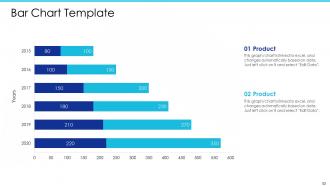
Slide 52: This slide shows a Bar Chart Template that compares 2 products’ data over a timeline of years.
Slide 53: This slide contains Post It Notes that can be used to express any brief thoughts or ideas.
Slide 54: This is the Puzzle slide.
Slide 55: This slide provides a Venn diagram that can be used to show interconnectedness and overlap between various departments, projects, etc.
Slide 56: This is a Thank You slide where details such as the address, contact number, email address are added.
Electronic Commerce Powerpoint Presentation Slides with all 56 slides:
Use our Electronic Commerce Powerpoint Presentation Slides to effectively help you save your valuable time. They are readymade to fit into any presentation structure.





FAQs for Electronic Commerce
Honestly, focus on three big things first: user experience, security, and making sure it works great on phones. Most shopping happens on mobile now anyway. Your site needs to load fast, have navigation that makes sense, and secure payment processing that doesn't freak people out. Search functionality is huge too - there's nothing worse than typing something in and getting zero relevant results. Good product photos and descriptions are obvious but still worth mentioning. Oh, and don't make checkout a nightmare with like 12 steps. People will bail. Having actual customer support helps too, even if it's just a decent FAQ section.
Dude, payment gateways are basically what make people trust your site enough to actually buy stuff. People see those PayPal or Stripe logos and instantly feel safer about typing in their card info - way better than some random checkout form that looks sketchy. I literally abandon carts when I don't recognize the payment method lol. The cool thing is they handle all the fraud protection and disputes too. So if something goes wrong, customers know they can get their money back. Just make sure whatever gateway you pick is super obvious on your checkout page. Trust me, it makes a huge difference.
Okay so SEO is basically how people find your store when they're googling stuff to buy. Most customers start on Google, right? If you're not showing up there, you're screwed. You'll want to figure out what keywords people actually type in when looking for your products - not what you think they search for, but what they really search for. Then work those terms into your product titles and descriptions naturally. Don't stuff them in weird places though, that looks spammy. Oh and make sure your site structure makes sense so Google can crawl it properly.
Track what your customers browse and buy - that's gold for showing them stuff they'll actually want. Google Analytics is clutch for spotting where people bail during checkout (usually payment pages, ugh). The cool part? You can predict trends and catch customers before they ghost you. Set up tracking first though - sounds boring but trust me, it's everything. Most e-commerce platforms have this built in now. Once you've got data flowing, you can fix slow pages and personalize their whole experience. It's honestly wild how much customer behavior tells you.
Dude, first thing - cut down that checkout form. Nobody's filling out 20 fields for a $15 purchase, it's ridiculous. Show shipping costs right away instead of surprising people at the end. Guest checkout is huge too, not everyone wants to create an account. Send those abandoned cart emails with a tiny discount - works pretty well. Oh and mobile optimization is critical since everyone shops on their phone now. Trust badges help, multiple payment methods too. But honestly? Just simplifying checkout will probably give you the biggest boost. Most sites overcomplicate it.
Mobile designs are game-changers for sales. Your customers won't stick around if they're struggling to tap tiny buttons or waiting forever for pages to load. Quick sites with easy navigation? Way more purchases. People browse longer too, which leads to those random "oh I need this" buys. The conversion boost is real - we're talking 20-30% higher rates on mobile-optimized sites. Honestly, there's no excuse not to prioritize mobile anymore since most shopping happens on phones anyway. Pull up your checkout process on your phone right now and see how clunky it feels. I bet you'll find some obvious fixes.
Okay so first thing - get SSL certificates set up because that's literally the bare minimum for encrypting customer data. Strong passwords and two-factor auth are must-haves too. Your payment stuff needs to be PCI DSS compliant, which sounds scary but isn't that bad. Don't store payment info on your own servers if you can help it - just let someone else handle that headache. Keep everything updated, get decent hosting with firewall protection, and run security audits regularly. Hackers are getting weirdly creative these days so you can't slack on this stuff.
Honestly, social media is huge for e-commerce because you're literally tapping into billions of people on Instagram, TikTok, Facebook. Their ad targeting is crazy precise too - you can narrow down exactly who sees your stuff. But here's the thing, organic content can be even better sometimes. Like product demos or behind-the-scenes posts that just randomly blow up. I've watched tiny brands get massive overnight from one viral TikTok. User-generated content is gold though - when customers post about your products, that's way more trustworthy than anything you could say. My advice? Pick maybe two platforms where your people actually are instead of spreading yourself thin everywhere.
Honestly, the biggest thing right now is AI personalization - it's getting scary accurate. Voice shopping through Alexa is finally taking off, plus Instagram and TikTok let you buy stuff without leaving the app. Everyone's obsessed with sustainability too, like carbon-neutral shipping and all that. Oh, and AR try-ons are insane now - I literally tried on sunglasses through my phone yesterday and almost bought three pairs lol. Subscription services are expanding beyond just products. Crypto payments are slowly becoming normal too, though still feels weird to me. For your stuff, I'd definitely go mobile-first and maybe add some social commerce features this year.
Dude, personalization is a game changer for conversions. Use their browsing history and past purchases to show customers what they actually want - it makes them feel like you totally understand them. That trust factor is huge, honestly. Instead of making people hunt through your entire catalog, you're basically serving up the good stuff right away. I'd start with simple product recommendations based on what they've bought or looked at before. Sounds basic but it can bump your average order value by 10-30%, which isn't nothing. Way easier than overhauling your whole site too.
Honestly, it's rough out there for small e-commerce. Amazon can buy in massive volumes so their costs are way lower - you're basically screwed on price competition from day one. Their marketing budget is probably what you make in a year, maybe more. Free shipping? Good luck with that when you don't have warehouses everywhere. I always tell people the only real shot is going super niche. Find something the big guys can't be bothered with and nail the customer service angle. Personal touch still matters to some people, thankfully.
Honestly, customer feedback is like getting free business advice - you'd be crazy not to use it! Set up those automated review requests after people buy stuff, then actually read what they're saying. Bad reviews? Perfect - now you know exactly what's broken in your checkout or shipping. But don't ignore the good stuff either, that tells you what to keep doing more of. I usually just make a simple spreadsheet to track patterns (I know, super fancy lol). The real magic happens when you tell customers "hey, we fixed that thing you complained about" - people love knowing they were heard.
Dude, COVID basically fast-forwarded e-commerce by like 5 years overnight. Global sales shot up 25% in 2020 - groceries and home stuff saw 50-100% increases, which is insane. People who'd never ordered online suddenly had zero choice during lockdowns. The crazy part? Most stuck with it even after stores reopened. I mean, once you realize you can get toilet paper delivered without pants on, why go back? Your digital strategy should definitely assume this shift is here to stay, not some temporary pandemic thing.
Honestly, these systems are lifesavers - they handle all the boring tracking stuff automatically so you don't have to. Real-time stock updates, auto-reordering when you're getting low, syncing across different platforms. No more awkward "sorry we're actually sold out" conversations with customers (those are the worst). You get solid data on what's flying off the shelves versus what's just sitting there collecting dust. The counting errors alone used to drive me crazy before I switched. Frees you up to think about bigger picture stuff instead of constantly putting out inventory fires.
So dropshipping is cool because you don't need to buy a bunch of inventory upfront - super low startup costs and no warehouse drama. You can basically sell anything without stocking it yourself. The downside though? Everyone's selling the same products, so profit margins kinda suck. And here's the annoying part - you're completely at your supplier's mercy for shipping times and quality control. Customer complaints become this whole mess when you can't actually touch the products. If you're gonna do it, spend time finding solid suppliers first. Oh, and try to find some niche stuff so you're not just competing on price with everyone else.
-
Enough space for editing and adding your own content.
-
Out of the box and creative design.
-
Great quality slides in rapid time.
-
Unique research projects to present in meeting.
-
Visually stunning presentation, love the content.
-
Great quality slides in rapid time.
-
Unique design & color.
-
Colors used are bright and distinctive.
-
Excellent work done on template design and graphics.