

Ecommerce payment systems powerpoint presentation slides




Try Before you Buy Download Free Sample Product
 Impress Your
 Audience
 100%
100% Editable
 Save Hours
 of Time


Introducing our content ready Ecommerce Payment Systems PowerPoint Presentation Slides. There are various online payment systems in use today. Showcase methods of online payment with the help of self-explanatory e-payment techniques PPT slides. Utilize e-commerce payment methods presentation deck to demonstrate various web payment solutions for online businesses to increase sales. Incorporate professionally designed online payment solution PowerPoint graphics to discuss online payment methods like google wallet, PayPal, square, amazon pay, bitcoin and so on. You can also make your audience aware of payment gateways using this professional-looking online payment methods presentation deck. The electronic payment system PowerPoint compete deck contains twenty-six ready to use slides with relevant content and suitable graphics. Furthermore, all slides given in this electronic payment system in eCommerce PPT are fully editable, so that the users can modify these as per their specific project needs. Therefore, download this high quality easy-to-use online payment methodologies presentation deck to analysis e-payment methods. Set a clear goal with our Ecommerce Payment Systems Powerpoint Presentation Slides. Stress on the need for a focused approach.
People who downloaded this PowerPoint presentation also viewed the following :
Content of this Powerpoint Presentation
Slide 1: This slide introduces Ecommerce Payment Systems. State Your Company Name and begin.
Slide 2: This slide shows Content of the presentation.
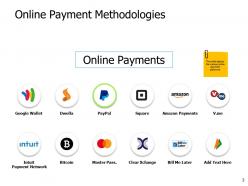
Slide 3: This slide presents Online Payment Methodologies depicting various online payment platforms.
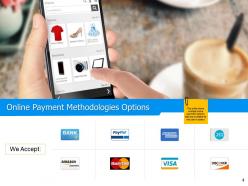
Slide 4: This slide displays Online Payment Methodologies Options that are available for the user to select.
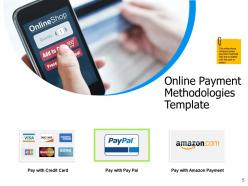
Slide 5: This slide represents Online Payment Methodologies Template with related imagery and payment options.
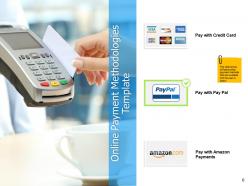
Slide 6: This is an optional slide for Online Payment Methodologies Template.
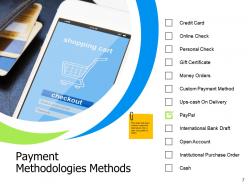
Slide 7: This slide showcases Payment Methodologies Methods including- Online Check, Personal Check, Gift Certificate, Money Orders, Custom Payment Method, Ups-cash On Delivery, International Bank Draft, Open Account, Institutional Purchase Order, Cash, Credit Card, PayPal.
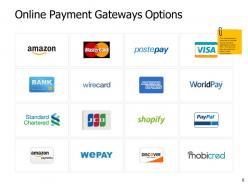
Slide 8: This slide displays Online Payment Gateways Options.
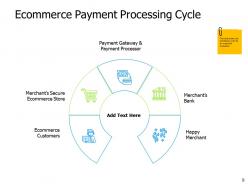
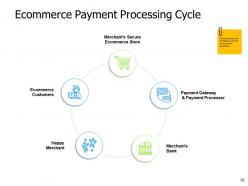
Slide 9: This slide shows Ecommerce Payment Processing Cycle as- Merchant’s Secure Ecommerce Store, Merchant’s Bank, Payment Gateway & Payment Processor, Happy Merchant, Ecommerce Customers.
Slide 10: This is an optional slide for Ecommerce Payment Processing Cycle.
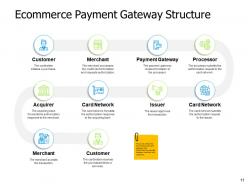
Slide 11: This slide presents Ecommerce Payment Gateway Structure describing- Customer, Merchant, Payment Gateway, Processor, Card Network, Issuer, Acquirer.
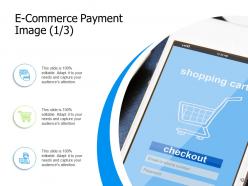
Slide 12: This slide displays E-Commerce Payment Image with text boxes.
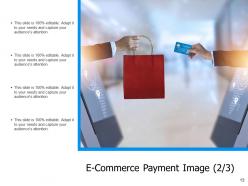
Slide 13: This is another slide with Ecommerce Payment Image.
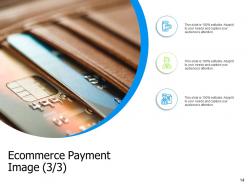
Slide 14: This is another slide displaying Ecommerce Payment Image with additional text boxes to show information.
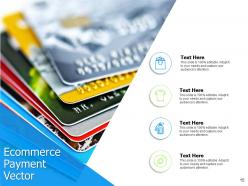
Slide 15: This slide represents Ecommerce Payment Vector with text boxes.
Slide 16: This slide displays Ecommerce Payment Systems Icons.
Slide 17: This slide is titled as Additional Slides for moving forward.
Slide 18: This is Our Team slide with names and designation.
Slide 19: This is About us slide to show company specifications etc.
Slide 20: This is a Comparison slide to state comparison between commodities, entities etc.
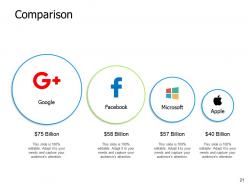
Slide 21: This is an optional Comparison slide.
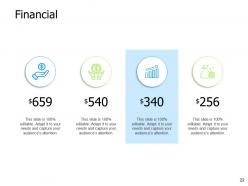
Slide 22: This is a Financial slide. Show your finance related stuff here.
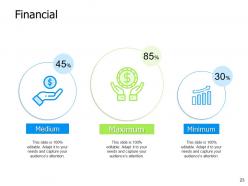
Slide 23: This is an optional Financial slide.
Slide 24: This is a Quotes slide to convey message, beliefs etc.
Slide 25: This slide is titled as Post It. Post your important notes here.
Slide 26: This is a Thank you slide with address, contact numbers and email address.
Ecommerce payment systems powerpoint presentation slides with all 26 slides:
Use our Ecommerce Payment Systems Powerpoint Presentation Slides to effectively help you save your valuable time. They are readymade to fit into any presentation structure.






FAQs for Ecommerce payment systems
So there's like four main types you'll see everywhere. Credit and debit card processors - think Stripe, Square. Then digital wallets like PayPal, Apple Pay, Google Pay. Buy-now-pay-later stuff is huge now (Klarna, Afterpay). Bank transfers and ACH payments too. Crypto's starting to pop up more but honestly still pretty niche. Here's the thing though - different age groups want different options. Younger people are obsessed with BNPL while older customers just stick with their cards. Fees vary wildly between them all. I'd definitely offer multiple options since people will literally abandon their cart if you don't have their preferred payment method.
So payment gateways are basically where customers type in their card details - like Stripe's checkout or PayPal's page. The processor actually handles moving money around behind the scenes, talking to banks and checking if there's enough funds. Honestly, it's kinda like ordering food - the menu/ordering system is the gateway, but the kitchen doing all the work is the processor. Companies like Square do both which is way simpler. Just double-check they work together when you're setting up, because compatibility problems are annoying as hell to fix later.
Okay so first things first - SSL certificates and PCI DSS compliance aren't optional, you just have to have them. Use tokenization instead of storing actual card numbers (seriously, don't store real card data if you can help it). Two-factor auth for admin access is a must. I've seen way too many companies get totally screwed by ignoring basic security stuff. Set up fraud detection to catch sketchy transactions, encrypt everything you store, and keep your systems updated. Honestly though? Just use Stripe or PayPal - they handle all the security headaches for you.
Dude, your payment setup can totally tank your conversion rates if it sucks. People bounce when checkout gets complicated - like 20-30% drops sometimes. Apple Pay and Google Pay boost sales by 15-20% because typing card details on mobile is actual torture. Don't force people to create accounts either, that's a conversion killer. Multiple payment options are clutch. I'd test your checkout flow monthly - honestly, most companies forget to do this and wonder why their bounce rates are horrible. One-click payments are where it's at.
Honestly, crypto payments are worth looking into. You'll save money on fees since there's no Visa/Mastercard taking their cut. International stuff settles way faster too - like minutes instead of days. The no-chargeback thing is actually amazing for preventing fraud headaches. Your customers don't have to hand over credit card info either, which people seem to love these days. Oh, and you're basically future-proofing for all those crypto people who'd rather spend Bitcoin than use their bank. Just make sure you get a decent payment processor that converts everything to regular money automatically - trust me, you don't want to deal with price swings messing up your books.
You gotta figure out what your actual customers want to use. Younger people are all about Apple Pay and digital stuff, but older folks still love their credit cards. Also depends where you are - PayPal's huge in some places but totally irrelevant in others. Don't go crazy with like 15 payment options though, that's just overwhelming. Pick 2-3 solid ones based on who you're selling to. Check what your competitors do, but honestly just ask your customers directly or test different options. Way better than guessing. Start simple with whatever your research shows, then you can always add more later if people actually want it.
Dude, mobile wallets are where it's at right now. Apple Pay, Google Pay, PayPal - customers love them because nobody wants to fumble around typing card numbers on their phone. One tap and they're done shopping. Security's way better too with all that tokenization stuff and fingerprint scanning. Mobile shopping keeps growing like crazy, so honestly? You'd be missing out big time if you don't add mobile wallet support soon. I'm telling you, it should be top of your list this quarter. Makes such a difference for conversions.
So payment fees are kinda all over the place tbh. Stripe and Square usually hit you with 2.9% + 30 cents per transaction. PayPal's worse at 3.5%+, though if you're doing serious volume you might get down to 2.4% with enterprise deals. Credit cards cost more than debit obviously. International stuff tacks on another 1-1.5%. Then there's all the random monthly fees and chargeback costs that add up. The whole fee structure is honestly a mess to figure out. Do you need recurring billing or multi-currency? That affects pricing too. But yeah, calculate your monthly volume first - higher numbers mean you can actually negotiate better rates.
PCI DSS is the main thing you gotta deal with - it's the security standard for credit card stuff. Basically you need to encrypt customer data, keep networks secure, test everything regularly. GDPR in Europe is another headache (trust me, that one gets messy fast). How much compliance you need depends on your transaction volume - small businesses get off easier than big retailers. Honestly though? Just use a payment processor that's already PCI compliant. Way less stress and you won't accidentally mess something up.
Honestly, recurring billing is a game changer because it stops people from second-guessing themselves every month. You know how you sometimes forget to renew Netflix and then get annoyed when it cuts off? Same thing happens with any subscription. Cards expire all the time too, which is super annoying, but decent billing systems will retry payments and send reminders before they just give up on you. The trick is letting customers easily update their payment info and manage everything from their account page. No friction means people stick around way longer since they're not constantly deciding whether it's worth it.
BNPL services like Klarna are absolutely everywhere right now - customers are obsessed. Crypto payments are finally becoming real too, not just hype. Apple Pay and Google Pay keep making checkout smoother, which honestly helps way more than people realize. Biometric stuff is picking up steam - fingerprints, face scans, the works. Voice commerce through Alexa is still pretty small but it's growing. The cool part? All these options working together actually cuts down on cart abandonment big time. I'd definitely check what payment methods your customers are actually requesting and go from there.
Cross-border payments are honestly such a pain. You can't just assume what works here will work everywhere else - like, China's all about Alipay while Europe loves SEPA transfers. Different countries have totally different banking rules too. The fees are brutal, currency conversion is a headache, and don't get me started on fraud detection across borders. My advice? Find one provider with solid international reach instead of juggling a bunch of regional ones. First step is figuring out where most of your international customers actually are, then work backwards from there.
Dude, checkout needs to be super smooth. Multiple payment options are a must - PayPal, Apple Pay, those buy-now-pay-later things. People get weirdly picky about how they pay. Keep it to like 2-3 steps max and throw some security badges on there because people freak out about entering card info. Guest checkout is clutch - nobody wants to create an account just to buy something. Show all your fees upfront too, not at the last second (seriously, that's so annoying). I'd test your own checkout process once in a while. If it bugs you, it's definitely bugging your customers.
Honestly, it's a game changer for cutting out all the tedious manual stuff. Your payment system syncs directly with your store, so customer info flows automatically and transactions happen way faster. No more typing the same data twice (which I used to mess up constantly). Customers stay on your site instead of getting redirected to some sketchy-looking payment page. Real-time inventory updates are clutch too. But the best part? Everything's in one dashboard. I can't tell you how much time I wasted switching between different systems just to track a single order.
Ugh, fraud and chargebacks are such a pain - they'll hit your cash flow hard. You lose the original sale PLUS get slapped with fees ($15-100 each time). Too many chargebacks? Your payment processor might dump you or stick you with crazy expensive "high-risk" rates. Document everything because that's honestly your best shot when fighting bogus disputes. Set up basic stuff like address verification and CVV checks - it's not foolproof but helps. The time you'll waste dealing with this stuff is almost worse than the money sometimes.
-
Awesomely designed templates, Easy to understand.