

Payment gateway powerpoint presentation slides




Try Before you Buy Download Free Sample Product
 Impress Your
 Audience
 100%
100% Editable
 Save Hours
 of Time


Handle the authorised and authenticated aspects of a transaction with our Payment Gateway PowerPoint Presentation Slides. This direct payment PPT slideshow can be used by a merchant acquiring company to showcase its objectives like the acquisition of thousand plus customers, introducing personalized and innovative devices in the market, better performance material at a lower cost, and development of end to end pos and payment solutions. Use the e-business PowerPoint templates to elucidate global and emerging merchant acquiring market overview, along with its industry analysis using pestle and swot. Translate your business’ edge by including the acquisition of components, products and application, with our cash-free PPT design. The cc avenue PowerPoint graphic also includes customer identification and business model. Develop strategies on the basis of market segmentation, positioning strategy and mapping along with price comparison as included in the net banking and upi PPT design. End the gateway integration PowerPoint presentation with a financial projection of your company.
People who downloaded this PowerPoint presentation also viewed the following :
Content of this Powerpoint Presentation
Slide 1: This is the title which slide introduces Payment Gateway. Add the name of your company here to start.
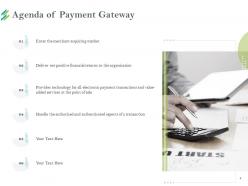
Slide 2: This slide contains the Agenda of Payment Gateway. This agenda includes - Enter the merchant acquiring market, Deliver net positive financial returns to the organization, Provides technology for all electronic payment transactions and value-added services at the point of sale, and Handle the authorized and authenticated aspects of a transaction, etc.
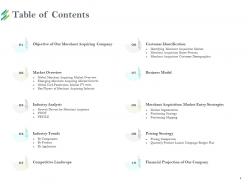
Slide 3: This slide contains the Table of Contents. The contents are - Objective of Our Merchant Acquiring Company, Market Overview, Industry Analysis, Industry Trends, Competitive Landscape, Customer Identification, Business Model, Merchant Acquisition Market Entry Strategies, Pricing Strategy, and Financial Projection of Our Company.
Slide 4: This slide introduces the Objective of Our Merchant Acquiring Company.
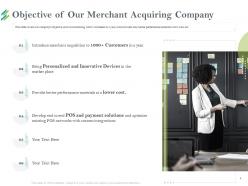
Slide 5: This slide presents the Objective of Our Merchant Acquiring Company. It includes introducing merchant acquisition to 1000+ Customers in a year, bringing Personalized and Innovative Devices in the marketplace, etc.
Slide 6: This slide introduces the Market Overview. This includes Global Merchant Acquiring Market Overview, Emerging Merchant Acquiring Market Growth, Global Card Penetration Market FY 2020, and Key Players of Merchant Acquiring Industry.
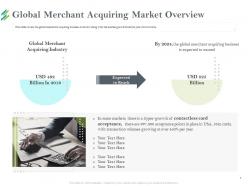
Slide 7: This slide presents the Global Merchant Acquiring Market Overview along with the market growth from the year 2019 to 2024.
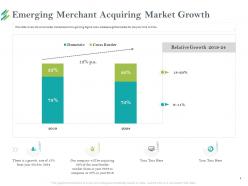
Slide 8: This slide presents the Emerging Merchant Acquiring Market Growth which shows the cross-border and domestic fast-growing digital and e-commerce global market for the year 2019 to 2024 comparing domestic and cross-border market share.
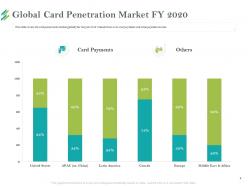
Slide 9: This slide presents the Global Card Penetration Market FY 2020 wherein the focus is on card payments and other payment sources. It compares card payments and other ways of payments for different countries like the United States, APAC, Latin America, Canada, Europe, and the Middle East & Africa.
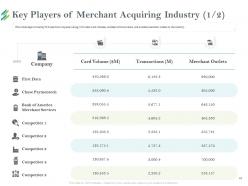
Slide 10: This slide tabulates part 1 of 2 of the Key Players of Merchant Acquiring Industry. This table depicts the key U.S merchant acquirers such as First Data and Chase Payments etc. along with their card volumes, number of transactions, and number of merchant outlets in the country.
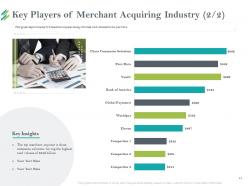
Slide 11: This slide graphically presents part 2 of 2 of the Key Players of Merchant Acquiring Industry. This graph depicts the key U.S merchant acquirers along with their card volumes for the year 2019.
Slide 12: This slide introduces the Industry Analysis which includes Growth Drivers for Merchant Acquirers, SWOT, and PESTLE.
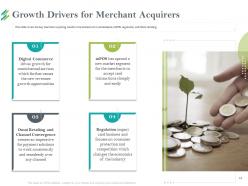
Slide 13: This slide provides the Growth Drivers for Merchant Acquirers such as Digital Commerce drives growth for omnichannel services which further causes the new revenues growth opportunities, mPOS has opened a new market segment for the merchants to accept card transactions cheaply, etc.
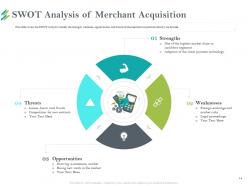
Slide 14: This slide presents a SWOT Analysis of Merchant Acquisition wherein the strength, weaknesses, opportunities, and threats to the merchant acquisition industry are studied.
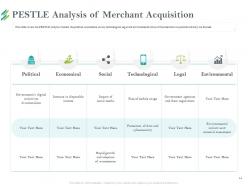
Slide 15: This slide presents the PESTLE Analysis of Merchant Acquisition wherein the political, economic, social, technological, legal, and environmental status of the merchant acquisition industry are studied.
Slide 16: This slide introduces Industry Trends which include - By Components, By Product, and By Application.
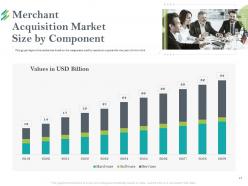
Slide 17: This slide graphically presents the Merchant Acquisition Market Size by Component. The graph depicts the market size based on the components used by merchant acquirers for the years 2019 to 2029.
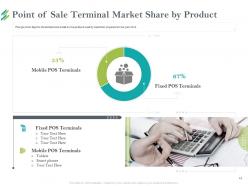
Slide 18: This slide shows the Point-of-Sale Terminal Market Share by Product. The pie chart depicts the market share based on the products used by merchant acquirers for the year 2019.
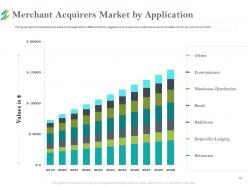
Slide 19: This slide graphically shows the Merchant Acquirers Market by Application. The graph depicts the market share based on the application in different industry segments such as restaurant, healthcare, retail, environment, etc. for the years 2019 to 2029.
Slide 20: This slide introduces the Competitive Landscape.
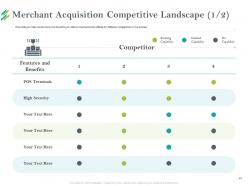
Slide 21: This slide tabulates part 1 of 2 of the Merchant Acquisition Competitive Landscape. It provides the features and benefits provided to the merchants offered by different competitors in the market.
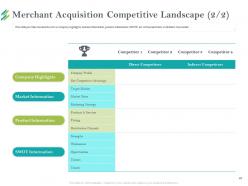
Slide 22: This slide tabulates part 2 of 2 of the Merchant Acquisition Competitive Landscape. It provides the details such as company highlights, market information, product information, SWOT, etc. of the merchants available in the market.
Slide 23: This slide introduces Customer Identification which includes Identifying Merchant Acquisition Market, Merchant Acquisition Buyer Persona, and Merchant Acquisition Customer Demographics.
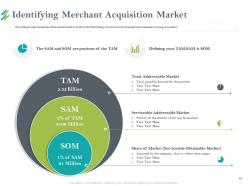
Slide 24: This slide showcases the Identifying Merchant Acquisition Market. It provides the details of the market based on TAM (Total Addressable Market), SAM (Serviceable Addressable Market), SOM (Serviceable Obtainable Market) along with the share of the population interested in buying our product.
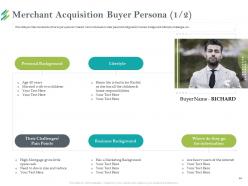
Slide 25: This slide presents part 1 of 2 of the Merchant Acquisition Buyer Persona. It provides the details of the buyer’s persona wherein we have focused on their personal background, business background, lifestyle, challenges, and information sources, etc.
Slide 26: This slide presents part 2 of 2 of the Merchant Acquisition Buyer Persona. It provides the details of the buyer’s persona wherein we have focused on their background, demographics. Identifiers, etc.
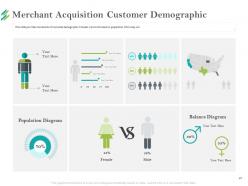
Slide 27: This slide visualizes the Merchant Acquisition Customer Demographics. It provides the details of customer demographic wherein we have focused on population, USA map, comparison between the genders, and balance diagram among others.
Slide 28: This slide introduces the Business Model.
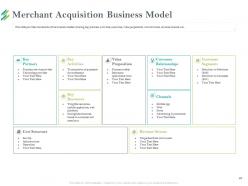
Slide 29: This slide presents the Merchant Acquisition Business Model and provides the details of the business model covering key partners, activities, resources, value proposition, customer relationships, channels, customer segments, cost structure, and revenue streams.
Slide 30: This slide introduces the Merchant Acquisition Market Entry Strategies which include Market Segmentation, Positioning Strategy, and Positioning Mapping.
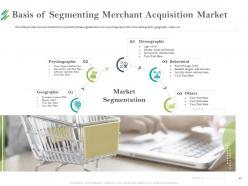
Slide 31: This slide presents the Basis of Segmenting Merchant Acquisition Market. It provides the basis of merchant acquisition market segmentation such as psychographic, behavioral, demographic, geographic, and others, etc.
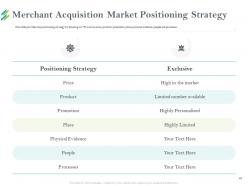
Slide 32: This slide tabulates the Merchant Acquisition Market Positioning Strategy and focuses on the 7 Ps which are Price, Product, Promotion, Place, Physical Evidence, People, and Processes.
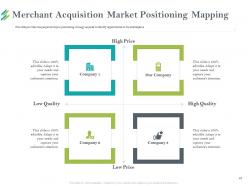
Slide 33: This slide showcases the Merchant Acquisition Market Positioning Mapping. It provides the perpetual map in the positioning strategy required to identify opportunities in the marketplace.
Slide 34: This slide introduces Pricing Strategy which includes Pricing Comparison and Quarterly Product Launch Campaign Budget Plan.
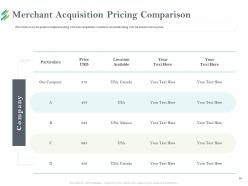
Slide 35: This slide tabulates the Merchant Acquisition Pricing Comparison. It shows the product comparison along with their competitors available in the market along with the location and its prices.
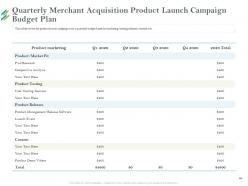
Slide 36: This slide tabulates the Quarterly Merchant Acquisition Product Launch Campaign Budget Plan. It covers the product launch campaign with a quarterly budget based on marketing, testing, releases, and content, etc.
Slide 37: This slide introduces the Financial Projection of Our Company.
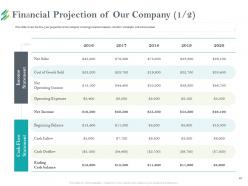
Slide 38: This slide tabulates part 1 of 2 of the Financial Projection of Our Company and it covers the five-year projection of our company covering income statement, cash flow statement, and balance sheet.
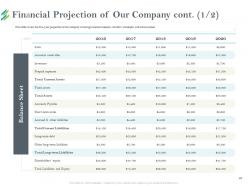
Slide 39: This slide tabulates and continues part 1 of 2 of the Financial Projection of Our Company from the previous slide. It covers the five-year projection of our company covering income statement, cash flow statement, and balance sheet.
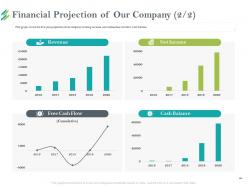
Slide 40: This slide tabulates part 1 of 2 of the Financial Projection of Our Company and it covers the five-year projection of our company covering income statement, cash flow statement, and balance sheet.
Slide 41: This slide contains a number of Payment Gateway Icons to choose from.
Slide 42: This slide introduces Additional Slides.
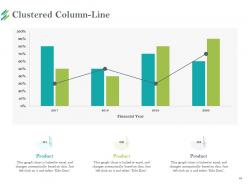
Slide 43: This slide shows editable Clustered Column Charts for tracking 2 products and comparing them with each other over the years.
Slide 44: This slide provides the Mission for the entire company. This includes the vision, the mission, and the goal.
Slide 45: This slide shows the members of the company team with their name, designation, and photo.
Slide 46: This slide is a Timeline template to showcase the progress of the steps of a project with time.
Slide 47: This slide is a Roadmap template to showcase the stages of a project, for example.
Slide 48: This is a Thank You slide where details such as the address, contact number, email address are added.
Payment gateway powerpoint presentation slides with all 48 slides:
Use our Payment Gateway Powerpoint Presentation Slides to effectively help you save your valuable time. They are readymade to fit into any presentation structure.












FAQs for Payment gateway
Honestly, start with security - PCI compliance is non-negotiable and you want solid fraud protection. Transaction fees will eat into your profits fast, so definitely shop around those rates. Integration with your current setup needs to be seamless or you'll hate yourself later. Processing speed matters since customers get impatient with slow checkouts. Their customer support quality is clutch too, especially when things go sideways at 2am. Oh and test their demo first! I learned that one the hard way - what looks good on paper doesn't always work smoothly in practice.
So payment gateways have pretty solid security these days. Your card info gets encrypted with SSL/TLS during transmission - basically scrambled so hackers can't read it. They also use tokenization, which swaps your real card numbers for random tokens that are worthless if stolen. Look for PCI DSS compliance too (sounds boring but it's the security gold standard). Real-time fraud detection catches sketchy transactions automatically. Multi-factor authentication protects the merchant side. Honestly, most major gateways are pretty secure now, but definitely verify they're PCI compliant and ask about their fraud tools before choosing one.
So hosted gateways redirect customers to like PayPal's page where they enter payment info - super easy setup. Integrated ones let people pay right on your site without bouncing around, but then you're dealing with all that PCI compliance stuff which is honestly a pain. Hosted is definitely the lazy option (in a good way) and perfect when you're starting out. You get more control with integrated since customers never leave your site, but it's way more work to implement. I'd probably just go hosted first and see how it goes - you can always switch later if you need that smooth checkout flow.
First thing - figure out your transaction volume and average order size. That'll tell you which pricing makes sense. Security's obviously a must, but don't get sucked into features you'll never touch. Some gateways work way better with certain platforms, so check how messy the integration will be. Honestly, the checkout flow matters more than people think - if customers have to jump through hoops, they'll bail. Oh and definitely test it yourself first. Pick like 3 or 4 options max and just crunch the numbers. Where your customers are located matters too for processing fees.
So payment gateways are basically what let you accept credit cards online - they're like the middleman between your customers and your bank account. When someone buys something, the gateway encrypts their card info and checks with their bank to see if the money's actually there. Then it either approves or declines the transaction. You literally can't take online payments safely without one. The tricky part is picking the right one though - some have crazy fees if you're not doing tons of volume. Just make sure whatever you choose plays nice with your website platform or you'll hate your life setting it up.
Transaction fees will absolutely crush your margins if you're not careful - we're talking 1.5% to 3.5% per sale plus those annoying fixed fees. Your order size makes a huge difference though. Like, 3% on a $10 sale hurts way more than the same rate on a $500 purchase. Build these costs into your prices right from the start. Once you get some decent volume going, definitely shop around different payment processors. Most people don't realize you can actually negotiate better rates. Honestly, it's one of those boring details that can make or break your bottom line.
Ugh, PCI compliance is the worst but you can't skip it. Different payment methods per region will drive you nuts too. API docs are always trash - nothing matches what actually happens. Testing environments? Forget about it, they're never like production. Failed payments need solid fallbacks or users get pissed. Currency stuff gets weird fast, plus fraud detection is its own nightmare. Honestly, just pick one payment method first and nail it completely. Then add more. Always have a backup gateway though - trust me on this one. Reconciling everything later is such a headache otherwise.
So basically, payment gateways do all the heavy lifting for international stuff. Your gateway converts euros to USD automatically using current exchange rates when customers pay. They also deal with all the crazy compliance rules each country has - honestly, that alone is worth it because regulations are a nightmare. Expect to pay extra fees though, usually 1-3% on top of regular processing. Oh, and definitely check if your gateway actually works in the countries you want to sell to before you get everything set up. Some have weird geographic blocks that'll mess up your plans later.
PCI-DSS compliance is the absolute must-have - can't touch credit card data without it. SOC 2 Type II is pretty standard too for security stuff. Got European customers? Then you're dealing with GDPR whether you like it or not. Healthcare payments mean HIPAA gets thrown into the mix, which is honestly just another headache. Most decent payment providers will actually walk you through this maze though, so don't panic. I'd start with PCI-DSS Level 1 and build from there. That covers your ass with the major card networks at least.
So payment gateways are like middlemen that connect your checkout to all the different payment systems. Apple Pay talks to Apple's servers, credit cards run through Visa/Mastercard, PayPal does its own weird thing - you get the idea. The gateway figures out where each payment needs to go and handles all that routing automatically. Pretty neat, honestly. Without it, you'd have to build separate connections for every single payment method, which sounds like a nightmare. Just double-check that whatever gateway you pick actually supports the payment types your customers want to use.
Real-time payments are everywhere now, plus buy-now-pay-later and crypto support aren't optional anymore. Embedded checkout is massive too - nobody wants users bouncing to external payment pages because you'll lose sales every time. Fraud prevention got way smarter with AI risk scoring and biometric stuff. Oh, and cross-border payments don't suck as much with better currency tools. Honestly, if you're shopping for gateways right now, go API-first. Find one that handles multiple payment methods in a single integration - trust me on this one.
Honestly, payment gateways are a total game-changer for checkout flow. Your customers can pay however they want - cards, Apple Pay, those buy-now-pay-later things everyone's obsessed with. The good ones save payment info securely so people don't have to type everything again (which is honestly such a pain). Fast processing matters too - I've definitely abandoned carts when they took forever to load. Oh, and if you sell internationally, make sure it supports whatever payment methods are popular there. Really depends on your audience though. Some people still prefer just basic credit card options.
Dude, mobile payments are seriously worth it for small businesses. Customers can just tap their phones and boom - instant sale. No more losing customers who "forgot their wallet." Setup costs aren't crazy expensive either. You'll get paid faster than with regular card processing, plus customers think you're all modern and stuff (shallow but true lol). Only real downsides? Transaction fees eat into profits a bit, and sometimes the tech acts up at the worst moments. I'd probably start with Square or Stripe first - see how it goes before adding more options. Way easier than diving into like five different platforms at once.
Check your API credentials first - that's usually the culprit. Test with tiny amounts to see what breaks. Your SSL certs current? Payment processors have status pages that'll tell you if they're having issues (I always forget to check those). Error logs are gold here. Look for patterns - is it choking at checkout or during processing? Specific card types acting up? Most gateways let you mess around in sandbox mode to figure things out safely. Still broken? Hit up their support but have transaction IDs and error messages ready or they can't help much.
Dude, payment gateways are about to get wild. Real-time fraud detection powered by AI is already rolling out - way smarter than the basic stuff we have now. Biometric auth is becoming huge too, so fingerprint scanning instead of typing passwords like it's 2010. Cross-border payments will get faster and cheaper thanks to blockchain, which honestly took long enough. Central bank digital currencies could flip everything upside down - that's the one I'm watching closest. Quantum computing for security is still years away though. I'd look into which providers are going heavy on AI first since that's happening now.
-
Great designs, really helpful.
-
Wonderful templates design to use in business meetings.
-
Best way of representation of the topic.
-
Innovative and attractive designs.
-
Designs have enough space to add content.