


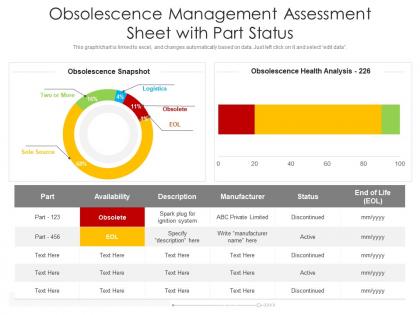
Obsolescence management assessment sheet with part status




Try Before you Buy Download Free Sample Product
 Impress Your
 Audience
 100%
100% Editable
 Save Hours
 of Time


Our Obsolescence Management Assessment Sheet With Part Status are topically designed to provide an attractive backdrop to any subject. Use them to look like a presentation pro.
People who downloaded this PowerPoint presentation also viewed the following :
Obsolescence management assessment sheet with part status with all 2 slides:
Use our Obsolescence Management Assessment Sheet With Part Status to effectively help you save your valuable time. They are readymade to fit into any presentation structure.
FAQs for Obsolescence management assessment sheet
So basically tech moves insanely fast now - your "cutting-edge" part is ancient history in like 6 months. Consumer preferences flip constantly too, which forces design changes. Then you've got supply chain chaos where suppliers just drop products with zero notice to chase bigger volume stuff. Oh, and don't get me started on regulatory changes that randomly make your components illegal overnight. It's honestly exhausting trying to keep up. My advice? Build some kind of monitoring system into your process from day one and always have backup suppliers lined up. Trust me on that last part - you don't want to scramble when it's too late.
Honestly, most companies wait until it's too late and then panic. Track supplier notices religiously - those guys know what's getting discontinued way before anyone else. Build actual relationships with your supply chain so they'll give you a heads up. Monitor sales drops and customer gripes about outdated features too. I'd do quarterly reviews where you assess which product lines are getting risky. Watch what competitors are doing and industry shifts. The whole point is staying ahead of it instead of scrambling when something disappears overnight. Also audit your portfolio regularly for aging tech - that stuff sneaks up on you fast.
Honestly, it's mostly tech moving so damn fast. Companies keep pushing out new features every few months, plus they literally design stuff to become outdated on purpose - it's called planned obsolescence and it's super annoying. Remember when your iPhone from like 2019 felt ancient by 2021? Hardware and software are so linked now that when one part of your system updates, everything else has to follow. Cloud stuff, AI changes, new regulations - it all snowballs. Best thing you can do is stay flexible when buying equipment and keep good relationships with vendors so they'll give you a heads up before discontinuing support.
I'd go 70-30 between new development and obsolescence management. Most companies flip this around and regret it big time. Your obsolescence budget should cover both the panic fixes and the monitoring stuff - catching those end-of-life notices early literally saves you from wanting to throw your laptop out the window later. Don't just think of it as maintenance costs, it's actually strategic. First audit what you've got and how risky it all is, then set up a rolling fund that grows with your product lineup. That way you won't be frantically calling suppliers at 2am when some critical component vanishes overnight.
Here's what I'd do - start tracking your suppliers religiously and get on their mailing lists for EOL announcements. Design everything modular so when one part dies, you're not screwing over your entire product. Multiple suppliers are a lifesaver too, don't put all your eggs in one basket. When you smell discontinuation coming, do a lifetime buy of critical stuff. I learned this the hard way on a project last year - we got blindsided by a chip going obsolete and it was a nightmare. Stay ahead of these things instead of scrambling when crisis hits.
Oh man, regulatory changes are brutal for this stuff. New compliance rules drop and suddenly your products are illegal to sell - happened overnight to a buddy in med devices last year. Automotive and chemical companies get hit the worst since they're so regulated. What saved his butt was setting up Google alerts for pending laws in his industry. Boring but worth it. Also try staying friendly with people at regulatory agencies if you can swing it. They sometimes give you a heads up before things go public. Short sentences help here: monitor early, plan ahead, don't get caught sleeping.
Start by mapping out your critical components - honestly, this part's kinda tedious but worth it. Check each one's supply chain health, lifecycle stage, and how stable the vendor is. Building relationships with suppliers is huge though, they'll actually warn you about discontinuations before they happen. Focus on the expensive or hard-to-replace stuff first. You'll want multiple sources for everything if possible. I use a simple scoring system to rank risk levels so I know where to put my time. Just don't forget to review regularly since things change constantly in this space.
Talk to your customers directly - they'll literally tell you what sucks if you ask. Set up surveys or quick check-ins with your top clients to see what features they're actually using. Most of the time there's so much dead weight just sitting there. I'd honestly start with your best 10 customers this week for a reality check. Once you know what matters, ditch the stuff nobody touches first. Then focus your energy on updating what people care about. Customer forums work great too if you want ongoing feedback instead of one-off surveys.
So obsolescence management is basically about keeping crap out of landfills, you know? Instead of dumping everything when it dies, you can refurbish or recycle old components. Honestly saves you money too - replacement costs add up fast. The trick is planning for this stuff upfront rather than panicking later when you're stuck with dead inventory. Track your waste patterns now and you'll make smarter buying decisions down the road. Plus extending product lifecycles just makes sense environmentally. It's one of those rare situations where doing the right thing actually helps your bottom line.
So basically you'll want to pull data from your ERP system, supplier databases, industry reports - all that stuff - and build models that can predict which parts are gonna become obsolete way before it actually happens. Start simple with automated alerts for end-of-life components, then get fancier with risk scoring models later. The key is analyzing purchasing patterns, supplier announcements, and tech roadmaps. With enough historical data, these predictions get surprisingly accurate (though setting it up is kind of a pain initially). Focus on tracking component lifecycles and supplier health to spot risks months ahead.
So basically, hardware problems are about parts getting discontinued and stuff breaking down physically. You'll need to either hoard spare parts or redesign around whatever's available now. Software's more about compatibility and security updates ending - but honestly, that's usually easier to deal with since you can migrate or patch things without breaking the bank. The real nightmare happens when both hit at once though. I learned this the hard way at my last job. Start tracking lifecycles early so you're not stuck ordering ancient components on eBay at 2am.
Your supply chain basically controls when parts become obsolete, which is kinda scary when you think about it. Suppliers consolidate or move production overseas, then suddenly you're panic-buying components before they disappear forever. We learned this the hard way during COVID - "reliable" supply chains aren't so reliable anymore. Build real relationships with your suppliers though. You need intel on their roadmaps, not just yours. Get those end-of-life warnings 12-18 months early by talking to them regularly. Trust me, waiting until the last minute sucks.
Honestly, just focus on five metrics and you'll figure out what's broken pretty fast. Track how often parts catch you off-guard going EOL - that's your obsolescence frequency. Response time matters too - how quickly do you actually act after getting notifications? The money stuff is painful but necessary: emergency buys, redesigns, production delays all add up quick. Also measure if you're predicting these events before they smack you in the face. Oh, and inventory turns for your strategic stock - you don't want parts just sitting there forever. Start there and you'll spot the weak points.
Get your engineering, procurement, and product teams talking monthly - like actually in the same room. Engineering spots aging components, procurement gets the supplier EOL notices, and product folks know what'll hurt customers most. Monthly cross-functional meetings work best in my experience. Each team brings their obsolescence radar - component discontinuations, design timelines, customer needs. Build a shared dashboard so nobody's flying blind. Oh, and map your current products against component lifecycles first - you'll probably find some scary stuff lurking. Don't wait until it's firefighting mode because that's when mistakes happen.
Honestly, predictive analytics with AI is where I'd start - it'll spot which parts are gonna fail before they actually do. ROI happens fast, like within a few months usually. Digital twins let you run "what if" scenarios on your products without breaking anything real, which is pretty cool. IoT sensors are tracking component health constantly now (the amount of data is kinda crazy). You can also look into blockchain for supply chain stuff - helps you see where components come from and when shortages might hit. Oh, and those automated sourcing platforms? They use machine learning to find backup suppliers instantly when your main one falls through. Start with the predictive stuff though - that's your quickest win.
-
Nice and innovative design.
-
Perfect template with attractive color combination.
-
Enough space for editing and adding your own content.
-
Content of slide is easy to understand and edit.
-
Amazing product with appealing content and design.